
Turning complex toxicology AI into a clear, usable product experience
Consone AI had already defined the toxicology science, predictive capability and product direction behind DioScor. Veda AI's role was to translate that work into a credible front-end experience that scientific users, partners and prospective buyers could understand, interrogate and evaluate.
- Client
- Consone AI
- Product
- DioScor
- Engagement
- Front-end product translation, interface design and development
- Status
- Front-end delivery complete; awaiting go-live
The starting point
Consone AI had already created the scientific foundation for DioScor: curated toxicity data from human and animal studies, deep-learning capability for organism-level toxicology prediction, and a defined direction for the product and its commercial use.
What the project needed from Veda AI was the front-end layer through which that capability could be used. A scientific user needed to submit a compound, understand a result, inspect confidence and evidence, and move through a coherent reporting journey.
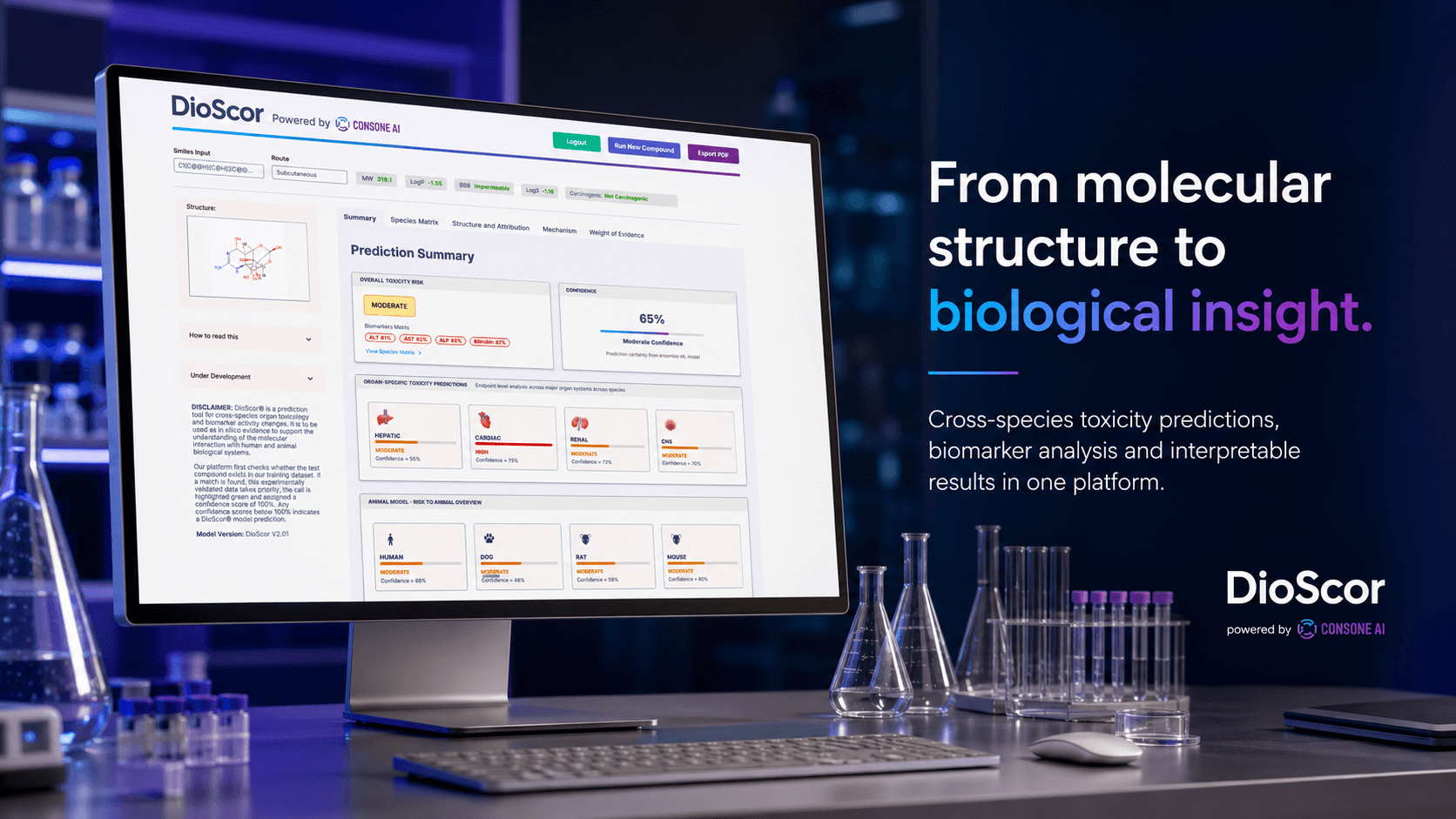
The front-end challenge for a commercial toxicology AI product
For a toxicology AI product moving towards commercialisation, the interface cannot simply expose raw model output. A prediction may be technically meaningful yet still be difficult to interpret, explain or incorporate into a professional workflow if the front end does not provide the right structure.
DioScor needed to communicate cross-species and organ-level predictions, model confidence, structural attribution, biomarker and mechanism context, known evidence, and the boundary between curated data and model output. It also had to remain scientifically responsible: a prediction does not replace regulatory testing or guarantee safety.
The task was not to invent Consone AI's strategy or science. It was to translate both into a front end users could understand and interrogate.
Veda AI's role: translating the product into the front end
Working from Consone AI's scientific requirements, defined product direction and subject-matter expertise, Veda AI designed and developed the front-end experience. The work focused on information architecture, interaction flow, visual hierarchy and the implementation needed to present complex outputs clearly.
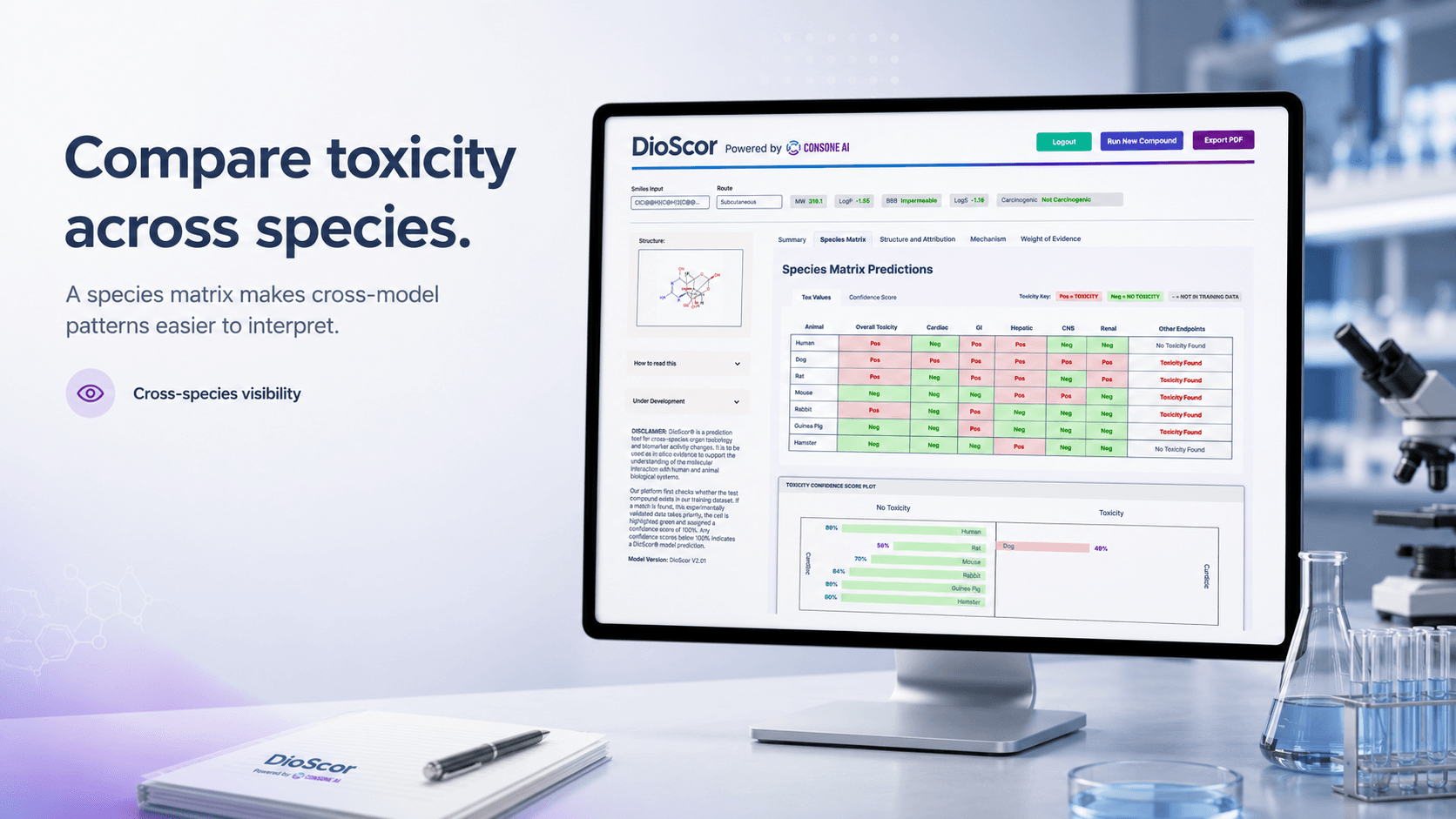
Veda AI did not define Consone AI's commercial strategy, scientific model or product claims. The contribution was translating those established inputs into a practical interface journey: molecular input, exposure route, prediction summary, cross-species comparison, structural and mechanism interpretation, weight of evidence and exportable reporting.
- Interface architecture — Organising a complex scientific workflow into a clear sequence of screens and decisions.
- Explainability presentation — Layering summary, confidence and evidence without making claims beyond the supplied science.
- Front-end delivery — Building the responsive product interface that makes the defined DioScor proposition tangible.
Designing for trust and explainability
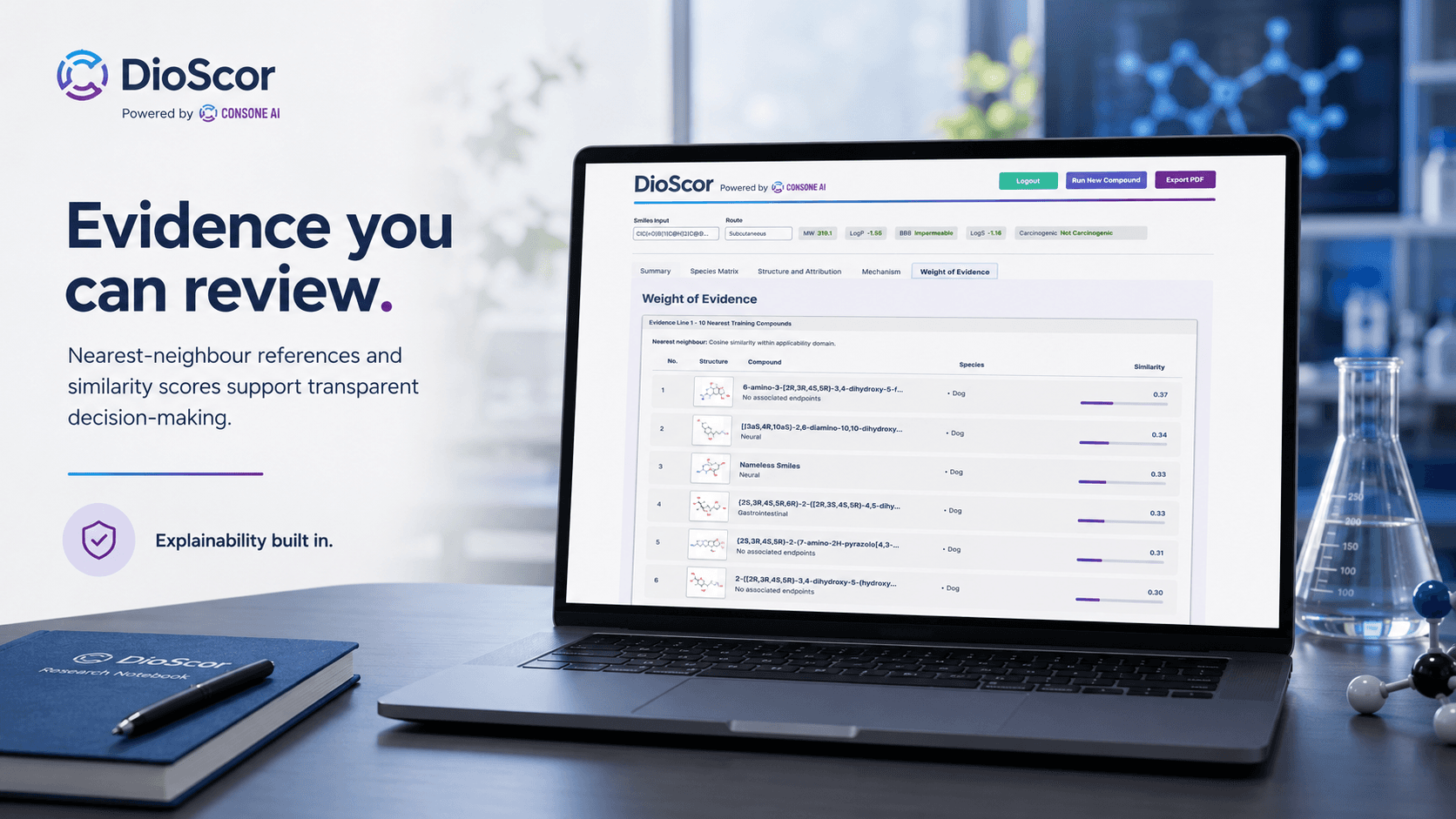
Users do not receive an unexplained answer. They can move from a summary prediction into confidence, organ-level risk, species comparisons, contributing molecular regions, biomarker mechanisms and similar known compounds.
The weight-of-evidence component lets model output sit alongside related known compounds, similarity values, species, endpoints and applicability context rather than presenting a prediction in isolation.

From defined product requirements to a delivered interface
Consone AI supplied the science, predictive capability and product proposition. Veda AI turned those inputs into a structured, visual and reportable front-end that could be demonstrated, reviewed and prepared for launch.
The delivered interface makes the intended product journey tangible without claiming ownership of the underlying commercial strategy or model. Real-world adoption, commercial performance and scientific outcome metrics will only be claimed once the platform is live and evidence exists.
Complex AI products need front ends people can understand and use
DioScor shows Veda AI translating an established scientific and commercial product direction into a responsible, understandable front-end experience without overstating its role in the underlying strategy or science.
- Defined scientific requirements translated into a coherent front-end journey
- Complex model output made layered and interrogable
- Uncertainty and evidence presented as core interface requirements
- Product design and responsive front-end implementation delivered together




Have a defined AI product that needs a credible front-end experience?
Veda AI can translate complex product requirements and model outputs into a clear, responsive interface for users, demonstrations and launch.