Entity SEO: Helping AI Systems Understand Your Business
Keyword optimisation makes a page findable. Entity clarity makes a business identifiable — and that is what determines whether a system can describe you at all.
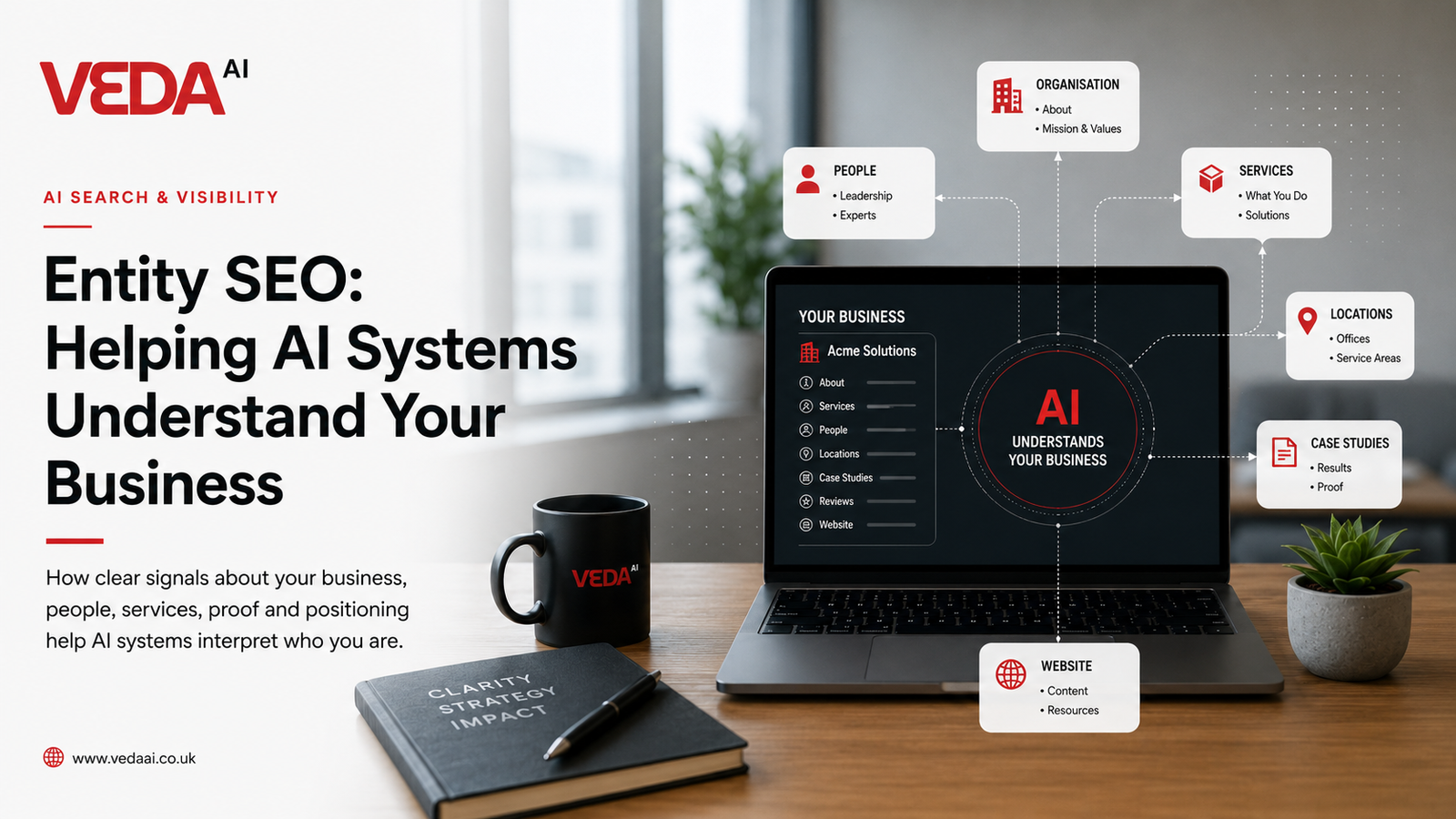
Entity SEO is the work of making it unambiguous what your business is, who runs it, what it sells, where it operates and what it has actually done — consistently, everywhere it is described. It is about being understood rather than being ranked.
A page can rank without a system having any coherent picture of the company behind it. That is survivable in a results list, where the user does the interpreting. It is fatal in a generated answer, where the system has to describe you before it can recommend you.
How this differs from keyword optimisation
Keyword work asks: does this page match this query? Entity work asks: can a system build a reliable picture of this organisation from everything available about it?
The practical difference shows up in what each fixes:
- Keyword problem — “we don’t rank for workflow automation”. Fixed on a page.
- Entity problem — “assistants describe us as a web design agency”. Not fixable on a page, because the confusion lives across many sources.
The second is more common than businesses expect, and considerably more damaging. Being described inaccurately is worse than being absent: you are in the conversation, working against you.
The five things a system needs to establish
1. The organisation
What kind of business this is, its legal name and trading names, its size and its category — stated in plain words on the site, not implied through brand language.
2. The people
Who runs it, what they are qualified to do, and whether they exist verifiably elsewhere. Named people with real credentials and external profiles are stronger evidence than an anonymous “our team”. Our own leadership profiles exist partly for this reason.
3. The services
What is sold, described as a buyer would name it. A page titled “Transforming Operations” tells a system nothing. A page that says plainly what the service is, who it is for and what it costs tells it a great deal.
4. The locations and service area
Where you are and where you work. A business that is genuinely national should say so; one that is genuinely regional should say that instead. Vagueness here removes you from both.
5. The proof
Evidence the work has been done: named clients where permitted, specific outcomes, honest limits. Case studies do more entity work than most businesses realise, because they attach your organisation to real sectors, problems and results.
Where entity clarity actually lives
Three layers have to agree, and the third is the one most often neglected.
Visible content
The primary layer. Google’s guidance is explicit that its models use publicly accessible, crawlable content, and that a page must be indexed and snippet-eligible to be eligible for generative features. If it is not in readable text on the page, it is not doing entity work.
Structured data
A supporting layer that describes what is already visible in a machine-readable form. It clarifies; it does not create. Google is direct that structured data is not required for generative AI search, and its guidelines require that markup match visible content. We cover the boundary in does schema markup improve AI search visibility.
External consistency
What everywhere else says. Companies House, LinkedIn, directories, association memberships, trade press, review platforms. If your site says “AI consultancy for manufacturers” and your LinkedIn says “digital agency”, you have given a system two incompatible identities and no way to choose.
The cheapest audit you can run
Open your own site, LinkedIn company page, Companies House record and any directory listing side by side. Read the one-line description on each. If they do not tell the same story, that is your first entity problem — and it costs nothing but an afternoon to fix.
What entity work cannot do
It is worth being precise, because this area attracts overstatement.
- It does not guarantee inclusion in a Knowledge Graph or any equivalent. That is not something a site owner controls.
- It does not mean a system “understands” you in any human sense. It means the available signals are consistent enough to be used.
- It does not substitute for evidence. Clear description of unproven claims is still unproven.
- It does not work quickly. Consistency has to be crawled, and external sources change on their own schedule.
Signals you have an entity problem
These tend to show up before anyone runs a formal measurement.
- Assistants describe you as a different kind of business than you are.
- You are named for a service you consider secondary, and absent for your core one.
- Prospects arrive with a materially wrong idea of what you do.
- Your own team describes the business differently depending on who is asked.
- Searching your company name returns a confusing mix of outdated profiles.
The last one is worth taking seriously. If a person struggles to assemble a coherent picture of your business from public sources in five minutes, a machine working from the same sources will do no better.
A sensible order of work
- Fix the one-line description of the business, and make it identical everywhere.
- Rewrite service pages so the service, the buyer and the geography are stated plainly.
- Make the people visible, named and verifiable.
- Attach proof to claims through case studies and specifics.
- Align external profiles with the site.
- Only then add structured data describing what is now visibly true.
That order matters. Markup added over vague content simply describes vague content accurately. Sequencing diagnosis before solutions is the same principle behind the CLARITY Method. Entity work of this kind sits inside our AI Search & Visibility service.
Key takeaways
- Entity SEO is about being identifiable, not about ranking a page.
- Five things must be establishable: organisation, people, services, locations, proof.
- Visible content leads; structured data supports; external consistency decides.
- Being described inaccurately is worse than being absent.
- Nobody can guarantee Knowledge Graph inclusion — treat that claim with suspicion.
Written by
Rian Patel
Founder, Veda AI
Practical thinking from real work with growing SMEs — written by the Veda AI team.
Related insights.
AI Search & Visibility
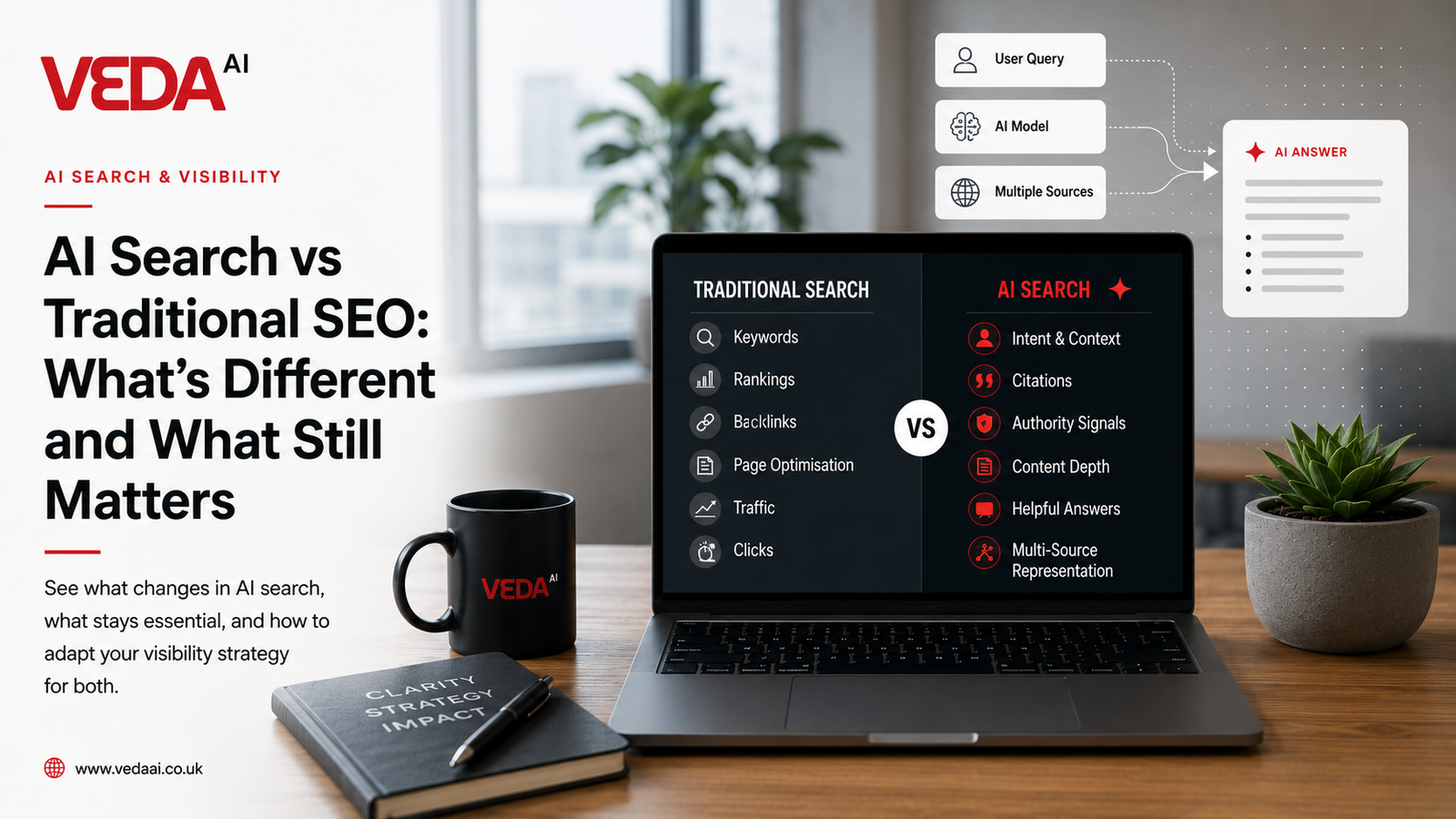
SEO vs AI Search Visibility: What Changes and What Still Matters?
The claim that AI has killed SEO does not survive contact with the documentation. What changes is narrower, and more interesting, than the headlines suggest.
9 min read · 31 July 2026
AI Search & Visibility
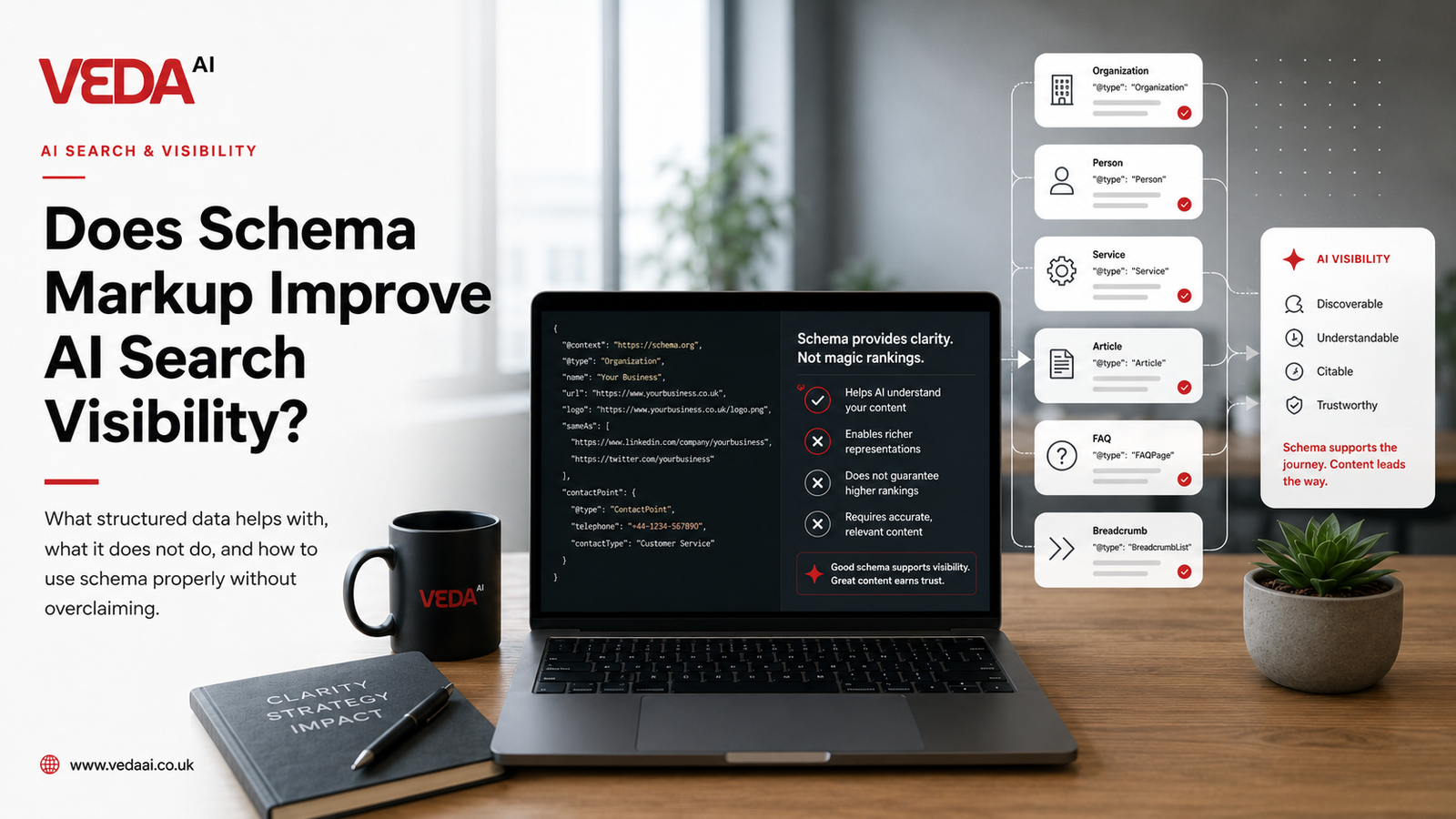
Does Schema Markup Improve AI Search Visibility?
Schema is not a ranking lever or a citation guarantee. It is a description of what is already on your page — and Google says as much in its own documentation.
9 min read · 1 August 2026
AI Search & Visibility
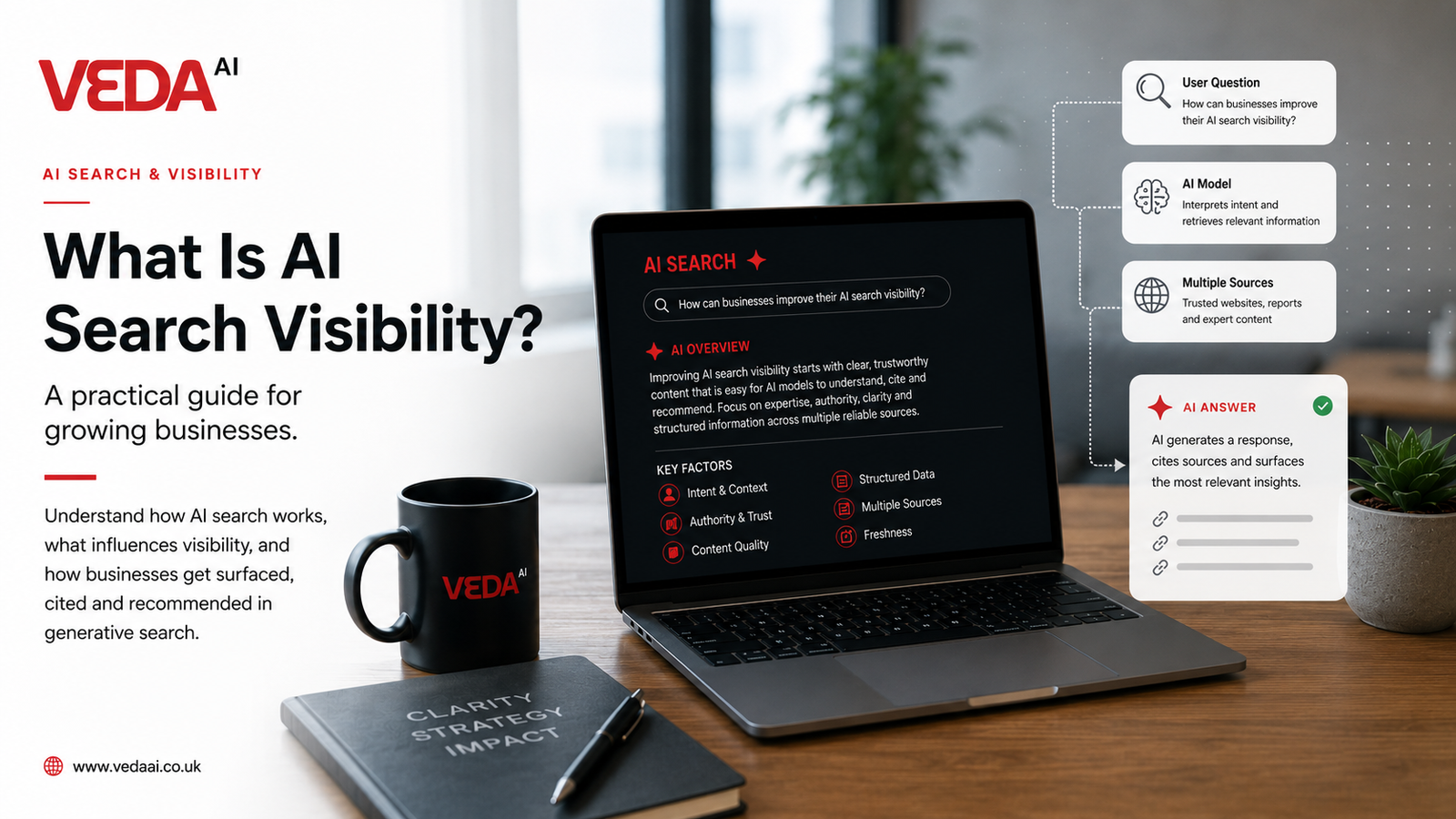
What Is AI Search Visibility? A Practical Guide for Growing Businesses
AI assistants now answer buyer questions directly. Visibility is no longer only about ranking — it is about whether a system can understand and recommend you.
9 min read · 31 July 2026
Get Veda AI Edge.
Practical briefings on AI adoption, automation, intelligent products and AI-assisted search — what changed, why it matters and what to consider next. No hype, no AI theatre.
By joining you agree to receive Veda AI Edge from Veda AI. Unsubscribe any time.
Ready to find what’s worth fixing?
Start with a short call.
We’ll help you work out whether the right next step is the guide, the £995 + VAT Business Efficiency Audit, or a scoped implementation conversation.