SEO vs AI Search Visibility: What Changes and What Still Matters?
The claim that AI has killed SEO does not survive contact with the documentation. What changes is narrower, and more interesting, than the headlines suggest.
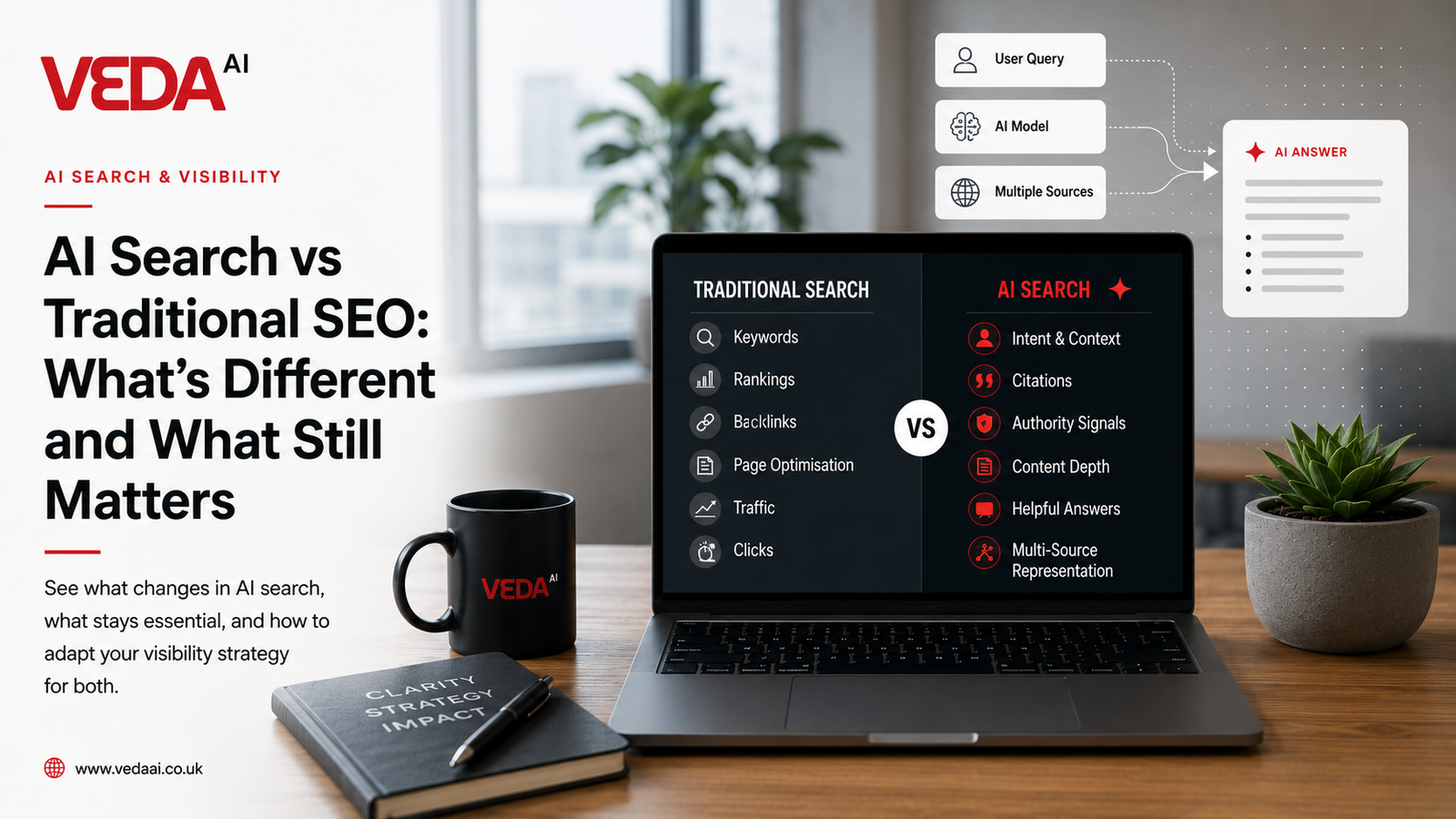
SEO has not been replaced by AI search. The technical and content foundations are largely shared, and Google states plainly that its generative features are “rooted in our core Search ranking and quality systems”. What changes is the shape of the result, the unit of competition, and how you measure whether any of it worked.
That is a less dramatic claim than “SEO is dead”, and it is considerably more useful if you are deciding where to put a budget. If the underlying idea is new, start with what AI search visibility actually means.
What genuinely stays the same
Google’s own optimisation guidance is unusually blunt about this. It states that the best practices for SEO continue to be relevant, that a page must be indexed and snippet-eligible to appear in generative features, and that content must be crawlable because the models use publicly accessible, crawlable content.
So the following remain load-bearing rather than legacy concerns:
- Crawlability and indexation.
- Sensible information architecture and internal linking.
- Page-level clarity about who a page is for and what it offers.
- Genuine expertise and first-party evidence.
- Site performance and accessibility, which affect whether people stay once they arrive.
What genuinely changes
The result is an answer, not a list
A ranked list invites comparison. A generated answer performs the comparison on the buyer’s behalf and presents a conclusion. That compresses the shortlist, and it moves the competition from “be on page one” to “be one of the three names in the paragraph”.
The unit of competition is the question, not the keyword
Conventional SEO optimises for a query string. AI-mediated discovery responds to a fuller question, often with context attached — sector, size, location, constraint. Google describes using a “query fan-out” technique in its AI features, issuing multiple related searches behind a single question. You are therefore competing across a cluster of implied queries rather than one.
Third parties carry more weight
If an answer is synthesised from many sources, what other people say about you contributes alongside what you say about yourself. This is the single largest practical divergence from classic on-site SEO, and it sits at the centre of our AI Search & Visibility work.
Measurement gets harder
Rank tracking has a stable object to track. AI answers vary by phrasing, by user context and over time, and referral traffic from assistants is incompletely attributed. Google has begun addressing part of this: Search Console now includes generative AI performance reporting for its own surfaces. That covers Google. It does not cover the rest.
SEO, GEO and AEO: are the new labels useful?
Generative engine optimisation and answer engine optimisation are the two terms most often used for this work. They are useful as shorthand for a genuine shift in emphasis. They are not separate disciplines with separate mechanics, and treating them as such tends to produce duplicated effort.
A reasonable working position: GEO and AEO describe the additional emphasis — entity clarity, evidence, third-party corroboration, question-level measurement — layered on foundations that are still recognisably SEO. If a provider tells you the foundations no longer matter, check that against Google’s published guidance before believing it.
Where the two diverge in practice
What a ranking report will not tell you
- Whether an assistant names you when the question is asked conversationally.
- Which sources an assistant leaned on to reach its answer.
- Whether you were described accurately or approximately.
- Whether a competitor is being recommended for questions you should own.
What AI visibility work will not fix
- A site that cannot be crawled or indexed.
- Service pages that do not state plainly what is sold and to whom.
- An absence of evidence that the work has been done before.
- A weak proposition. Neither discipline can make a vague offer compelling.
What to keep doing, and what to add
Keep doing
- Technical health: crawlability, indexation, sensible internal linking.
- Clear service pages that state the offer, the buyer and the geography.
- First-party evidence — case studies, named people, specifics.
- Conventional keyword coverage for the searches that still happen in a results page.
Add
- A defined set of buyer questions, measured deliberately rather than assumed.
- Entity consistency across the web, not only on your own domain.
- Deliberate third-party corroboration: listings, roundups, commentary, reviews.
- Reporting that tracks question-level visibility, not only rank and sessions.
Three claims worth challenging
If a provider makes any of these, ask for the source.
- “SEO no longer matters.” Google’s published guidance says the opposite, and states its AI features run on core Search systems.
- “You need special AI markup or an AI text file.” Google states you do not need to create new machine-readable files, AI text files, markup or Markdown to appear in its AI features.
- “We guarantee citations in ChatGPT.” No provider controls what a model outputs. Guarantees here are not deliverable.
What this means for a growing business
Do not run two programmes. Run one, with the foundations intact and an added layer of question-level measurement, entity clarity and third-party authority. The foundations are shared; the reporting and the priorities are what change.
If you want to know where you currently stand rather than argue about terminology, that is what a baseline is for. An AI Search Visibility Audit records where you stand today, against which questions, and what to change first. Structured data is the technical question that most often follows this comparison; what schema markup can and cannot do for AI search is worth reading before investing in it.
Key takeaways
- Google states its AI features are rooted in core Search systems — the foundations are shared.
- What changes: answers instead of lists, questions instead of keywords, more weight on third parties, harder measurement.
- GEO and AEO describe emphasis, not a separate technical discipline.
- Anyone telling you SEO is obsolete is contradicting the platform documentation.
Written by
Rian Patel
Founder, Veda AI
Practical thinking from real work with growing SMEs — written by the Veda AI team.
Related insights.

AI Search & Visibility
What Is AI Search Visibility? A Practical Guide for Growing Businesses
AI assistants now answer buyer questions directly. Visibility is no longer only about ranking — it is about whether a system can understand and recommend you.
9 min read · 31 July 2026

AI Search & Visibility
Entity SEO: Helping AI Systems Understand Your Business
Keyword optimisation makes a page findable. Entity clarity makes a business identifiable — and that is what determines whether a system can describe you at all.
9 min read · 1 August 2026

AI Search & Visibility
Does Schema Markup Improve AI Search Visibility?
Schema is not a ranking lever or a citation guarantee. It is a description of what is already on your page — and Google says as much in its own documentation.
9 min read · 1 August 2026
Get Veda AI Edge.
Practical briefings on AI adoption, automation, intelligent products and AI-assisted search — what changed, why it matters and what to consider next. No hype, no AI theatre.
By joining you agree to receive Veda AI Edge from Veda AI. Unsubscribe any time.
Ready to find what’s worth fixing?
Start with a short call.
We’ll help you work out whether the right next step is the guide, the £995 + VAT Business Efficiency Audit, or a scoped implementation conversation.