What Is AI Search Visibility? A Practical Guide for Growing Businesses
AI assistants now answer buyer questions directly. Visibility is no longer only about ranking — it is about whether a system can understand and recommend you.
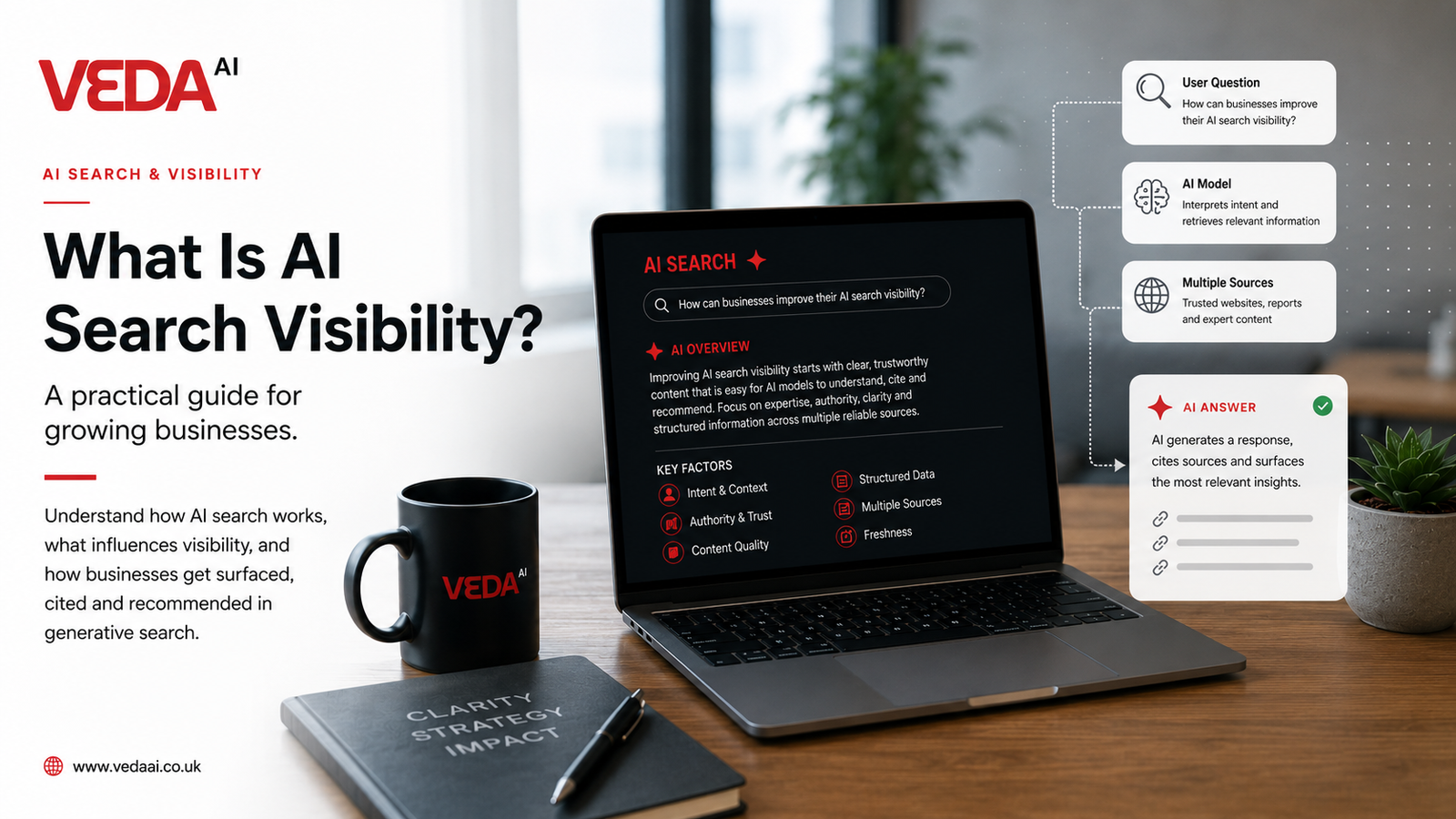
AI search visibility is whether AI assistants — ChatGPT, Google’s AI features, Copilot, Perplexity and others — can find your business, understand what it does, and put it forward when someone asks a question you should be the answer to. It is not a ranking position. It is closer to a question of whether a system is willing to name you.
That distinction matters commercially, because buyers increasingly ask an assistant before they open a search results page. If the assistant names three firms and yours is not among them, you were not outranked. You were not considered.
Ranked, cited, recommended: three different things
Most confusion about AI visibility comes from collapsing three separate outcomes into one word. They are worth separating, because they are earned differently and measured differently.
- Ranked — your page appears in a conventional results list for a query. This is classic SEO and it still happens.
- Cited — an AI answer references your page as a source, usually with a link. You are supporting evidence for someone else’s answer.
- Recommended — the assistant names your business as an option. This is the commercially valuable one, and it is the one least under your direct control.
You can be cited without being recommended: your guide explains a topic well, so it is used as evidence, while three competitors are named as the firms to approach. You can also be recommended without being cited, where an assistant draws on what it has learned about your market rather than reading your site in the moment.
What actually has to be true first
Before any of this is possible, some unglamorous technical conditions have to hold. Google is unusually direct about this: to be eligible to appear in its generative AI features, a page must be indexed and eligible to be shown in Google Search with a snippet. Google also states that its generative features are “rooted in our core Search ranking and quality systems”.
In other words, the foundations are not separate from search. They are the same foundations. A page that cannot be crawled, is not indexed, or is blocked from producing a snippet is not a candidate for an AI answer either.
The picture is similar but not identical elsewhere. OpenAI documents several distinct crawlers, and they do different jobs. OAI-SearchBot is the one used to surface websites in ChatGPT’s search features. GPTBot crawls content that may be used in model training. ChatGPT-User handles fetches triggered by a user in conversation, and OpenAI notes it is not used for automatic crawling. These are documented separately by OpenAI, and they can be controlled separately.
A common own goal
Blocking every AI-related user agent in robots.txt is often done in one sweep to prevent training use. It also removes the crawler responsible for surfacing your site in ChatGPT search. Those are different decisions and deserve to be taken separately.
What you can control, and what you cannot
It is worth being honest about the boundary, because a good deal of marketing in this area is not.
Genuinely within your control
- Whether your pages can be crawled and indexed at all.
- Whether each crawler is permitted, and on what terms.
- How clearly your site states what you do, who you serve and where.
- Whether your claims are specific, evidenced and consistent across the web.
- Whether independent sources describe you accurately.
Not within your control
- Whether any given assistant names you for any given question.
- How a model weighs one source against another.
- When a model’s underlying knowledge was last refreshed.
- Whether an answer includes links at all on a particular surface.
Anyone promising guaranteed inclusion in an AI answer is promising something they cannot deliver. Google itself advises site owners to be wary of third-party tools that promise ranking success or claim to use internal metrics. The same scepticism is warranted for guaranteed AI citations.
Why this is a commercial problem, not a technical one
The temptation is to treat AI visibility as a checklist: add markup, write more posts, block or unblock a crawler. Those things matter at the margin, but they do not answer the question a business actually has, which is whether it is being put in front of buyers at the moment of choice.
That question can only be answered by deciding which questions matter. “Are we visible in AI?” has no answer. “When a finance director in Yorkshire asks which firms help mid-sized manufacturers automate quote-to-cash, are we named?” has a testable one.
This is why serious work in this area starts with a defined set of commercially relevant questions rather than a tool’s default report. Building and testing that set is the first thing an AI Search Visibility Audit does.
A worked example (hypothetical)
A twenty-person engineering firm in Leeds sells production-line automation to food manufacturers. Its website is well designed and describes “transformative operational partnerships”. It ranks respectably for its own name and for a handful of technical terms.
Asked “who helps mid-sized food manufacturers automate production lines in the North of England”, an assistant names three other firms. Nothing is broken. But nowhere on the site does the phrase “food manufacturing” appear alongside “production line automation” and a geography, and no third-party source connects those things to the company either. There is nothing for a system to match against the question, and no corroboration if it tried.
The fix is not markup. It is stating plainly what is sold, to whom and where; publishing the evidence that it has been done; and making sure at least some independent sources say the same. This example is illustrative rather than a client engagement.
What good looks like
- Your service pages name the service, the buyer, the sector and the geography in plain words.
- At least one piece of public evidence exists for each core claim.
- Your description of the business is consistent across your site, LinkedIn and any directory or association listing.
- Named people with real credentials are visible and attributable.
- You know which twenty questions matter and roughly where you stand on them.
Where to start
- Confirm the basics: are your commercial pages crawlable, indexed and snippet-eligible?
- Decide your crawler policy deliberately, separating training access from search surfacing.
- Write down the ten to twenty questions a good-fit buyer would actually ask an assistant.
- Establish a baseline against those questions before changing anything.
- Fix the clarity and evidence problems the baseline exposes, then measure again.
None of that requires believing that search has been replaced. It has not — and the relationship between the two is the subject of our comparison of SEO and AI search visibility. If you would rather see how the work itself is approached, that is our AI Search & Visibility service.
Key takeaways
- AI visibility is about being understood and named, not only ranked.
- Ranked, cited and recommended are three different outcomes with different value.
- Google states its AI features are rooted in core Search systems, and require indexing and snippet eligibility.
- OpenAI runs distinct crawlers for training, search surfacing and user-triggered fetches, controllable separately.
- No one can guarantee an AI recommendation. Anyone who does is selling something else.
Written by
Rian Patel
Founder, Veda AI
Practical thinking from real work with growing SMEs — written by the Veda AI team.
Related insights.
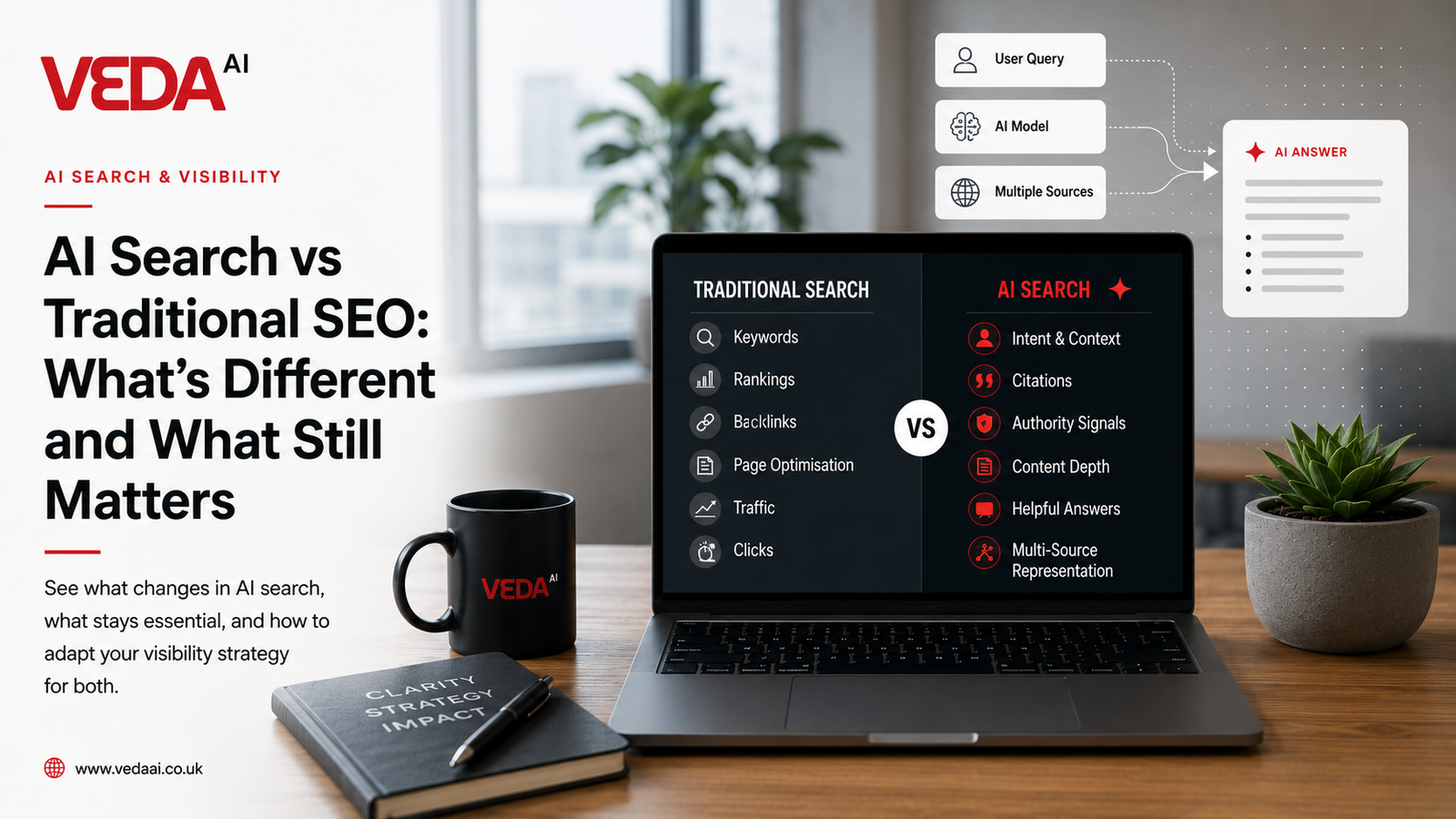
AI Search & Visibility
SEO vs AI Search Visibility: What Changes and What Still Matters?
The claim that AI has killed SEO does not survive contact with the documentation. What changes is narrower, and more interesting, than the headlines suggest.
9 min read · 31 July 2026
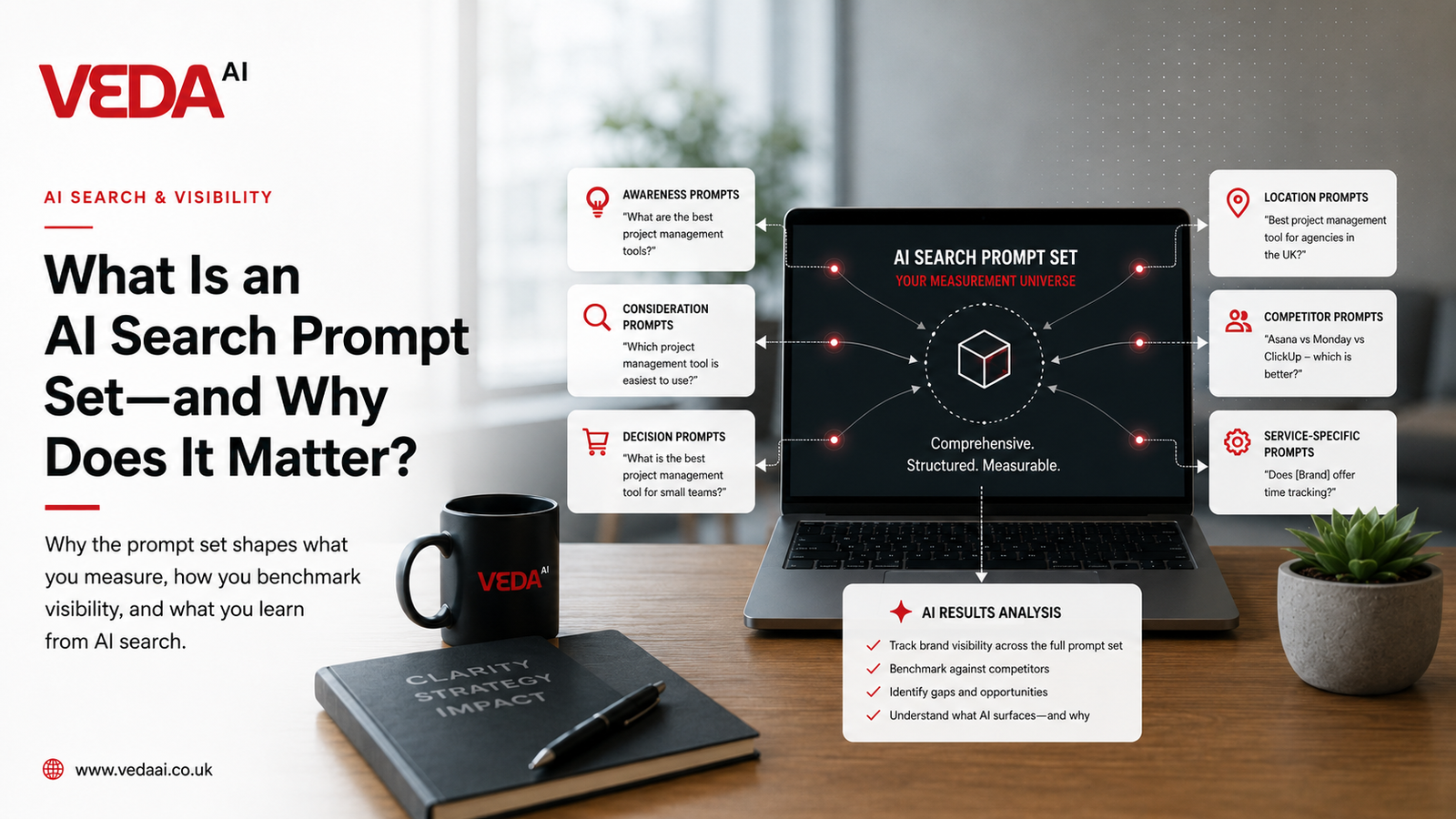
AI Search & Visibility
What Is an AI Search Prompt Set—and Why Does It Matter?
Visibility numbers only mean something relative to the questions they were measured against. The prompt set is that contract — and most reports never show you theirs.
9 min read · 1 August 2026
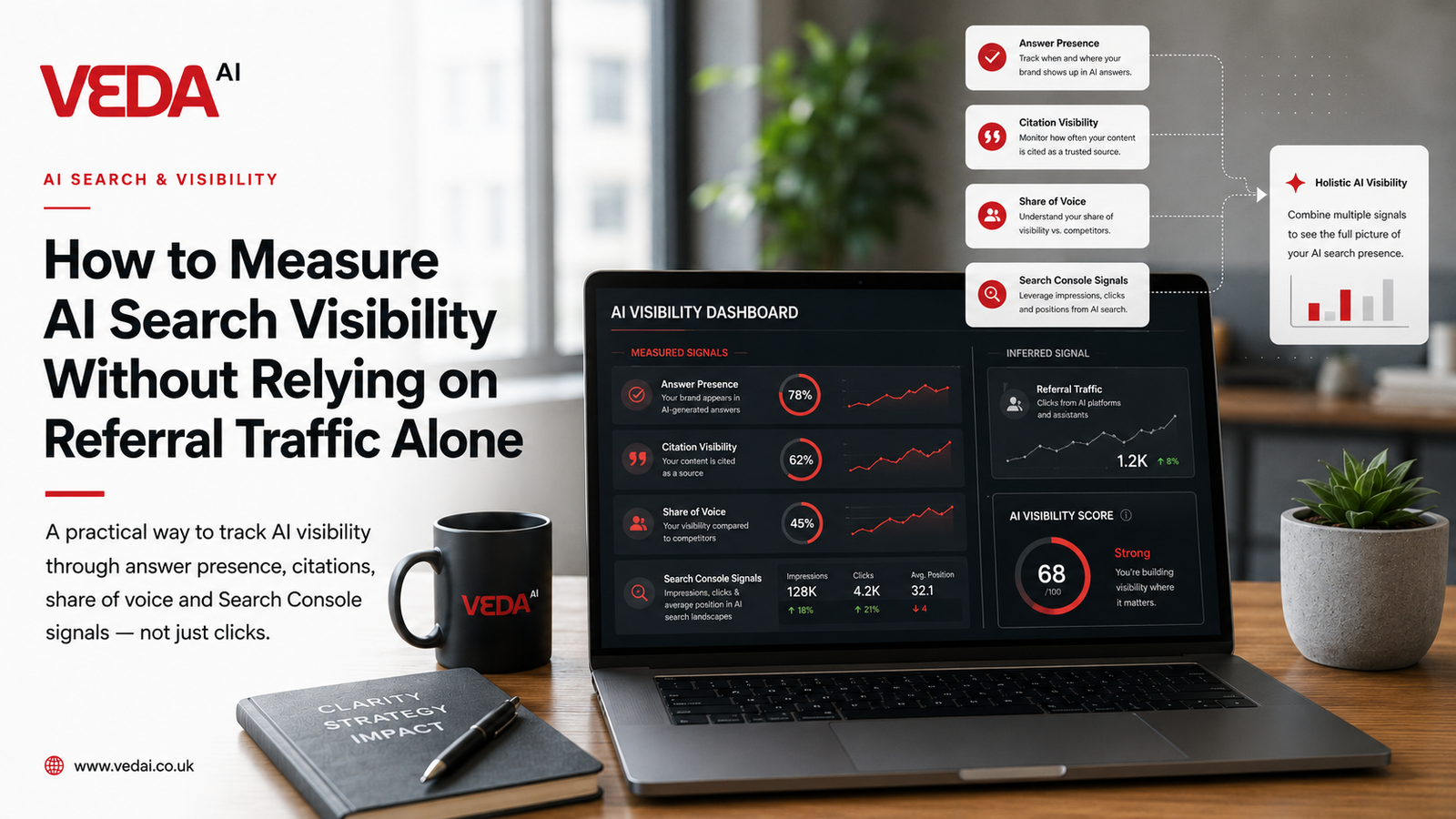
AI Search & Visibility
How to Measure AI Search Visibility Without Relying on Referral Traffic Alone
Waiting for AI referral traffic to prove the work is like judging a billboard by its click-through rate. The useful signals sit earlier in the chain.
10 min read · 1 August 2026
Get Veda AI Edge.
Practical briefings on AI adoption, automation, intelligent products and AI-assisted search — what changed, why it matters and what to consider next. No hype, no AI theatre.
By joining you agree to receive Veda AI Edge from Veda AI. Unsubscribe any time.
Ready to find what’s worth fixing?
Start with a short call.
We’ll help you work out whether the right next step is the guide, the £995 + VAT Business Efficiency Audit, or a scoped implementation conversation.