How a technology partner helps you get more from the systems you already have
How ongoing advice, integration, practical AI support and staff adoption can help your business get more from the tools already in place.
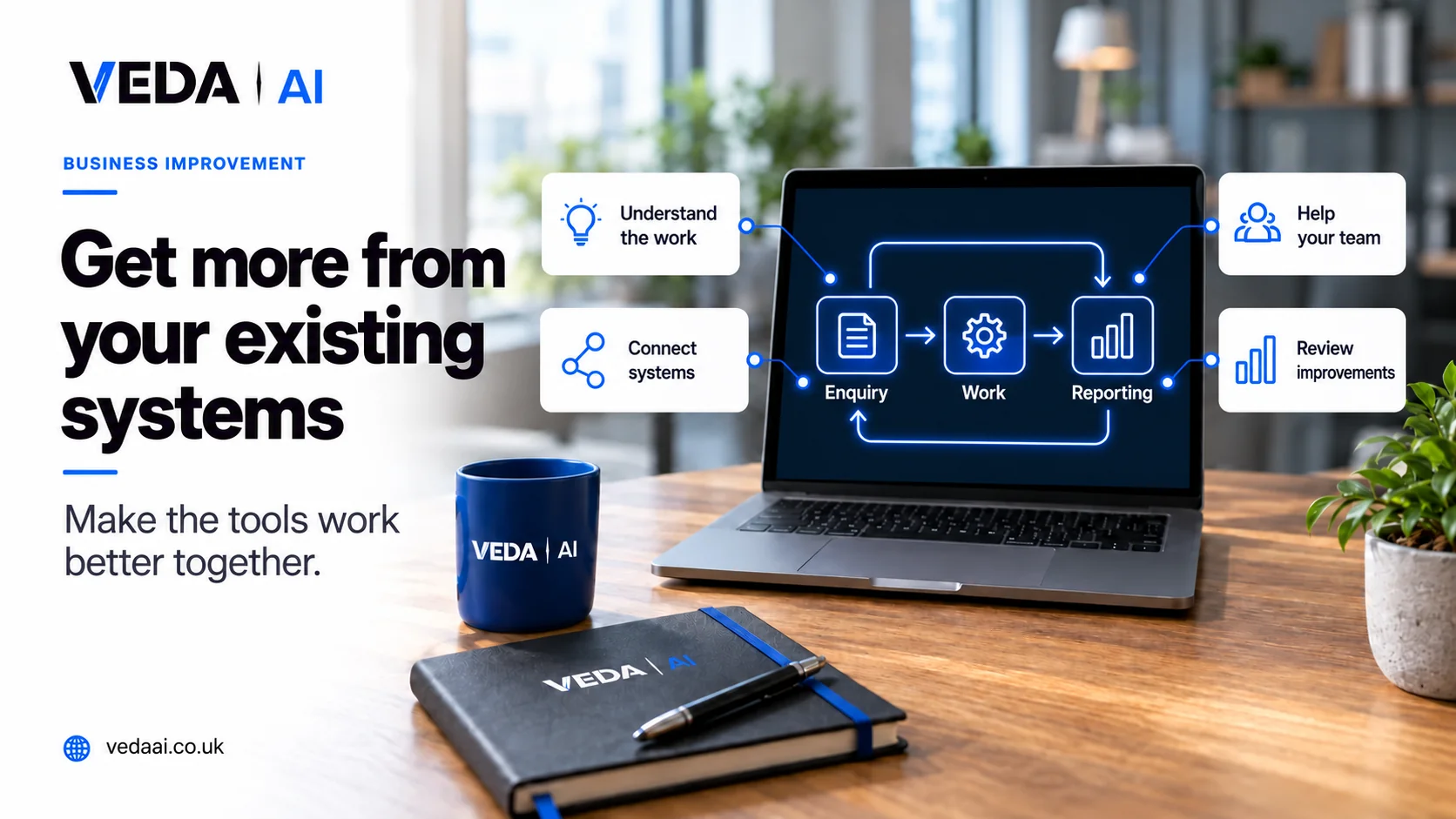
Your business probably already pays for a collection of useful tools. There is software for sales, accounts, scheduling, customer communication and perhaps several subscriptions bought to solve a particular problem.
Yet staff still copy information between systems, managers request spreadsheets and important work depends on someone remembering to chase it.
Buying another platform may help. But there is often a more useful question to investigate first: how could the business get more value from what is already in place?
That is a practical starting point for an ongoing technology partnership, because the work can combine understanding the operation, making changes and helping people use them consistently.
Look at the working day across the systems
A software vendor can explain its product. Your team understands the work it needs to complete. The opportunity often sits between those two perspectives.
Imagine an illustrative business using separate tools for sales and job scheduling. Each application does its main job reasonably well, but customer details are copied manually when an enquiry becomes confirmed work. Staff check several screens before answering a customer update.
The immediate task is to follow that handover and understand where effort is being lost. Which information is needed? Who checks it? What happens when an order changes?
A technology partner can investigate the whole journey before recommending whether configuration, integration, training or a replacement would help.
Separate missing capability from missed opportunity
A system can appear unsuitable because it has been configured poorly, introduced incompletely or left unchanged as the business has grown.
Check what it can actually support today, including the relevant settings, permissions, subscription requirements and supported integrations. Test real examples before relying on a feature name in a product brochure.
An approval feature, for instance, is useful only if it handles the routes and exceptions your business needs. A report is valuable only if the underlying information is dependable enough to answer the question.
This investigation may confirm a genuine limitation. It may also identify an improvement that avoids a larger purchase and the disruption of moving systems.
Improve how the systems work together
A useful change might connect an existing enquiry form to the sales system, reduce repeated entry or make an agreed status visible to the people who need it.
The work needs to account for failures as well as successful transfers. If a customer record cannot be matched, someone should be able to see the problem and resolve it. Otherwise, the automation may hide work rather than remove it.
Start with a manageable connection and check how it behaves in normal use. What is easier for staff? Which exceptions remain? Does the change make information more reliable elsewhere?
Those answers can guide the next priority in the partnership rather than encouraging a large set of disconnected automations.
Help people use the tools with confidence
A technology improvement may involve very little development. Staff might need clearer guidance on an existing feature or practical help using an approved AI tool for a specific task.
For illustration, a team preparing routine customer correspondence could practise using AI to produce a first draft, with appropriate information controls and a clear expectation that a person checks the result.
The value would depend on whether the task becomes easier without reducing accuracy or introducing inappropriate information sharing. That needs to be tested with the people doing the work.
Veda AI combines technical delivery and team adoption within its wider approach. Existing tools can be part of that work when they offer a sensible route to the business outcome.
Use the monthly relationship to build on what works
An ongoing arrangement can help these improvements fit together. After addressing one handover, the team can return to see whether it is working and identify the next useful step.
In the sales and scheduling example, more reliable customer information might make it possible to improve job updates later. Better updates could then reduce the need for staff to investigate routine enquiries.
That is an illustrative sequence, not a promised timetable. Each step should earn its place through the problem it addresses and the effort it requires.
The benefit of continuity is that later choices can use evidence from earlier work, while the team retains an understanding of the systems and people involved.
Keep the economics visible
An inexpensive change can still carry ongoing costs. An integration may need maintenance, an automation platform may charge for usage, or a feature may require a different software plan.
Compare those commitments with the benefit you can reasonably expect. Recovering staff time can create capacity, but it does not automatically reduce payroll or turn into cash savings.
Include the effort your team will need to contribute and any disruption involved. Sometimes a small improvement to an existing tool offers the best return. Sometimes repeated workarounds show that replacement deserves serious consideration.
A useful partner should be able to explain that judgement and revisit it when the evidence changes.
Start with one point of friction
Choose a recurring task that staff find frustrating and ask them to show how they complete it today. Bring the systems, the workarounds and a few real examples into the discussion.
The aim is to find a useful change you can act on, then assess what it improves. That can provide a practical starting point for a longer programme across automation, AI, systems and staff capability.
If that sounds like the help your business needs, explore Veda AI's Business Improvement Partnership. Start with the work you want to make easier and let that guide the technology decisions.
Related insights.

Business Efficiency
Technology retainer vs one-off project: which is right for your business?
Compare a defined project with an ongoing partnership and understand when continuity, monthly capacity and connected priorities can help your business.
5 min read · 19 October 2026

Business Efficiency
Software development agency or technology partner: what changes with an ongoing partnership?
Explore how an ongoing technology partnership connects practical advice, implementation and follow-through across changing business priorities.
5 min read · 19 October 2026

Business Efficiency
How to choose a technology partner for your business
The questions and evidence that help business owners choose a partner who can understand the operation and keep useful improvements moving.
5 min read · 19 October 2026
Get Veda AI Edge.
Practical briefings on AI adoption, automation, intelligent products and business improvement — what changed, why it matters and what to consider next. No hype, no AI theatre.
By joining you agree to receive Veda AI Edge from Veda AI. Unsubscribe any time.
Ready to find what’s worth fixing?
Turn the idea into steady improvement.
Work alongside a team that helps you prioritise and deliver AI, automation and software changes each month. Explore the Business Improvement Partnership or discuss the business on a free call.