How to choose a technology partner for your business
The questions and evidence that help business owners choose a partner who can understand the operation and keep useful improvements moving.
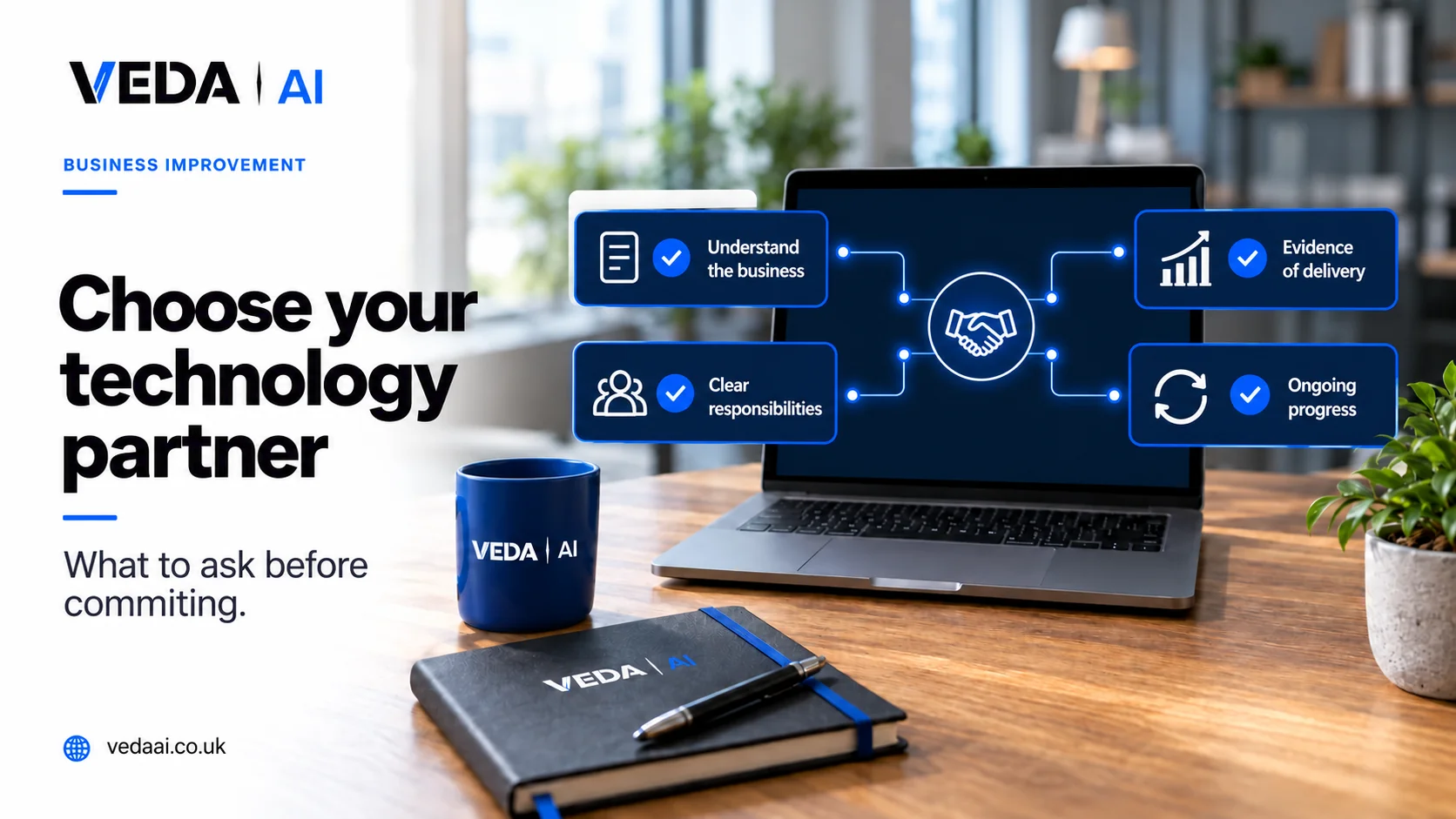
Choosing a technology partner can feel difficult when you are buying expertise you do not have internally. Every supplier seems capable, every presentation includes impressive examples, and it is hard to know which questions will reveal how they actually work.
You do not need to become a software engineer to make a sound decision. You need a clear business problem, comparable evidence and a way to test how a prospective partner thinks.
The aim is to find a team whose judgement you can assess, whose responsibilities are clear and whose working style suits your business.
Give everyone the same starting point
Before approaching providers, write a short description of the situation. Explain what happens today, where it causes difficulty and what a useful improvement would look like.
For example: “Quoting, customer handovers and reporting all involve repeated administration. We want help choosing the priorities and making steady improvements while the business keeps running.” Ask prospective partners to explain how they would work through that situation over time.
Include relevant constraints: the systems you need to keep, staff availability, budget boundaries and any deadline that actually matters. Be open about what you do not know.
This gives providers the same problem to respond to. Without it, you may end up comparing proposals for entirely different interpretations of your needs.
Look at the questions they ask
A useful partner should want to understand how the business works before recommending a substantial change.
In the quoting example, they might ask how many quotes you handle, which ones take longest, where prices come from, who approves exceptions and whether delays affect sales. They should also want to speak to the people preparing the quotes.
Those questions help distinguish the visible symptom from its causes. The answer might involve software, but it could also involve pricing rules, approval authority or inconsistent information.
Ask: “What would you need to learn before recommending an approach?” A thoughtful answer should expose uncertainty and explain how the team would investigate it.
Request evidence that matches your need
A polished portfolio shows presentation quality. You also need evidence of relevant work and how it was delivered.
Ask for an example with comparable operational complexity, constraints or users. A project in a different sector may be more informative than one in your industry if the underlying challenge is similar.
Useful questions include what changed, what the provider was responsible for, what proved difficult and what happened after launch. Where results are quoted, ask how they were measured and over what period.
If a reference conversation is available, ask the client about communication, handling of setbacks and the effort their own team had to contribute. Respect confidentiality where details cannot be shared.
Check how the relationship maintains momentum
Ask what happens between the initial discussion and the next useful change. Who investigates an opportunity, proposes the next step and returns to the result? How are staff supported when working habits need to change?
Veda AI connects advice, implementation and adoption in its partnership approach. When assessing any provider, look for a practical explanation of how those responsibilities work together over time.
Meet the people who would do the work
The people presenting the proposal may not be the people delivering it. Understand the team before making the commitment.
Who will lead the engagement? Who provides technical oversight? Which work is handled by employees, subcontractors or other providers? How are absences and changes of personnel managed?
You are looking for a credible arrangement, not a particular team size. A small specialist team may suit your need well. A larger provider may offer broader cover. The important point is knowing who is accountable and how their available capacity matches the proposal.
Ask how your own staff would communicate with that team when a decision or problem needs attention.
Make the commercial model understandable
You should be able to explain what you are buying without relying on the sales presentation.
For a project, clarify scope, assumptions, acceptance criteria, payment milestones and how changes are priced. For ongoing work, clarify the allowance or service, prioritisation process, minimum commitment and treatment of unused capacity.
In both cases, establish recurring software and infrastructure costs, support boundaries and responsibilities after launch. Acknowledging a support request and resolving the underlying issue are different commitments; ask what any response promise actually covers.
If proposals differ substantially in price, compare the work and responsibilities included before drawing a conclusion about value.
Check how they handle disagreement and uncertainty
Technology work involves decisions with incomplete information. Ask providers to describe a time they recommended a smaller solution, challenged a requirement or stopped work that no longer made sense.
A useful answer should explain the reasoning and how the client was involved. You want a partner who can disagree constructively while respecting your authority over the business.
Also ask how they report emerging risks. Finding out early that a dependency could delay delivery gives you choices. Finding out at the deadline leaves fewer options.
Clear communication about limitations is part of competence.
Make ownership part of the buying decision
Before signing, understand access to systems, documentation, data and any custom work. Establish what would be available if you changed providers and which third-party restrictions apply.
Keep the discussion practical: could another competent team understand and continue the work? What would a handover involve? Who inside your organisation would hold the necessary account access?
Then record your assessment against the same criteria for every provider: understanding, relevant evidence, delivery team, commercial clarity, communication and continuity. Note unresolved questions alongside strengths.
Before committing, ask the provider to apply their proposed way of working to your actual priorities. You should understand how the first decisions lead to delivery and how the relationship will be reviewed. Explore Veda AI’s monthly partnership if that is the kind of continuing support your business needs.
Related insights.
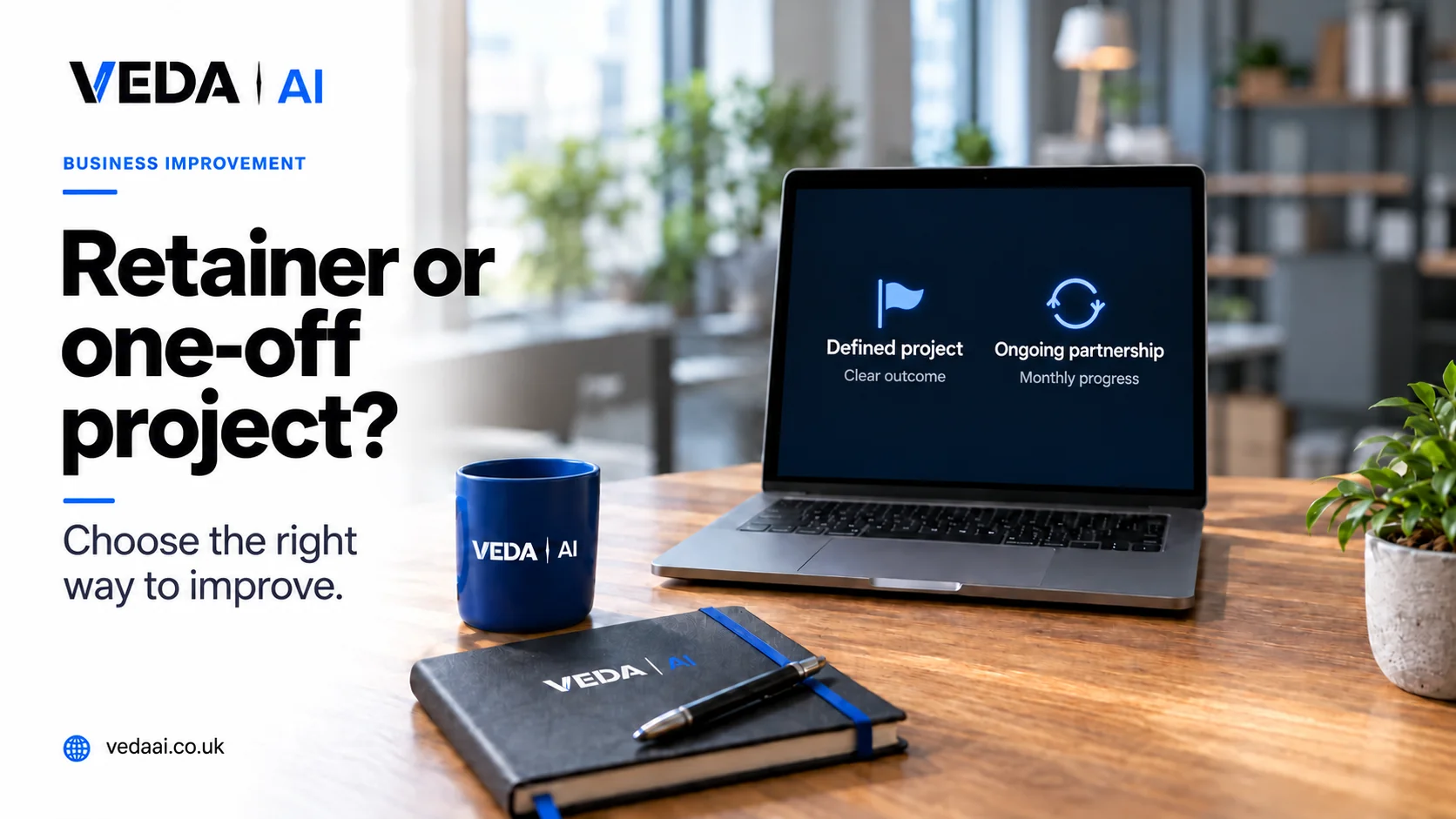
Business Efficiency
Technology retainer vs one-off project: which is right for your business?
Compare a defined project with an ongoing partnership and understand when continuity, monthly capacity and connected priorities can help your business.
5 min read · 19 October 2026
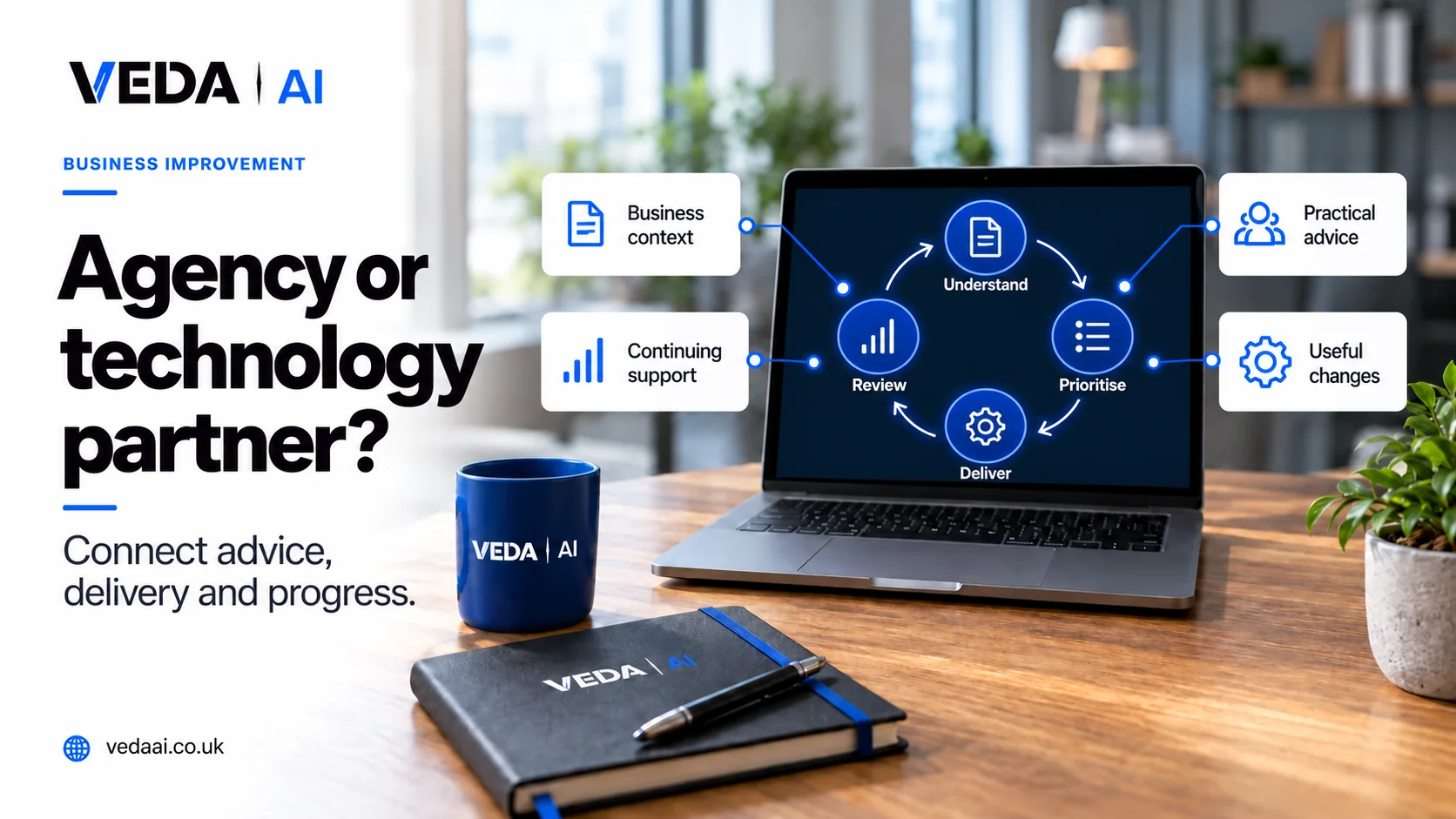
Business Efficiency
Software development agency or technology partner: what changes with an ongoing partnership?
Explore how an ongoing technology partnership connects practical advice, implementation and follow-through across changing business priorities.
5 min read · 19 October 2026
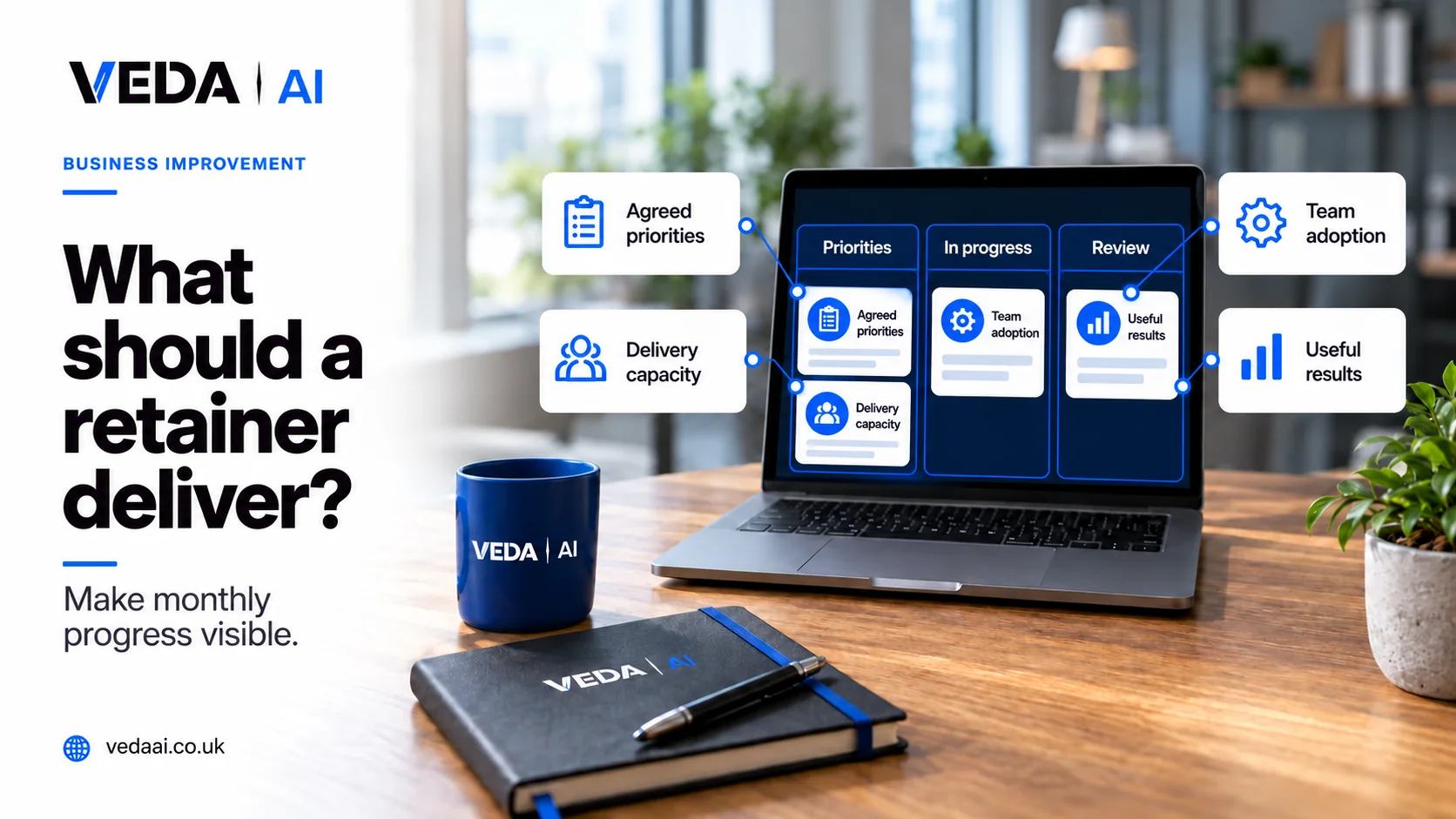
Business Efficiency
What should you actually get from a monthly technology retainer?
What to expect from monthly priorities, delivery, adoption and review, with Veda AI’s Foundation, Growth and Leader options explained.
5 min read · 19 October 2026
Get Veda AI Edge.
Practical briefings on AI adoption, automation, intelligent products and business improvement — what changed, why it matters and what to consider next. No hype, no AI theatre.
By joining you agree to receive Veda AI Edge from Veda AI. Unsubscribe any time.
Ready to find what’s worth fixing?
Turn the idea into steady improvement.
Work alongside a team that helps you prioritise and deliver AI, automation and software changes each month. Explore the Business Improvement Partnership or discuss the business on a free call.