Technology retainer vs one-off project: which is right for your business?
Compare a defined project with an ongoing partnership and understand when continuity, monthly capacity and connected priorities can help your business.
Your business has a list of things technology could improve. Quotes take too long. Customer information lives in several places. Reporting depends on someone spending Friday afternoon assembling a spreadsheet.
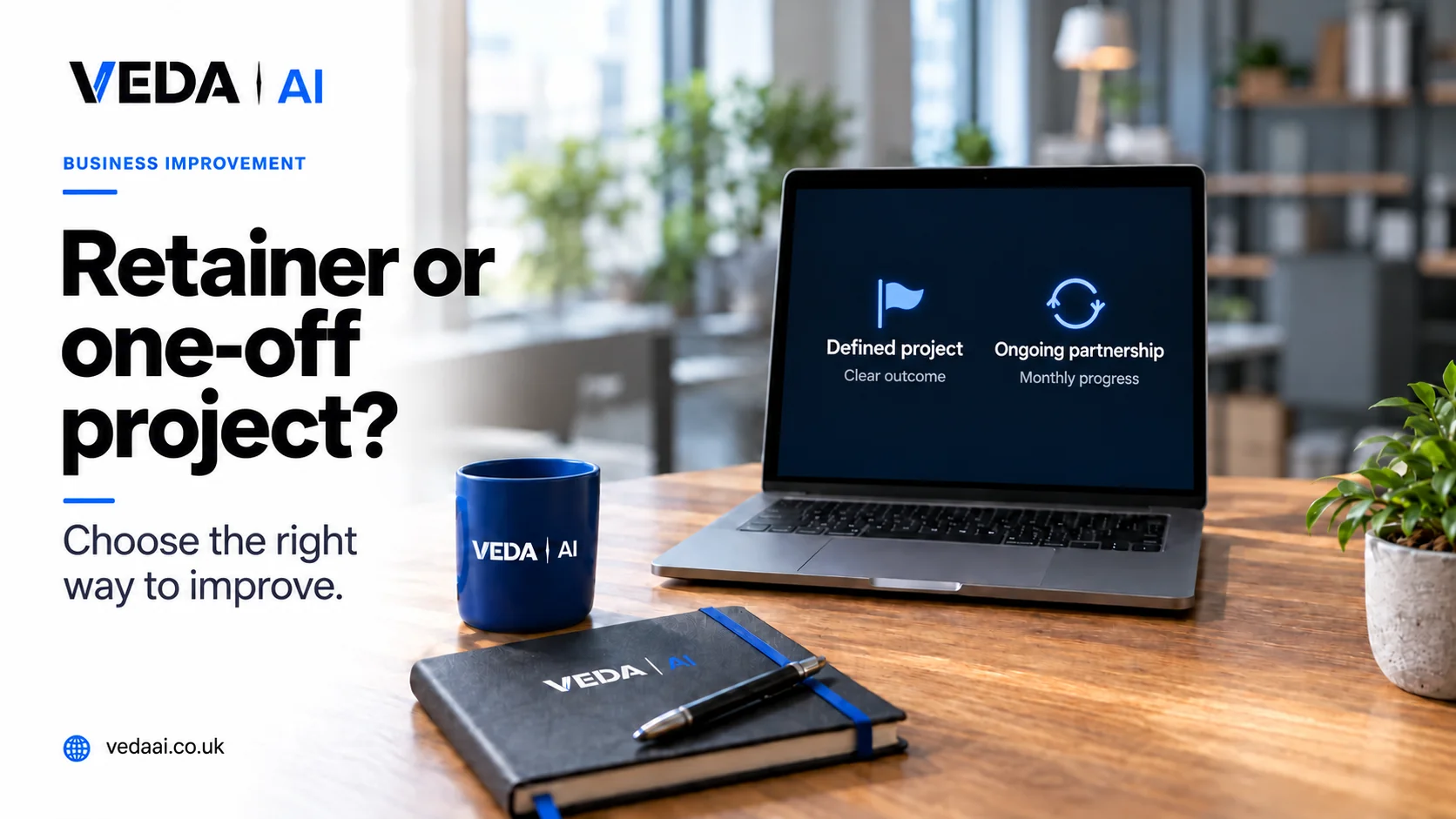
You could commission a project to fix one problem. Or you could reserve time with a technology team each month and work through the priorities together.
Both can be sensible. The choice depends on how clearly you understand the work, how often your priorities change, and how much support your own team can provide. Before comparing prices, establish what kind of commitment the business actually needs.
When a one-off project makes sense
A project works well when you can describe a specific outcome and recognise when it has been delivered.
For example, imagine a distributor needs an ordering portal for existing trade customers. The users are known, the pricing rules are understood, and the portal needs to connect to a particular stock system. There will still be questions to resolve, but the central requirement is reasonably stable.
A project creates a defined piece of work around that requirement. You can agree the scope, milestones, responsibilities and acceptance criteria before committing to the full build. Depending on the contract, the price may be fixed, estimated or based on time spent.
That structure is useful when there is a clear deadline, a ring-fenced budget or a single investment to approve. It also suits businesses that already have someone internally who can make decisions and manage what happens after launch.
When a retainer makes sense
A retainer can suit a business with a continuing stream of worthwhile improvements, especially where each change helps reveal the next priority.
Imagine a service business that first needs better enquiry handling. Improving that process exposes a problem with job scheduling. Resolving scheduling then makes it possible to produce more useful capacity reports.
These improvements are connected, but trying to specify every detail at the outset could create a large project based on incomplete knowledge. An ongoing arrangement allows the business and its technology team to learn, deliver and adjust in stages.
At Veda AI, the monthly partnership provides reserved capacity across consulting, AI and development. That allows the conversation to begin with the business problem and continue through the agreed work, rather than requiring every need to arrive as a software specification.
The commercial agreement still needs boundaries. A monthly fee should tell you what capacity or service you are buying, how work is prioritised and what happens when demand exceeds the allowance. Ongoing access does not mean unlimited delivery.
Compare the whole commitment
A monthly fee and a project quote describe different things. Comparing the headline figures alone can hide the cost of managing the work.
With a project, consider the effort needed to prepare the brief, supply information, test the result, train users and arrange future changes. A low build price may exclude important work your team will still need to do.
With a retainer, consider whether there is enough valuable work to use the reserved capacity. Your staff must also be available to answer questions and adopt the changes. Paying for availability will not create progress if decisions sit unanswered for weeks.
For either model, ask about software subscriptions, hosting, third-party charges, maintenance and support. Clarify which costs continue after delivery and which services require a separate agreement.
Flexibility needs a decision process
One attraction of a retainer is being able to change direction. That becomes a weakness if every new request displaces work already under way.
An illustrative example: the operations director wants quoting improved, sales requests a new dashboard, and finance needs help with invoice matching. All three may be worthwhile. Starting all three at once could leave everyone waiting.
Agree who decides the order, how urgent work is handled, and when a new request justifies stopping something else. A short priority list with a clear owner usually provides a stronger basis for delivery than a long list labelled urgent.
Projects need the same discipline in a different form. If the requirement changes, agree the effect on scope, cost and timing before treating the extra work as included.
Be honest about when either model is a poor fit
A retainer is difficult to justify when you only have one small, well-understood task and no credible follow-on work. It can also become expensive waiting time if the business is too busy to participate.
A large project is risky when nobody has investigated the process it is supposed to improve. If the team disagrees about how orders should be approved, software will not settle that disagreement for you.
Where uncertainty is the main problem, start with a bounded discovery exercise. Use it to understand the opportunity and decide whether a project, ongoing support or an internal change is appropriate. Diagnosis should leave you better able to make that choice.
Use four questions to make the decision
Ask yourself:
- Can we describe a useful finish line for the work?
- Do we have several connected priorities that will need attention over time?
- Who internally can make decisions and help changes become established?
- What evidence would tell us this investment is worthwhile?
A clear finish line points towards a project. A continuing improvement agenda may justify a retainer. If neither is clear, more investigation is likely to be useful before a substantial commitment.
If the business has a continuing improvement agenda, consider what maintaining the relationship makes possible: retaining context, returning to results and progressing connected priorities. Those are useful reasons to choose a partnership when they match the work your business needs.
At Veda AI, an initial conversation can help you work through that choice. You can explore the Business Improvement Partnership with those questions in mind.
Related insights.

Business Efficiency
Software development agency or technology partner: what changes with an ongoing partnership?
Explore how an ongoing technology partnership connects practical advice, implementation and follow-through across changing business priorities.
5 min read · 19 October 2026

Business Efficiency
How to choose a technology partner for your business
The questions and evidence that help business owners choose a partner who can understand the operation and keep useful improvements moving.
5 min read · 19 October 2026
Business Efficiency
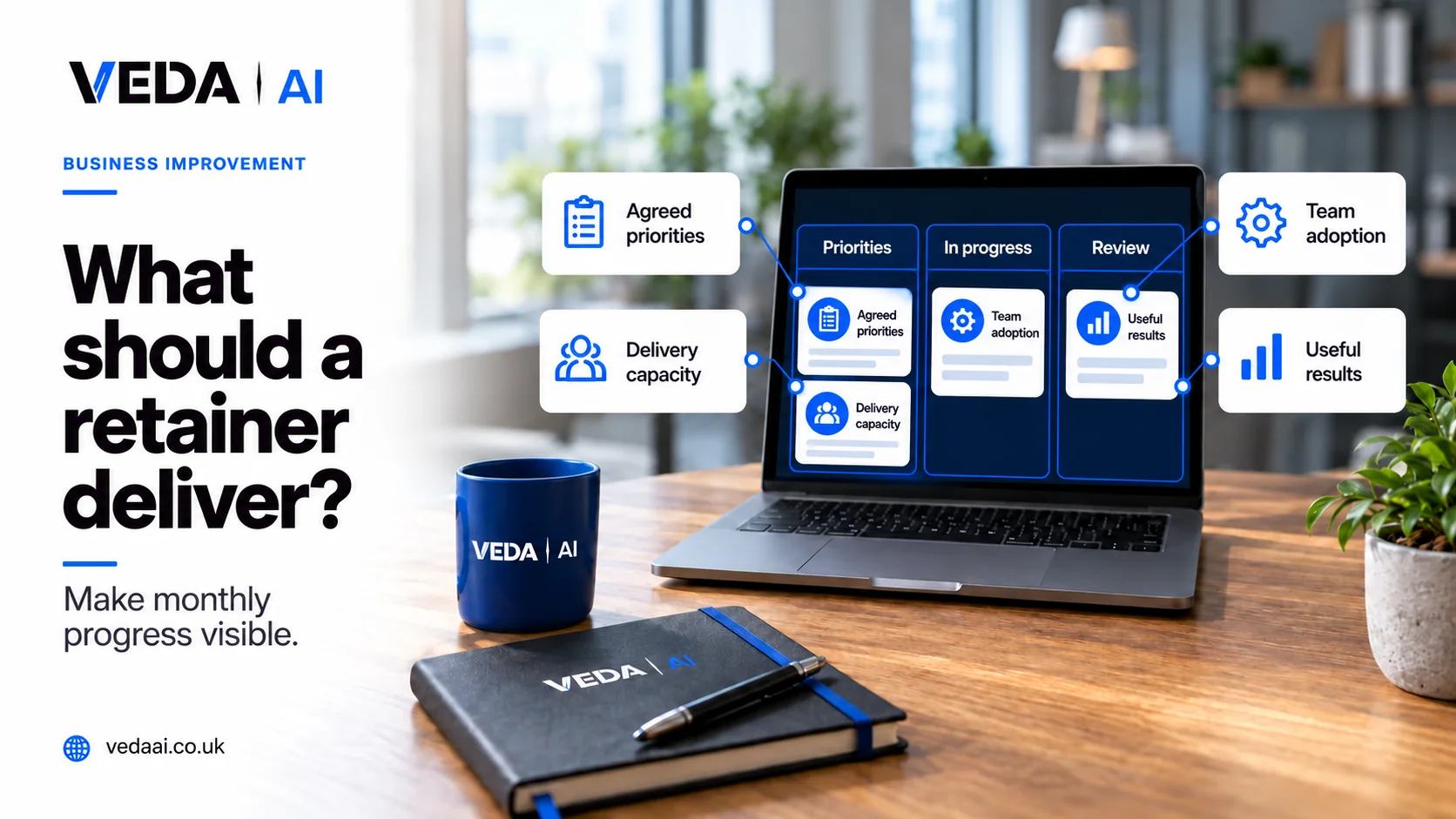
What should you actually get from a monthly technology retainer?
What to expect from monthly priorities, delivery, adoption and review, with Veda AI’s Foundation, Growth and Leader options explained.
5 min read · 19 October 2026
Get Veda AI Edge.
Practical briefings on AI adoption, automation, intelligent products and business improvement — what changed, why it matters and what to consider next. No hype, no AI theatre.
By joining you agree to receive Veda AI Edge from Veda AI. Unsubscribe any time.
Ready to find what’s worth fixing?
Turn the idea into steady improvement.
Work alongside a team that helps you prioritise and deliver AI, automation and software changes each month. Explore the Business Improvement Partnership or discuss the business on a free call.