What should you actually get from a monthly technology retainer?
What to expect from monthly priorities, delivery, adoption and review, with Veda AI’s Foundation, Growth and Leader options explained.
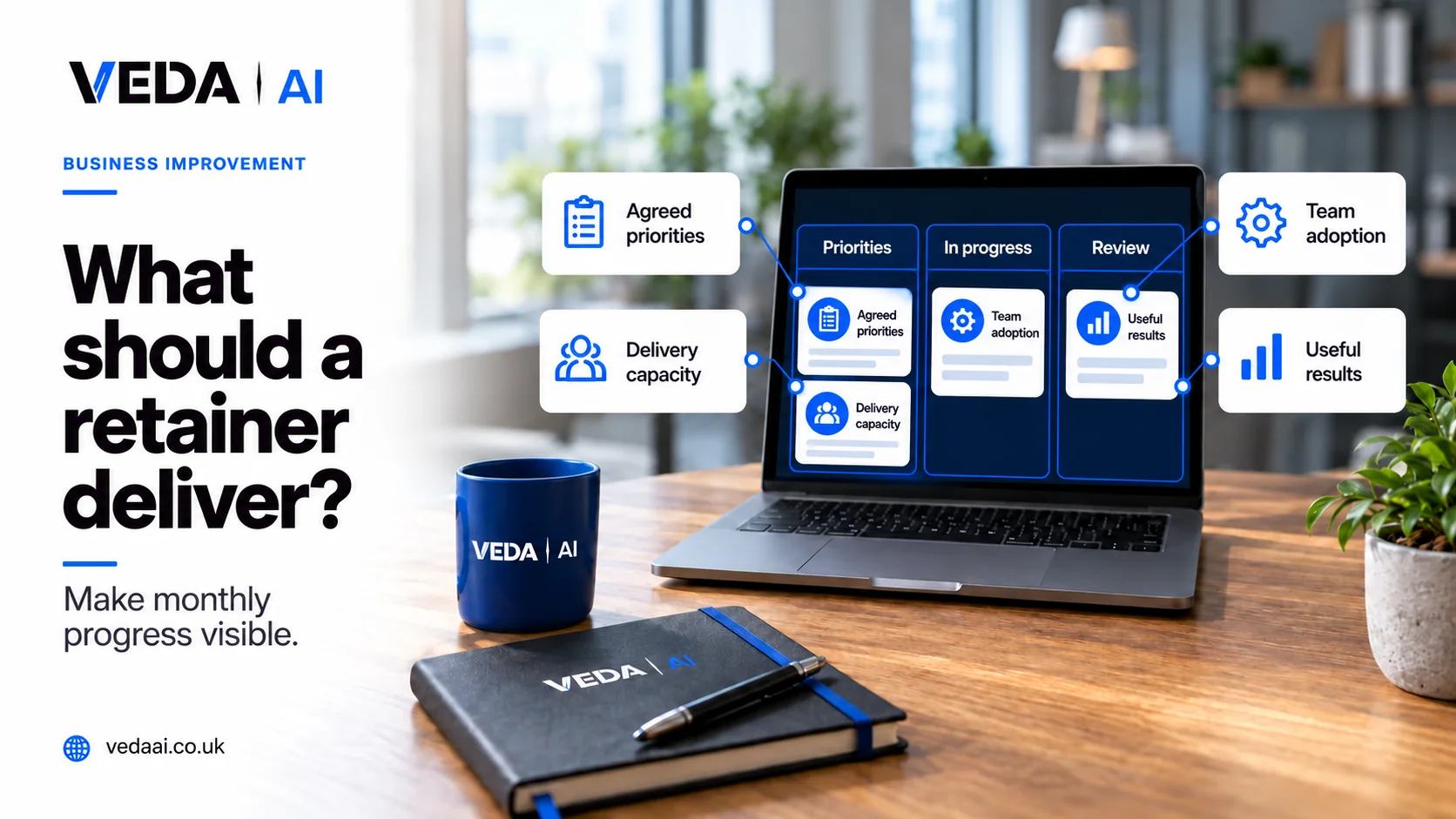
A monthly technology retainer should be easy to explain. What work is it helping you move forward? What has changed in the business? What needs your attention next?
If the answers depend on decoding a timesheet or remembering several informal conversations, the relationship needs more clarity.
A retainer may reserve delivery time, provide a defined support service or combine several responsibilities. Those are different purchases. Before assessing whether you are getting value, establish what the agreement is intended to achieve and what it actually includes.
Veda AI's Business Improvement Partnership is built around ongoing work across consulting, AI and development. That gives you a basis for asking a more useful question: how is the relationship helping the business make progress across the priorities that matter?
A short set of agreed priorities
You should know which business problems the team is working on and why they take precedence.
“Improve operations” is too broad to guide delivery. “Make order approval visible so jobs stop waiting in individual inboxes” gives people something they can investigate and act on.
A useful monthly plan links the priority to an intended result, identifies the next deliverable and names any decisions your team needs to make. It should also make deferred work visible so nobody assumes everything on the list is progressing.
There will be uncertainty, particularly early in an engagement. The plan should say what needs investigating and what decision that investigation will support.
Visibility of how capacity is used
Reserved time can cover more than development. Understanding a process, testing a change, preparing training and reviewing a difficult technical decision can all be necessary work.
You should still be able to understand the balance. If most of the month went into investigation, what was learned? If delivery slowed because access was missing, when was that raised and what can you do about it?
The purpose is to make informed decisions about the allowance. A business may need to reduce the number of priorities, resolve a dependency or reserve more time for staff training.
A detailed activity log alone does not explain those choices. Ask for the relationship between the time used, what it produced and what remains.
Outputs you can inspect
An improvement should produce something more concrete than a reassuring update.
Depending on the work, that might be a functioning integration, a revised workflow, a tested configuration, a decision paper or a documented process that your team can follow.
Ask to see the output in the context where it will be used. A dashboard demonstration is more useful when it shows whether a manager can answer the question that prompted the work. An automation demonstration should include what happens when information is missing or an exception occurs.
Some months may focus on groundwork. That can be justified, provided the work and its purpose are visible.
Help turning delivery into normal practice
A change that staff cannot use reliably will struggle to produce value.
Suppose a new enquiry workflow has been configured. Someone still needs to explain who checks the queue, how enquiries are assigned and what to do when an enquiry falls outside the usual categories.
Agree who provides that preparation and how much time it needs. Your internal manager may lead the operational change while the external team supplies guidance, training or technical support.
Do not leave adoption as an implied extra. It should be part of the plan wherever the intended benefit depends on people working differently.
Evidence that relates to the original problem
A monthly review should distinguish delivery progress from business results.
An integration being live is a delivery milestone. Fewer orders needing manual re-entry is an operational result. Whether that creates cash savings depends on what the business can actually stop spending or avoid hiring for.
Choose a small number of measures appropriate to the work. For an approval process, you might look at waiting time, overdue items and how often staff need to chase. Where a baseline is weak, acknowledge that limitation and improve the measurement.
An honest review can say that the change is in use but there is not yet enough evidence to judge its effect.
Boundaries for support and additional work
An improvement allowance and an emergency support service solve different needs. Understand how the agreement handles a broken workflow, a new feature request and a staff question.
Check operating hours, acknowledgement commitments, escalation routes and how support affects planned work. Establish who covers services supplied by other vendors.
You also need a way to approve work that exceeds the allowance. Without one, either the supplier absorbs unplanned effort or the business receives an unexpected bill. Neither creates a dependable relationship.
A review that leads to a decision
The monthly conversation should help you decide what to continue, adjust, pause or investigate next.
An illustrative review might conclude that order approval is improving, staff need another week of support, and the next dashboard should wait until data quality is addressed. That is more useful than declaring every workstream green.
How this relates to Veda AI's partnership levels
The published monthly options are:
- Foundation — £2,795 per month excluding VAT; 4 days delivery allowance.
- Growth — £4,595 per month excluding VAT; 8 days delivery allowance.
- Leader — £8,195 per month excluding VAT; 16 days delivery allowance.
Review, training, support and communication arrangements vary by level. All work, reporting, reviews, training and strategy use the monthly days. The right level depends on how much work you can usefully progress and the involvement needed, with the activities planned together.
Prices and inclusions checked on 18 October 2026; consult the pricing page for current terms.
Whatever provider you choose, use a simple test: can you see what was agreed, what was delivered, what changed and what happens next? That is a sound starting point for judging whether the relationship is earning its place.
Related insights.

Business Efficiency
Technology retainer vs one-off project: which is right for your business?
Compare a defined project with an ongoing partnership and understand when continuity, monthly capacity and connected priorities can help your business.
5 min read · 19 October 2026

Business Efficiency
Software development agency or technology partner: what changes with an ongoing partnership?
Explore how an ongoing technology partnership connects practical advice, implementation and follow-through across changing business priorities.
5 min read · 19 October 2026

Business Efficiency
How to choose a technology partner for your business
The questions and evidence that help business owners choose a partner who can understand the operation and keep useful improvements moving.
5 min read · 19 October 2026
Get Veda AI Edge.
Practical briefings on AI adoption, automation, intelligent products and business improvement — what changed, why it matters and what to consider next. No hype, no AI theatre.
By joining you agree to receive Veda AI Edge from Veda AI. Unsubscribe any time.
Ready to find what’s worth fixing?
Turn the idea into steady improvement.
Work alongside a team that helps you prioritise and deliver AI, automation and software changes each month. Explore the Business Improvement Partnership or discuss the business on a free call.