Practical AI Adoption for SMEs: Where It Fits, and Where It Doesn't
AI helps in some parts of an operational SME and is the wrong tool in others. This grounded guide separates the noise from the practical question: where AI genuinely fits, where it does not, and how to adopt it without making your operation more complicated.
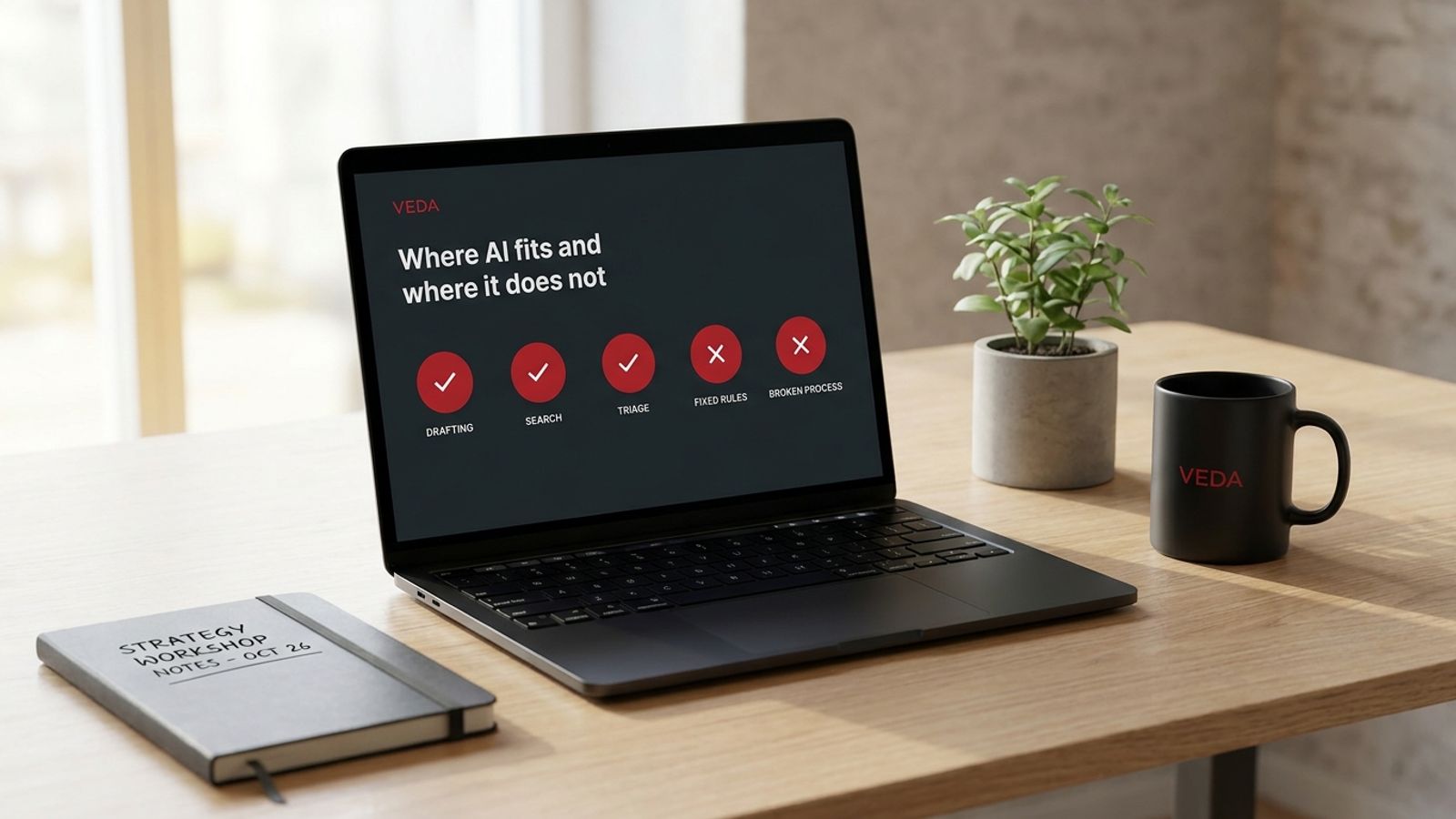
Most growing businesses know when something feels off. The work is getting done, but it takes more people, more chasing and more late evenings than it should. So when AI comes up, the question is rarely whether it is impressive. The question is whether it would actually help here.
That is the right question, and it is a harder one than the noise around AI suggests. AI is genuinely useful in some parts of an operational business and quietly useless, or worse, in others. Practical AI adoption for SMEs is about telling those two apart before you spend money or attention.
This piece is deliberately grounded. No trends, no model names, no tool roundups. Just where AI fits in a real SME, where it does not, and how to adopt it without making your operation more complicated than it already is.
AI is a capability, not a strategy
It helps to be clear about what AI is. It is a capability, like a skilled pair of hands or a good filing system. It is not, on its own, a plan for your business.
That distinction matters because of how AI is usually sold. The pitch is often "add AI" as if the technology itself is the outcome. But a capability only pays off when it sits on a sound operating model and points at a real problem. Bolt it onto a business to look modern and you get cost and confusion, not improvement.
This is why the order of operations matters so much. You get value from AI when you already understand your workflows, your bottlenecks and where the manual drag actually lives. Without that picture, you are guessing, and AI is an expensive way to guess.
Where AI genuinely fits in an SME today
The most useful framing for AI in a smaller operational business is simple: it assists a person. It speeds up or sharpens work a human is still responsible for, rather than running unattended in the background. Hold that line and the genuinely good uses become easy to spot.
Drafting and summarising routine communications
A lot of operational time goes into language-heavy admin: quote follow-ups, supplier emails, job updates, internal notes. AI is good at producing a sensible first draft or summarising a long thread, so a person edits and approves rather than starting from a blank page. The human still owns the message. The drudgery shrinks.
Making messy internal information findable
Most SMEs sit on years of scattered knowledge: documents, emails, notes, old quotes, specifications. The cost is not the storage, it is the time spent hunting for the one thing someone needs. AI-assisted search and retrieval across that material can turn "where did we put that" into a quick answer, which is often more valuable than anything flashier.
First-pass handling of documents and forms
Pulling key details out of incoming emails, PDFs, order forms and supplier paperwork is repetitive and error-prone when done by hand. AI can do a first pass, lifting the relevant fields so a person checks rather than retypes. It will not be perfect, which is exactly why a human still confirms before anything is acted on.
Triage, classification and surfacing patterns
There is a quieter set of uses that suit an SME well:
- Triage and routing: tagging incoming enquiries, prioritising them and sending each to the right person rather than a shared inbox no one fully owns.
- Helping people through repetitive, language-heavy tasks: assisting judgement on the boring parts so skilled staff spend their time where it counts.
- Surfacing patterns in data you already hold: spotting which jobs slip, which customers go quiet, where rework clusters, so a person can look closer.
In every one of these, AI is the assistant. It drafts, finds, sorts and flags. A person decides. That framing keeps you out of trouble and keeps the value real.
Where AI does not fit, and is the wrong tool
This is the half of the conversation that usually gets skipped, and it is the half that protects your time and money. Knowing where AI does not belong is as practical as knowing where it does.
Deterministic, rule-based work is not an AI job
If a task follows fixed rules with a predictable output, you do not want AI making a judgement about it. You want it done the same way every time. That is automation, not AI, and confusing the two leads to fragile, unpredictable systems doing work that should be boringly reliable.
If you are weighing up which problems are AI-shaped and which are simply repetitive, it is worth being deliberate about sequence and starting with the work that is well understood first.
A broken or undefined process
AI does not fix a messy process. It amplifies it. Point it at a workflow no one has properly defined and you get faster, more confident mess, with the added problem that it now looks legitimate. If a process is unclear or broken, the honest move is to fix the operating model first, and a Business Efficiency Audit gives you that clear picture before you change anything.
High-stakes decisions, missing systems and "adding AI"
A few more places where AI is the wrong tool:
- High-stakes decisions with no human oversight. Anything that affects money, safety, compliance or a customer relationship needs a person accountable for the call. AI can inform it; it should not make it alone.
- Standing in for systems or visibility you do not have. If you cannot see your jobs, stock or margins clearly today, AI will not give you that. It needs sound systems and reliable data to work from.
- "Adding AI" with no specific problem. If you cannot name the task it will improve and how you will know it worked, you are not ready to adopt anything yet.
Why AI adoption fails in practice
When AI does not deliver in an SME, the cause is rarely the technology. It is almost always one of a handful of practical failures, and they are predictable.
- A weak operating model. The underlying process is unclear, so there is nothing solid for the tool to stand on.
- No clear use case. AI was adopted as a general idea rather than aimed at one defined, valuable task.
- No ownership. No one is responsible for whether it actually helps, so it drifts and quietly gets abandoned.
- Poor data hygiene. The information feeding it is scattered, inconsistent or out of date, so the output cannot be trusted.
- Treating it as magic. Expecting it to run without review, then losing faith the first time it gets something wrong.
None of these are exotic. They are the same reasons any tool fails in a business that adopted it before it was ready. The fix is not a better tool. It is a clearer picture and a more disciplined approach.
How to adopt AI properly
A practical adoption sequence looks much less dramatic than the marketing and works far better.
Get clarity first. Before you adopt anything, understand where the real friction sits in your operation. This is the work a Business Efficiency Audit exists for, and it stops you from automating or AI-ing the wrong thing.
Pick one real, bounded problem. Not a programme of transformation. One task, with a clear before and after, where you can judge whether it genuinely helped.
Keep humans in the loop. Design the tool to assist a person, with review built in, rather than to run unattended. This is what makes adoption safe and trusted internally.
Build on solid systems. AI works best when it sits on a sound operating model and reliable data. Often the more valuable work is modernising that foundation so smarter tools have something to stand on.
This is where the groundwork shows its worth. When Encounter Walking Holidays modernised its operating model away from printed guides and manual admin towards a smarter, scalable digital model, the point was a sounder operating model, not a clever feature.
The same logic applied to Infinity Club, where the work was digitising the business model: moving from a static web presence to a structured digital operating model. Get that structure right and smarter tools, including AI where it fits, have something dependable to build on.
Check it actually helped. Decide up front how you will measure improvement, then look honestly. If a use case does not earn its place, drop it and move on. Disciplined adoption means being willing to say no.
How Veda approaches AI adoption
Our approach to AI adoption is deliberately unglamorous. We treat AI as one capability among several, grounded in how your operation actually runs rather than in what is fashionable. The starting point is always a clear picture of the business, not a demo.
In practice that means starting with a Business Efficiency Audit to find where the real drag is, fixing the operating model where it needs fixing, and then applying AI only where it genuinely assists a person and earns its keep. Sometimes that points to AI. Often it points to better systems or automation first. Honest advice means telling you which.
A grounded next step
If you are weighing up AI for your business, the most useful thing is not a tool. It is clarity about where it would actually help and where it would not.
See how we approach AI adoption when it is grounded in operations rather than noise, and if you want a clear picture of where the real friction sits first, a Business Efficiency Audit is the natural place to start.

Written by
Rian Patel
Founder, Veda AI
Rian Patel is the founder of Veda AI, helping growing SMEs improve business efficiency with practical AI, automation and smarter systems.
Related insights.
Automation & AI
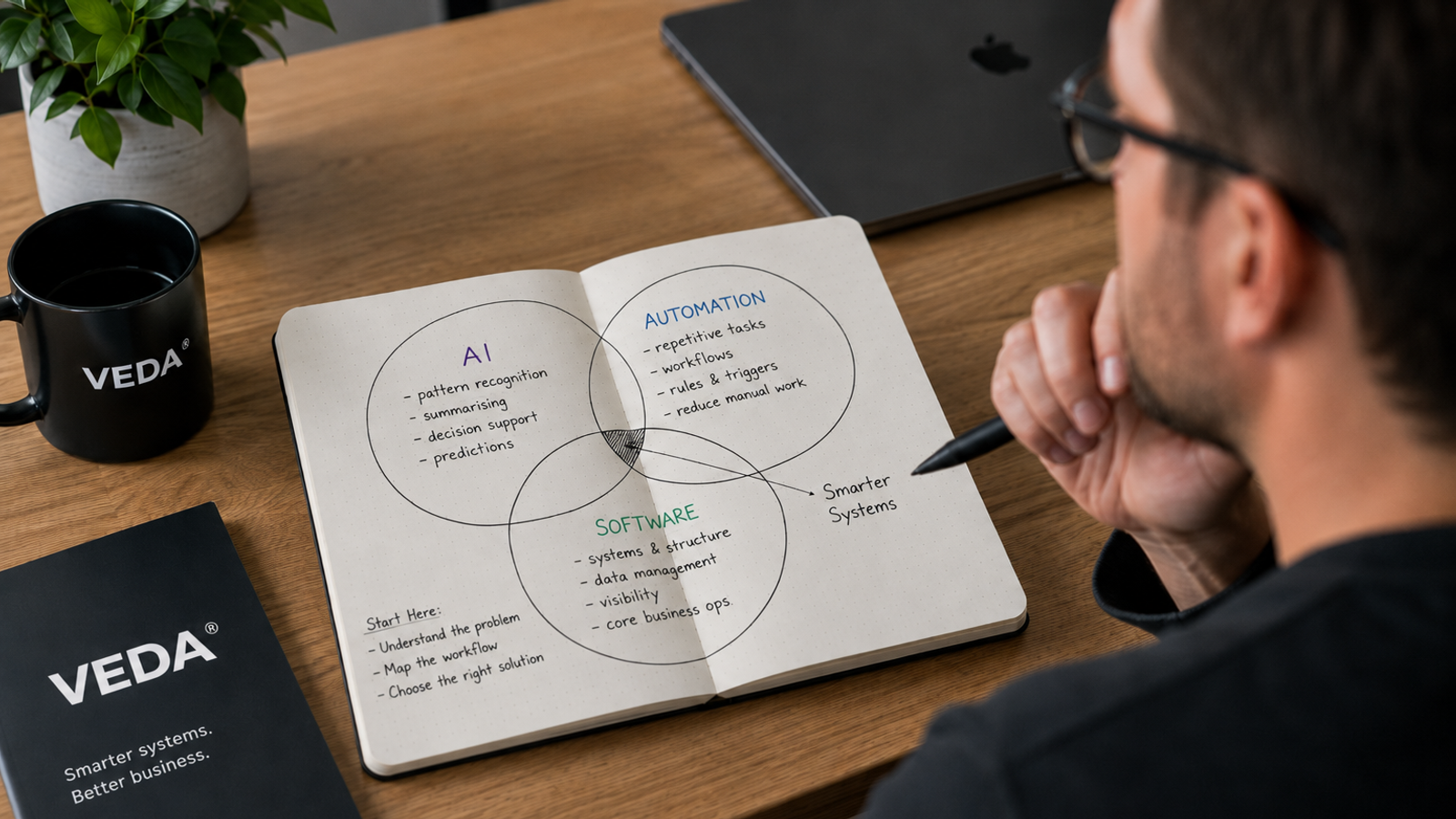
AI vs Automation vs Software: What Should Your Business Actually Use?
AI, automation and software solve different business problems — and confusing them wastes time and money. Here’s when each one actually makes sense, when it does not, and why diagnosis should usually come before you pick a tool.
9 min read · 18 June 2026
Automation & AI
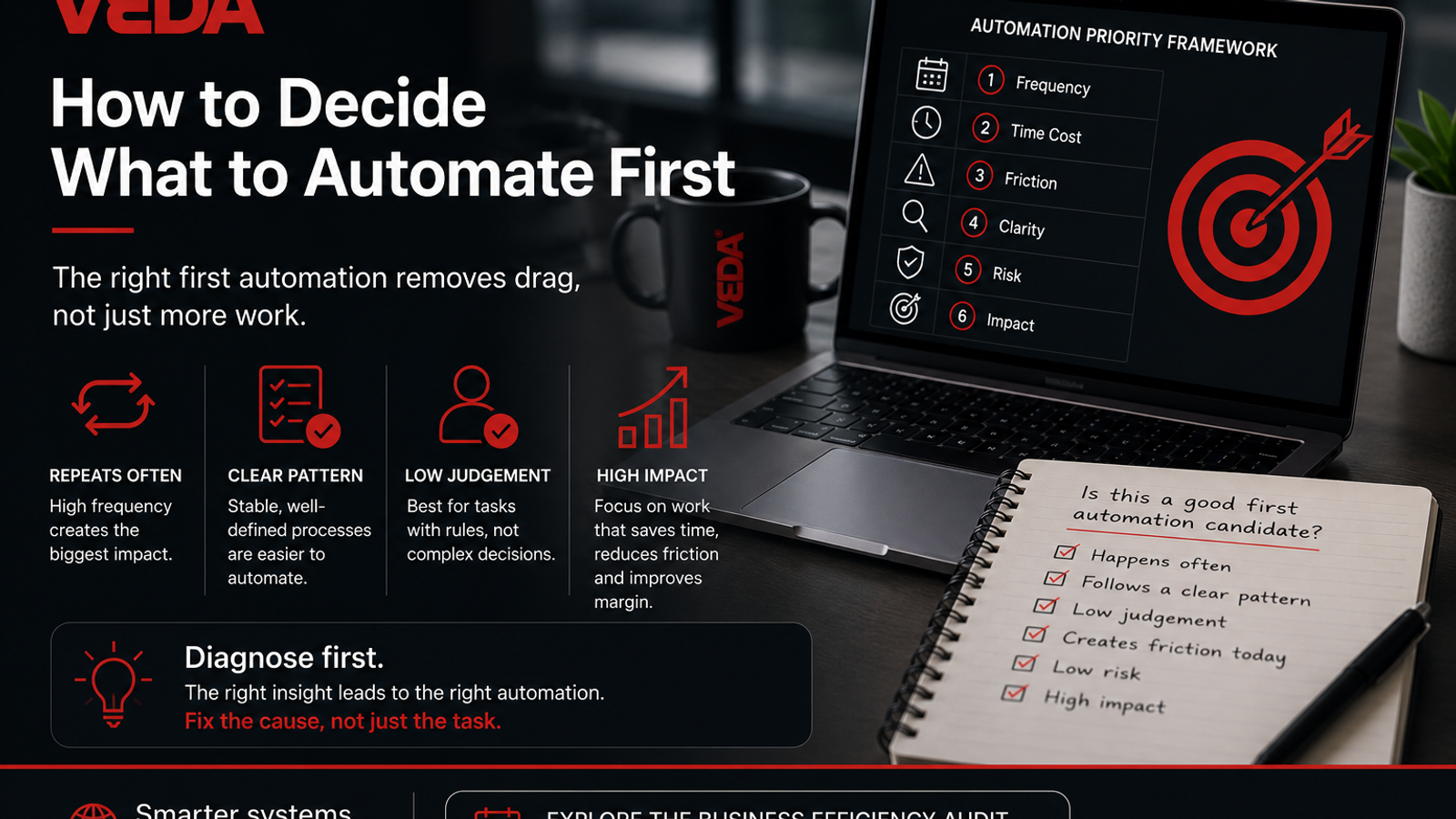
How to Decide What to Automate First
Not sure what to automate first? Here’s how growing SMEs can prioritise automation by frequency, friction, clarity, risk and impact — and why diagnosing the workflow beats starting with a tool.
10 min read · 18 June 2026
Get Veda AI Edge.
Practical briefings on AI adoption, automation, intelligent products and AI-assisted search — what changed, why it matters and what to consider next. No hype, no AI theatre.
By joining you agree to receive Veda AI Edge from Veda AI. Unsubscribe any time.
Ready to find what’s worth fixing?
Start with a short call.
We’ll help you work out whether the right next step is the guide, the £995 + VAT Business Efficiency Audit, or a scoped implementation conversation.