AI vs Automation vs Software: What Should Your Business Actually Use?
AI, automation and software solve different business problems — and confusing them wastes time and money. Here’s when each one actually makes sense, when it does not, and why diagnosis should usually come before you pick a tool.
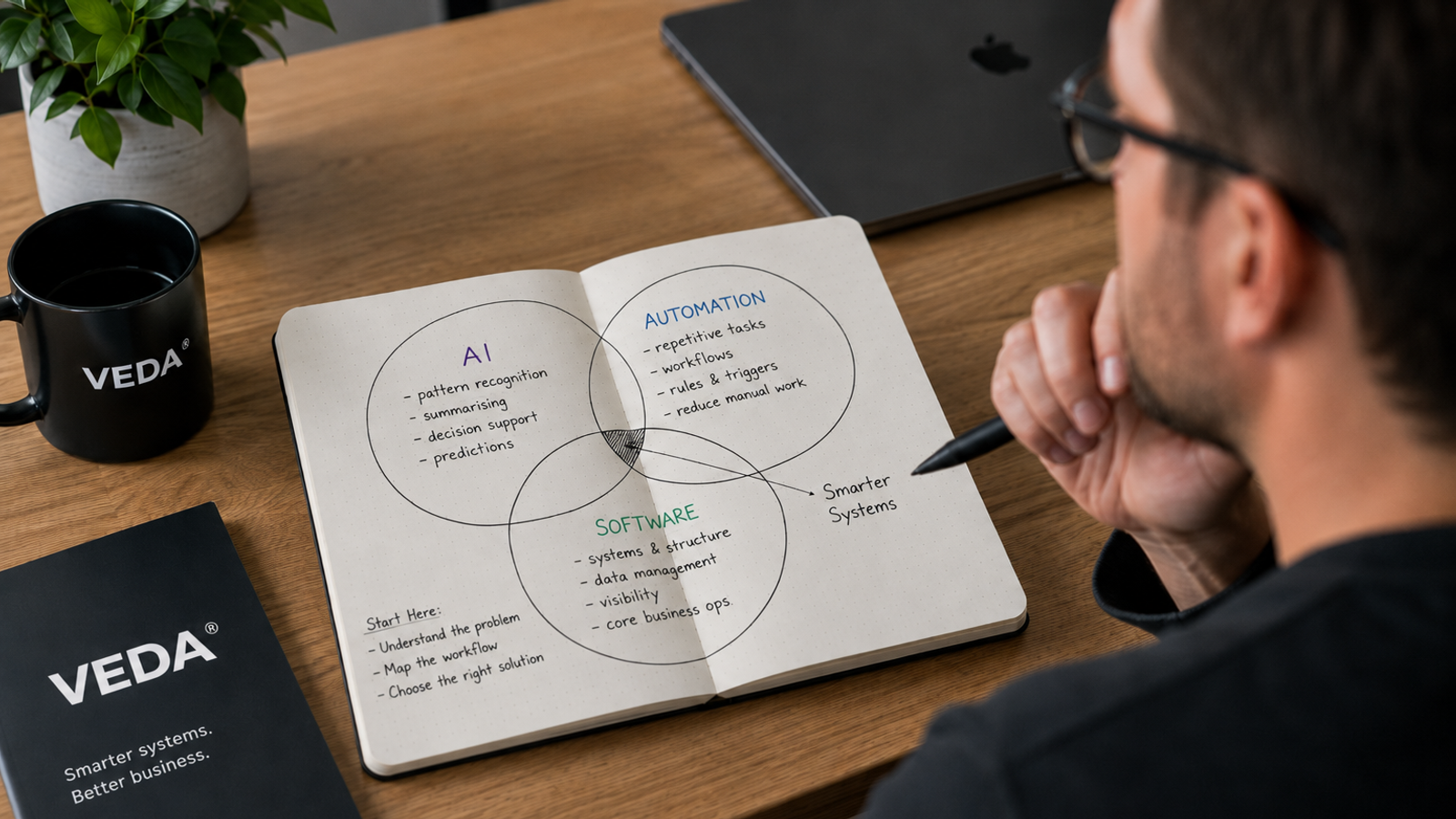
A lot of businesses use the words AI, automation and software as if they all mean the same thing.
They do not.
That might sound obvious, but it causes a huge amount of wasted time and wasted money.
A business starts talking about AI when the real problem is a broken workflow. Another starts looking at automation when what it actually needs is better visibility and clearer handovers. Someone else commissions software when the process underneath it is still messy, inconsistent or poorly defined.
The result is usually the same: a lot of activity, not enough improvement, and a growing sense that technology is more confusing than helpful.
If you want to make a sensible decision, the first step is not choosing the most exciting tool.
It is understanding the problem properly.
These are different tools for different jobs
AI, automation and software can all be valuable.
In the right situation, each can save time, reduce friction and improve how a business operates.
But they solve different kinds of problems.
That is why treating them as interchangeable usually leads to the wrong decision.
A better way to think about it is this:
- AI helps where judgement, pattern recognition, summarising or decision support are involved
- Automation helps where repetitive steps can be handled more consistently by a system
- Software helps where a business needs a clearer structure, system or operating environment for work to happen properly
And before any of those, some businesses simply need better process clarity.
That part matters more than people think.
What AI is actually useful for
AI is most useful when the work involves interpreting information, spotting patterns, supporting decisions, or generating first-draft outputs faster.
For example, AI can help with:
- summarising information
- generating draft content or responses
- identifying patterns in data
- categorising or extracting information
- supporting teams with search, retrieval or decision-making
- reducing the effort involved in certain knowledge-heavy tasks
Used well, it can speed up work that normally depends on people reading, reviewing, drafting or analysing information manually.
But AI is not magic.
It does not automatically fix a disorganised business.
If the underlying workflow is unclear, if responsibilities are vague, or if the information going in is inconsistent, adding AI often creates more confusion rather than less.
That is why AI is usually most effective when it is applied to a process that already makes sense.
What automation is actually useful for
Automation is best for repeatable, rule-based work.
It is useful when the business is spending time on tasks that happen regularly, follow a pattern, and do not require much judgement.
That might include:
- moving data between systems
- sending notifications
- routing forms or requests
- triggering updates
- reducing repetitive admin
- creating reminders or task handovers
- updating records when certain conditions are met
Automation works best when the steps are already known and stable.
If the workflow changes constantly, if no one agrees on what the process is, or if the task depends heavily on human interpretation, then automation can become brittle very quickly.
In other words, automation is excellent for removing repeatable drag.
It is much less effective at solving structural confusion.
What software is actually useful for
Software is useful when a business needs a stronger system underneath the work.
That might mean:
- a better operating environment
- clearer workflow structure
- more reliable information flow
- better visibility across teams or projects
- a system that reflects how the business actually works
Where AI helps with judgement-heavy tasks, and automation helps with repeatable actions, software often provides the framework the business runs on.
That could be:
- an internal platform
- a project system
- a customer-facing application
- a workflow management environment
- a purpose-built operational tool
Software makes the most sense when the issue is not just that a task is repetitive, but that the overall system is weak, fragmented or unfit for how the business operates.
That is why businesses sometimes mistake a systems problem for an automation problem.
The admin might feel repetitive, but the real issue may be that the system underneath the work is not doing its job.
Why businesses often get this wrong
Most businesses do not start with a clean technical diagnosis.
They start with pressure.
Something feels slow. The team is busy. Work is getting messy. Delivery takes too much coordination. Visibility is poor. The owner is getting pulled into too many decisions.
Then the business starts looking for a solution.
That is where the confusion begins.
Sometimes they hear a lot about AI and assume AI must be the answer.
Sometimes an automation tool sounds close enough to the problem to justify trying it.
Sometimes a software build feels like the “proper” fix, even though the business has not yet agreed what the workflow should actually look like.
The problem is not ambition.
The problem is jumping to a category before understanding the issue properly.
A simple way to think about the difference
If the problem is:
- too much repetitive admin — automation may help
- too much manual handling of information — AI may help
- poor structure, visibility or workflow support — software may help
- unclear process, weak handovers or operational mess — better workflow design may be needed first
That last point is the one businesses often skip.
They look for a technology answer before they have created enough clarity around the work itself.
When AI is the wrong first move
AI is often the wrong first move when:
- the business does not yet understand where time is being lost
- the workflow is inconsistent
- information is unreliable
- ownership is unclear
- the real issue is process design rather than decision support
In those situations, adding AI can create the appearance of progress without solving the actual drag.
It may help at the edges, but it will not remove the root cause.
That is why businesses can end up spending money on “innovation” while the same operational friction remains underneath.
When automation is the wrong first move
Automation is usually the wrong first move when:
- the process changes every time
- no one has defined the rules properly
- exceptions are constant
- the task depends on human judgement
- the issue is really a systems or visibility problem
A bad process that runs automatically is still a bad process.
Sometimes it is worse, because the business now feels committed to something that is hard to change.
When software is the wrong first move
Software is often the wrong first move when:
- the business has not yet mapped the workflow clearly
- the pain points are still vague
- people have not agreed what “better” looks like
- the issue could be solved by simpler process changes
- the core problem is diagnostic rather than technical
Commissioning software too early can lock a business into the wrong shape.
If the problem has not been understood properly, the system often reflects the confusion rather than fixing it.
Most businesses do not need “more tech” first — they need clarity
This is usually the most important point.
A lot of growing SMEs do not need to start with AI, automation or software.
They need to start by understanding:
- where time is actually being lost
- which workflow is creating the drag
- what is causing the friction
- what type of problem they are really dealing with
- what should be fixed first
Without that clarity, it is very easy to spend money solving the wrong problem.
That is why diagnosis matters.
So what should your business actually use?
The honest answer is: it depends on the nature of the problem.
If the issue is repetitive, manual and clearly rule-based, automation may be the right fit.
If the issue involves knowledge work, pattern recognition, summarising information or supporting decisions, AI may be the right fit.
If the issue is that the business lacks the right system structure altogether, software may be the right fit.
And if the issue is still unclear, the right answer is probably not a technology category yet.
It is diagnosis.
The best first step is usually to diagnose before you decide
This is exactly why many growing businesses benefit from starting with a Business Efficiency Audit.
Before deciding whether the answer is AI, automation, software or workflow redesign, the audit helps uncover:
- where the inefficiency actually sits
- what type of problem it is
- what it is costing the business
- what should be fixed first
- which kind of solution makes the most sense
That avoids a lot of wasted effort.
It also leads to better decisions, because the business is choosing based on real operational clarity rather than guesswork.
Final thought
AI, automation and software are all useful.
But they are not interchangeable, and they are not automatically the answer just because the business feels inefficient.
The better question is not:
“What technology should we use?”
It is:
“What is actually causing the drag in the business, and what kind of fix does that problem really need?”
Once that is clear, the right answer becomes much easier to spot.
Not sure whether the issue is AI, automation, software or workflow design?
If your business knows something feels inefficient but you are not yet clear what needs fixing first, start with a Business Efficiency Audit.
It is designed to help uncover where time and margin are being lost, what type of problem you are really dealing with, and what the right next step looks like.

Written by
Rian Patel
Founder, Veda AI
Rian Patel is the founder of Veda AI, helping growing SMEs improve business efficiency with practical AI, automation and smarter systems.
Related insights.
Automation & AI
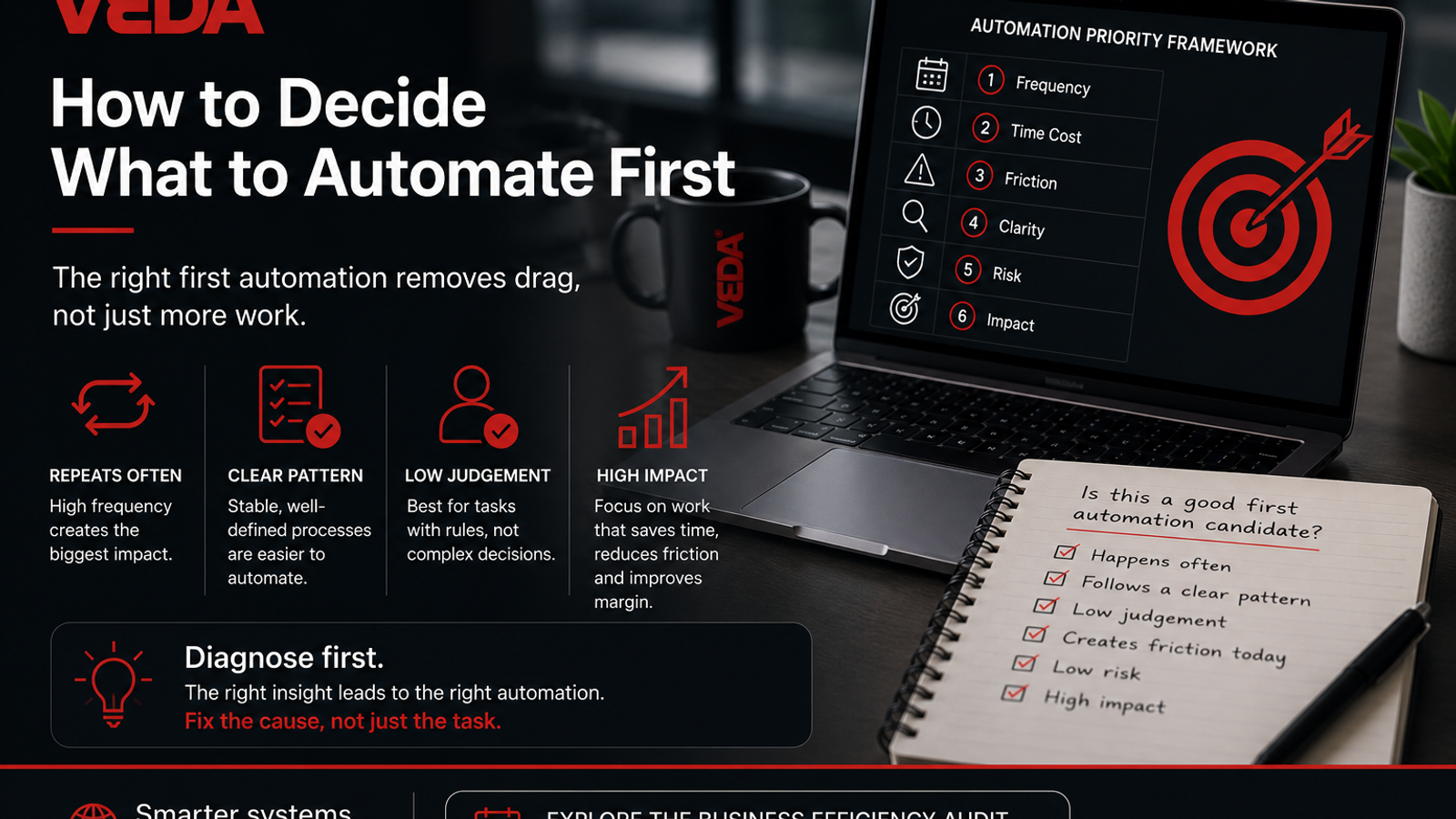
How to Decide What to Automate First
Not sure what to automate first? Here’s how growing SMEs can prioritise automation by frequency, friction, clarity, risk and impact — and why diagnosing the workflow beats starting with a tool.
10 min read · 18 June 2026
Systems & Operations
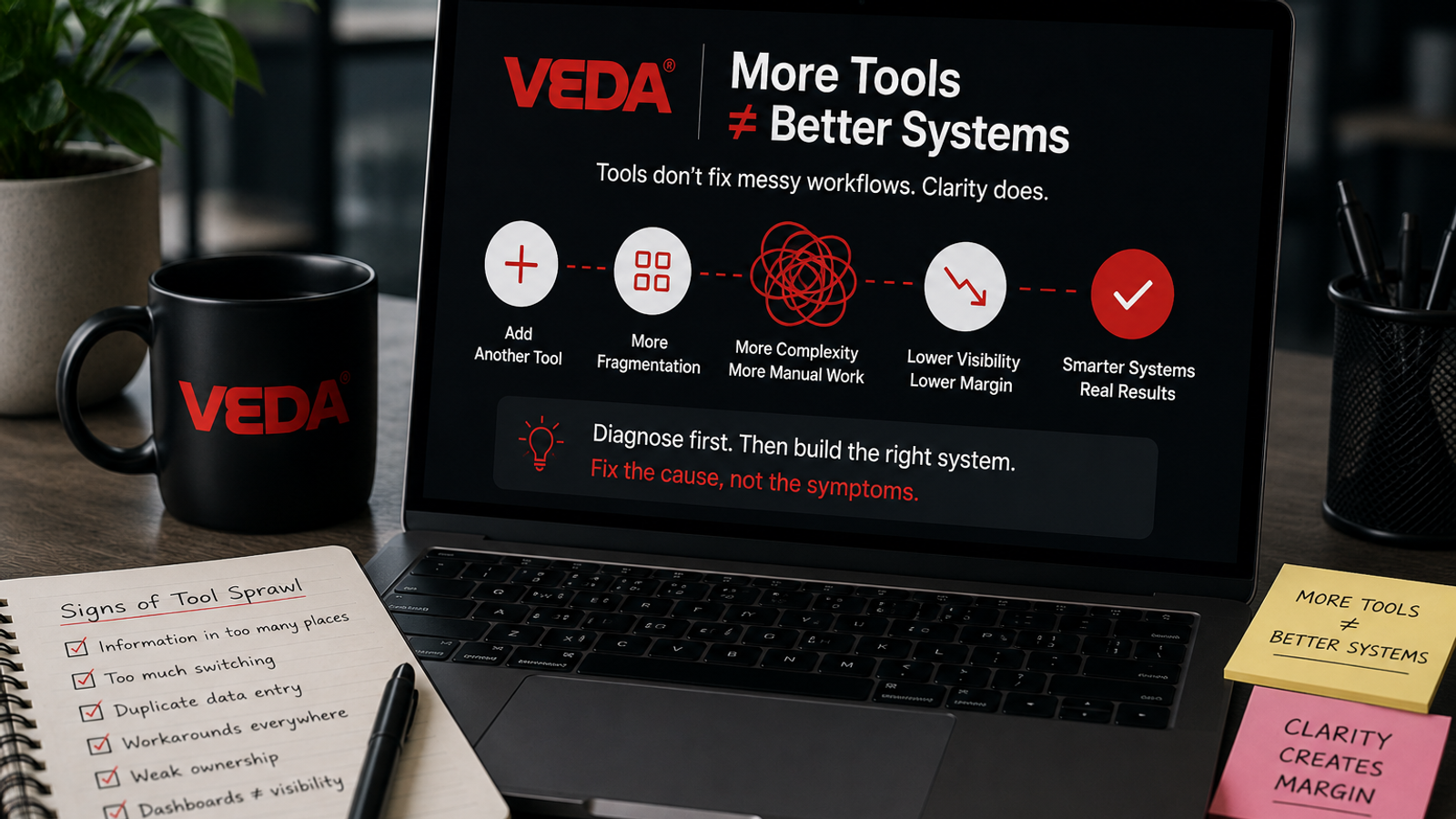
Why More Tools Don’t Always Create a Better System
More software does not always mean a better system. Here’s why growing SMEs end up with tool sprawl, fragmented workflows and dashboards that mask poor visibility — and what to diagnose before buying another platform.
10 min read · 18 June 2026

Business Efficiency
What Is a Business Efficiency Audit?
A Business Efficiency Audit helps growing SMEs find where time, margin and clarity are being lost — then decide which workflows, systems or automation to fix first. Here’s what it looks at, what you get, and when it’s the right place to start.
8 min read · 18 June 2026
Automation & AI
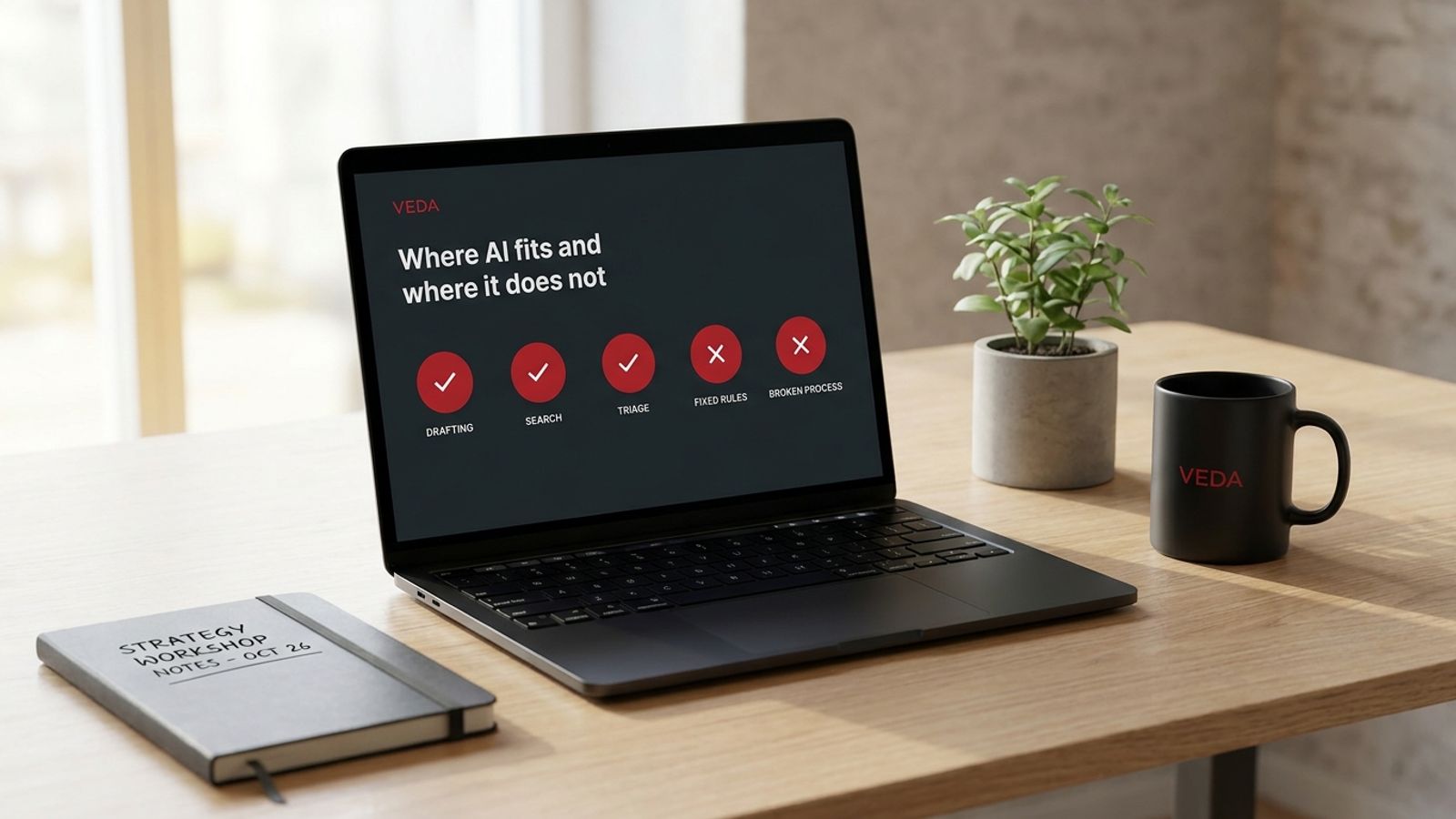
Practical AI Adoption for SMEs: Where It Fits, and Where It Doesn't
AI helps in some parts of an operational SME and is the wrong tool in others. This grounded guide separates the noise from the practical question: where AI genuinely fits, where it does not, and how to adopt it without making your operation more complicated.
8 min read · 24 June 2026
Get Veda AI Edge.
Practical briefings on AI adoption, automation, intelligent products and AI-assisted search — what changed, why it matters and what to consider next. No hype, no AI theatre.
By joining you agree to receive Veda AI Edge from Veda AI. Unsubscribe any time.
Ready to find what’s worth fixing?
Start with a short call.
We’ll help you work out whether the right next step is the guide, the £995 + VAT Business Efficiency Audit, or a scoped implementation conversation.