Practical AI training for SME teams: turn a session into useful working habits
Plan role-specific AI practice, safe approved use, output checking and follow-up so training fits the people doing the work.
Choose a real task before choosing a training format
Start with the work people already do and one capability you want them to use better. A customer-service colleague practising a first response needs different examples from an operations manager checking a document summary. Generic demonstrations can show a tool exists without showing how it belongs in the job.
Describe a useful outcome and its limits. The goal may be a draft a colleague can safely check and edit, not unattended messages to customers. Name who approves the workflow and what remains a human decision.
Set the boundaries before the exercise
Explain which tools and accounts are approved, what information may be used and where output must be checked. Practise with synthetic examples unless the organisation has established appropriate handling for the real information. Do not ask staff to paste customer or commercially restricted material into a tool simply to make a demonstration more realistic.
ICO guidance on AI and data protection is relevant to workflows involving personal information. It does not endorse a particular tool or make every AI exercise lawful. Your organisation needs to understand the actual purpose, data and controls before use.
Practise the whole working habit
A useful exercise includes the input, the instruction, the output and the acceptance check. Show staff how to identify missing context, unsupported statements and a result that does not match the source. Give them permission to reject an answer rather than treating a polished response as authority.
For a fictional enquiry-response exercise, prepare a synthetic message and an approved set of service facts. Ask the colleague to produce a draft, check every factual commitment and decide what needs a person. The aim is a repeatable checking habit, not a competition to generate the longest prompt.
Give the workflow an owner and a support route
Write a short procedure that staff can find when doing the task. Include the approved inputs, checking steps, who to ask and what to do when the tool produces an unsuitable result. Ownership matters when the tool, service facts or process changes.
Ask the people using the workflow which part remains slow or confusing. A training problem may actually be an access issue, missing information or a poorly defined handover. Additional training alone will not repair that operating constraint.
Follow up using observed work
Check whether the habit is being used, whether output quality is acceptable and whether the whole task takes less effort. Keep training attendance separate from adoption and realised business benefit. A short follow-up with representative examples is more informative than assuming a completed session changed the operation.
The partnership tiers include team AI training twice a year on Foundation, quarterly on Growth and monthly on Leader. Choose the tier around the complete delivery and review arrangement, not training frequency alone. Training supports an agreed improvement programme; it does not promise that every staff member or task will use AI.
Bring one useful task to the first conversation
A free AI Strategy Call is a practical starting point if you want to discuss where AI fits the team. Bring a recurring task, the people involved and the decisions that need checking. You do not need to select a tool first.
Business Improvement Partnership onboarding is included in the monthly fee. A separate £995 plus VAT Business Efficiency Audit remains optional if you want a standalone diagnosis. The partnership begins with a three-month commitment, then rolling monthly. Cancellation requires 30 days’ written notice, effective at the end of a monthly billing period after the initial term.
Sources and further reading
Related insights.
Business improvement
How to measure automation ROI: saved hours are not always cash savings
Build a realistic automation business case by separating recovered capacity, actual avoided costs, recurring costs and observed adoption.
5 min read · 9 October 2026
Business improvement
Business Efficiency Audit or ongoing partnership: where should you start?
Choose between an optional standalone diagnosis and an ongoing improvement partnership with included onboarding and monthly delivery.
5 min read · 9 October 2026
AI Search & Visibility
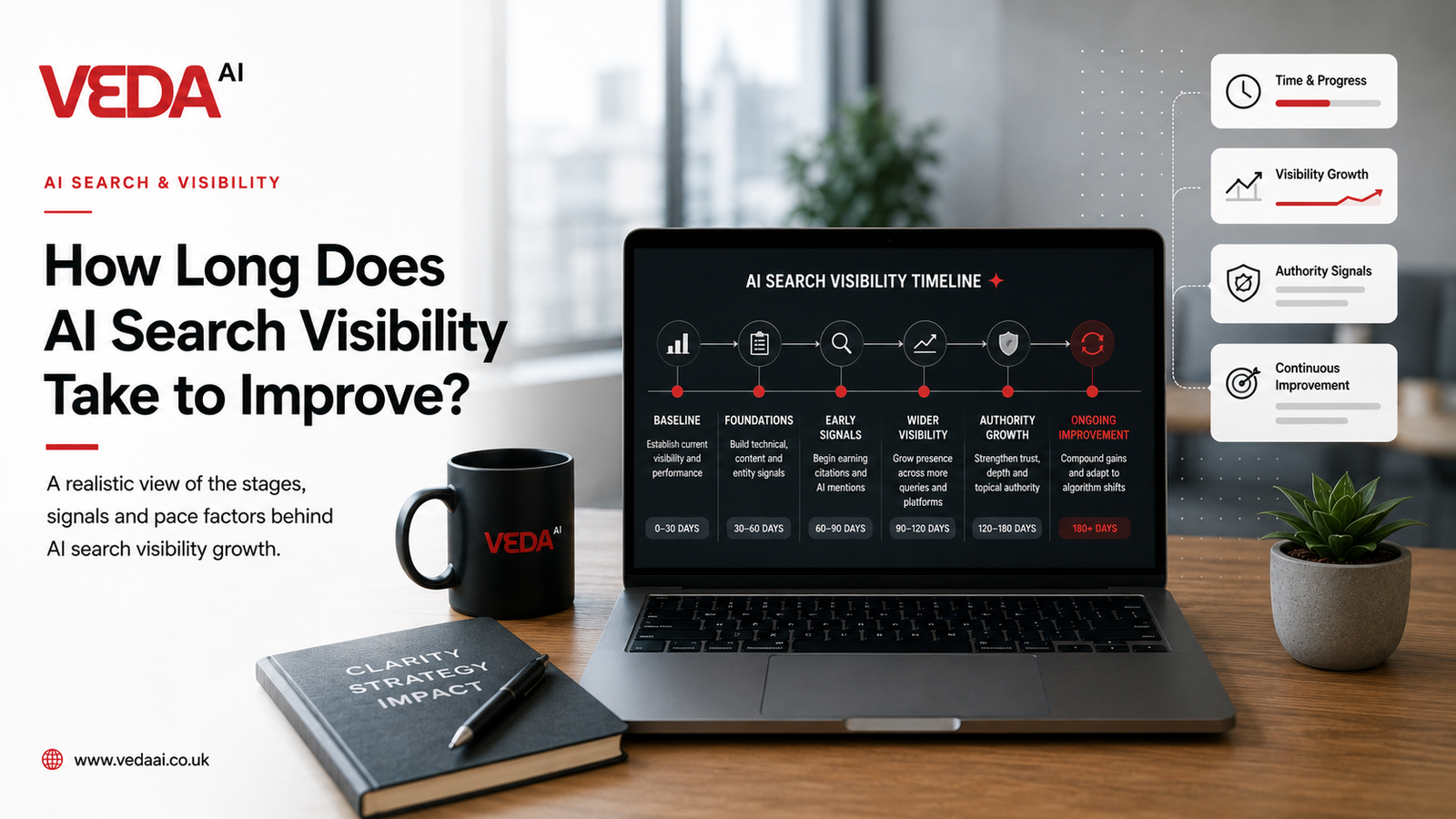
How Long Does AI Search Visibility Take to Improve?
The honest answer is that it depends on five things — and that the early signals are visible long before the commercial ones.
9 min read · 1 August 2026
Get Veda AI Edge.
Practical briefings on AI adoption, automation, intelligent products and AI-assisted search — what changed, why it matters and what to consider next. No hype, no AI theatre.
By joining you agree to receive Veda AI Edge from Veda AI. Unsubscribe any time.
Ready to find what’s worth fixing?
Turn the idea into steady improvement.
Work alongside a team that helps you prioritise and deliver AI, automation and software changes each month. Explore the Business Improvement Partnership or discuss the business on a free call.