Signs Your Growing Business Is Quietly Leaking Time and Margin
Working hard, staying busy, maybe even growing — yet the business feels heavier to run than it should. The leak is quiet because no single number shouts about it. Here are the everyday signs that time, margin and visibility are draining away, and the calm first step to seeing where.

Most growing businesses know when something feels off. The work gets done, the customers are looked after, revenue might even be climbing — and yet the business feels heavier to run than it should.
That heaviness rarely shows up as a single bad number. Nobody hands you a report titled "this is where you are losing money." Instead it leaks out in small, everyday ways: a job that waits on one person, a quote that takes too long to put together, an afternoon lost to chasing information that should have been one click away.
This is a self-check, not a sales pitch. Below are the common signs of business inefficiency we see in operational SMEs — trade, production, signage, print, fabrication, installation-led businesses and the like. If several of them feel familiar, the problem is almost never effort. It is how the work flows.
Why the leak is so quiet
Time, margin and visibility tend to leak in tiny increments. Five minutes re-keying an order. Ten minutes finding the right file. A job sitting in someone's inbox over the weekend because only they can approve it.
None of those moments is alarming on its own. That is exactly why it is hard to spot. The cost is spread thinly across every week, every person and every job, so no single event ever shouts loudly enough to get fixed.
The signs below are how that quiet drain becomes visible. Read them as symptoms, not verdicts. Symptoms are useful precisely because they point you towards a cause you can actually do something about.
Sign 1: You are busy but margins are flat or tightening
This is the one that confuses owners most. The diary is full, the team is stretched, turnover is holding up or even growing — and somehow the money at the bottom is not moving in the same direction.
When effort is high but margin is flat, the gap is usually being eaten somewhere between winning the work and delivering it. Rework, waiting, chasing, duplicate admin and small errors all sit in that gap and none of them appear on an invoice.
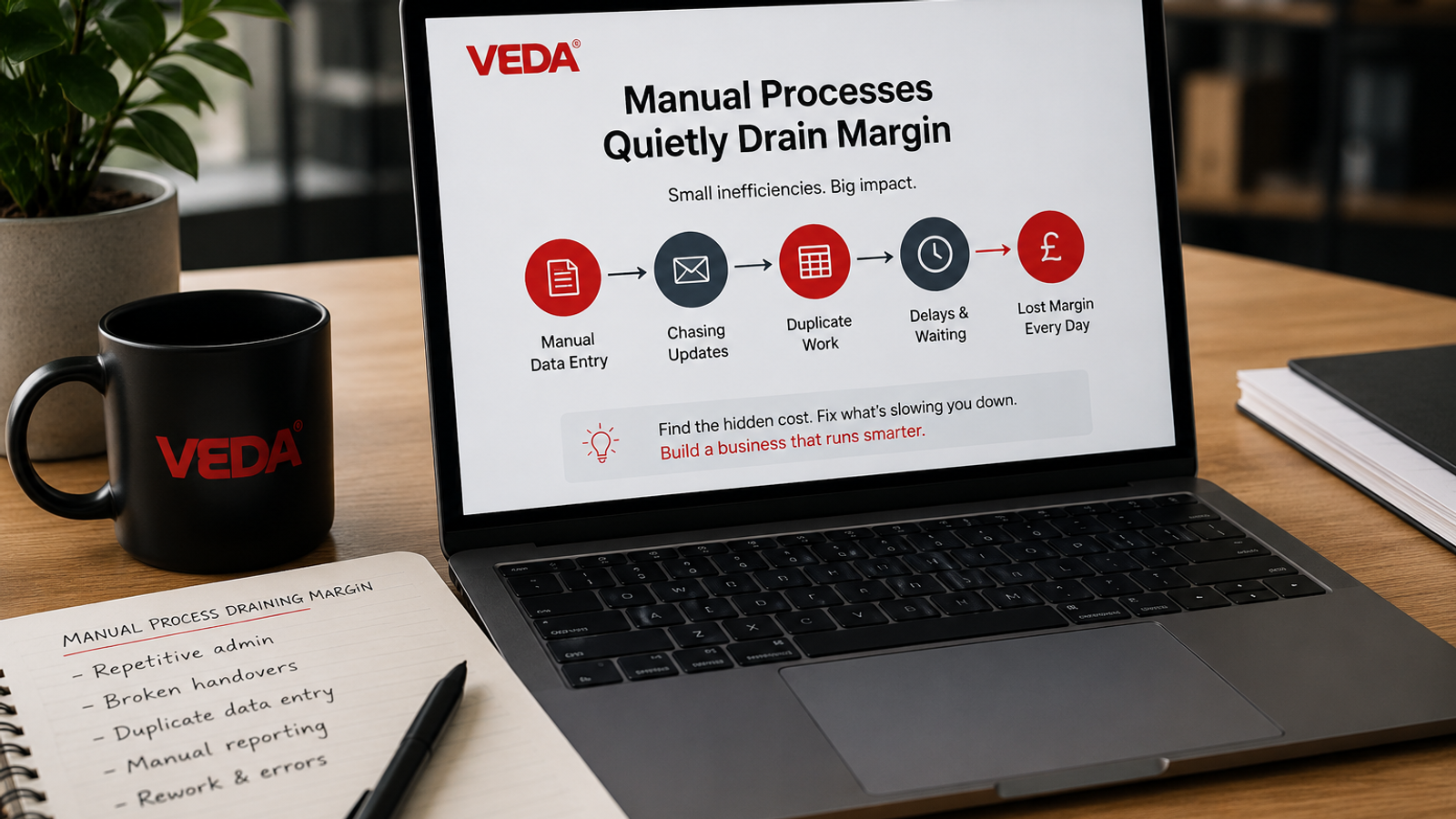
We have written separately about the mechanics of this — exactly where the money goes when work is done by hand. If margin is your main worry, start there: Where Manual Processes Quietly Drain Margin.
Sign 2: You keep fighting the same fires
Every business has the odd emergency. The warning sign is when the same emergency keeps coming back — the same supplier mix-up, the same missed handover, the same customer chasing the same update.
Recurring problems are not bad luck. They are a process telling you it has a gap in it. When a fire reappears on a regular basis, what you are really seeing is a step in the workflow that depends on someone remembering, rather than on the system making it hard to get wrong.
The tell is how the problem gets solved. If it is always solved by a person heroically stepping in, rather than by the process catching it, you will be solving it again next month.
Sign 3: Key information lives in people's heads or scattered files
Ask where the current status of a job actually lives and the honest answer is often: in Dawn's head, in a WhatsApp thread, on a printout by the machine, and in a spreadsheet someone updates when they remember.
This is a visibility problem, and it is one of the clearest signs of business inefficiency because it quietly taxes everything else. When there is no single source of truth, people spend real time reconciling versions, asking each other questions and double-checking what is current.
It also makes the business fragile. If the one person who knows is off sick or on holiday, the work slows down — not because nobody is capable, but because nobody can see.
Sign 4: The same data gets typed in more than once
Watch how a single job moves through your tools. A customer's details get entered into the quoting system, then again into the job sheet, then again into the accounts package, then again into the spreadsheet you use to track delivery.
Manual re-keying, double entry and copy-paste between systems are some of the most reliable signs that your tools are not actually joined up. Each hop is a few minutes lost and a fresh chance for a typo, a wrong price or a missed line.
If you find yourself maintaining the same information in several places, that is not diligence. It is a workflow asking to be connected.
Sign 5: Work stalls at the handovers
Look at where jobs actually sit and wait. It is rarely while someone is working on them. It is in the gaps between people — waiting for an approval, waiting for a drawing to be signed off, waiting for one person to pass the baton.
Handovers are where time goes to hide. A job can be "in progress" for days while doing nothing at all, because it is parked in a queue behind one busy person or one missing decision.
If your throughput depends on a single individual being available — to quote, to approve, to release a job — you do not have a capacity problem so much as a flow problem. Adding people often makes it worse, because it adds more handovers.
Sign 6: Quoting, ordering or scheduling is slow or inconsistent
The front end of an operational business is where a lot of margin is quietly decided. If quoting is slow, you lose work to whoever replied first. If quoting is inconsistent, you win some jobs you should have priced higher and lose some you priced out of fear.
The same goes for ordering and scheduling. When these depend on memory, gut feel or one person's spreadsheet, you get variation you cannot see — the same job priced two ways, the same material ordered late, the same week overbooked.
Consistency here is worth real money. The absence of it is one of the clearer signs of business inefficiency, because the cost lands directly on price and on delivery dates.
Sign 7: Simple questions need a spreadsheet to answer
Two questions tend to expose this. "Where is this job right now?" and "How are we doing this month?"
In a business with good visibility, you can answer both in a moment. In a business that is leaking, answering either one means someone has to stop, pull numbers from three places and build a spreadsheet to make sense of it — by which time the answer is already out of date.
If you cannot see where things stand without manual effort, you are running the business slightly blind. Decisions get made on the last thing you happened to hear, rather than on what is actually happening.
Sign 8: Growth has made things harder, not smoother
You would expect a bigger business to feel more capable. Often it feels more chaotic instead. More jobs, more people and more tools, but more friction with all of it.
That is because the informal ways of working that carried a smaller team do not scale. The shortcuts, the "just ask Steve", the shared mental model of how things get done — these quietly break as you add volume and headcount.
This is so common it deserves its own explanation, which we have written here: Why Growing SMEs Lose Time as They Scale. If your business feels harder to run than it did when it was smaller, you are not imagining it.
A quick self-check
Read back through the signs and count how many you recognise. Be honest rather than generous to yourself.
- Busy and stretched, but margins flat or tightening.
- The same problems and the same fires keep coming back.
- Key information lives in heads, chats and scattered files.
- The same data gets typed into more than one system.
- Jobs wait at handovers, approvals or one key person.
- Quoting, ordering or scheduling is slow or inconsistent.
- Simple status and performance questions need a spreadsheet.
- Growth has added friction rather than removing it.
One or two on their own might just be a busy patch. Several at once is a pattern, and the pattern is the point. When this many things feel true, the issue is rarely how hard your team works. It is how the work flows between people, tools and steps.
The good news: these are diagnosable
The reason this matters is that everything above is a symptom of something specific and findable. You are not facing a vague mood of "things are hard." You are facing a set of concrete points where time, margin and visibility leak out — and those points can be located.
The mistake most owners make here is to jump straight to a fix. New software, a new hire, a new tool someone recommended. That is guessing. If you do not yet know where the biggest leaks are, you can spend money and effort solving the wrong problem and still feel the heaviness.
The better order is to get a clear picture first, then fix the things that actually matter. That is the whole reason the Business Efficiency Audit exists — to turn a felt-but-fuzzy sense of friction into a specific, prioritised view of where the work is breaking down.
SportVision is one example: a review that turned a felt-but-unclear sense of friction into a prioritised, roadmapped picture. You can read how that played out in their review.
Only once the picture is clear does it make sense to talk about fixes. That is when automation and smarter systems do their best work — applied to the specific steps that are costing you, rather than bolted on in the hope they help.
A calm next step
If several of these signs landed, you do not need to overhaul everything tomorrow. You need to see clearly first. A Business Efficiency Audit gives you that picture — where time and margin are actually leaking, and what is worth fixing first — before you change a single tool or process.
Working hard is not the problem. Working through friction you cannot see is. Naming it is where it starts to get lighter.

Written by
Rian Patel
Founder, Veda AI
Rian Patel is the founder of Veda AI, helping growing SMEs improve business efficiency with practical AI, automation and smarter systems.
Related insights.
Business Efficiency
Where Manual Processes Quietly Drain Margin
Manual processes can quietly drain margin through duplicated admin, broken handovers, poor visibility and rework. Here’s where the drag really sits, why it compounds as you grow, and what to fix first.
9 min read · 18 June 2026

Business Efficiency
Why Growing SMEs Lose Time as They Scale
Growing SMEs often lose time as workflows, systems and handovers fail to keep up. Here’s where operational drag really comes from as you scale — and how to diagnose what to fix first, before reaching for more tools, hires or AI.
8 min read · 18 June 2026
Get Veda AI Edge.
Practical briefings on AI adoption, automation, intelligent products and AI-assisted search — what changed, why it matters and what to consider next. No hype, no AI theatre.
By joining you agree to receive Veda AI Edge from Veda AI. Unsubscribe any time.
Ready to find what’s worth fixing?
Start with a short call.
We’ll help you work out whether the right next step is the guide, the £995 + VAT Business Efficiency Audit, or a scoped implementation conversation.