Where Manual Processes Quietly Drain Margin
Manual processes can quietly drain margin through duplicated admin, broken handovers, poor visibility and rework. Here’s where the drag really sits, why it compounds as you grow, and what to fix first.
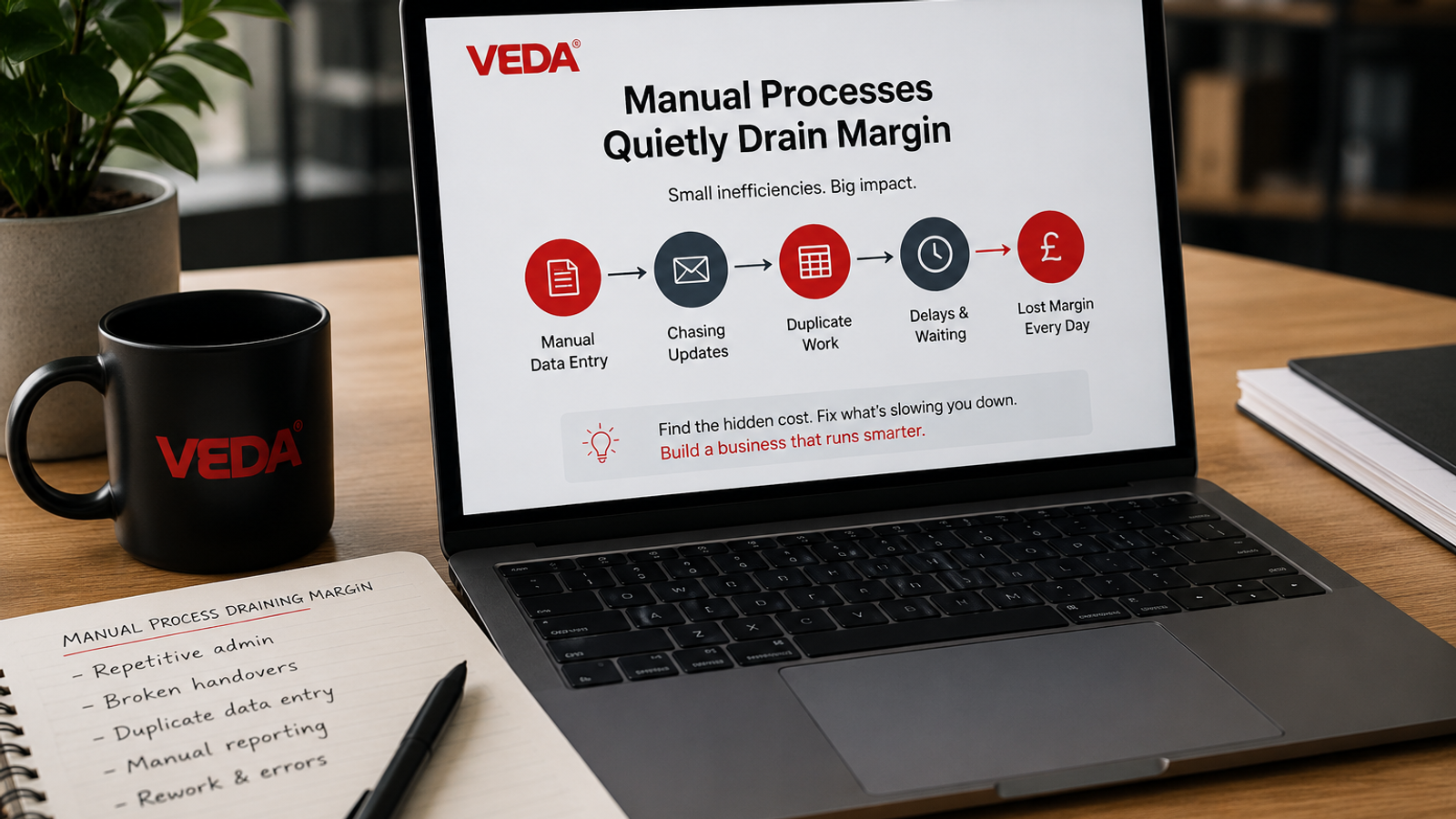
Most businesses do not lose margin in one dramatic moment.
It usually happens quietly.
A few extra minutes here. A duplicated step there. A delay nobody notices at first. An update that has to be chased manually. Information copied from one place to another. A mistake that creates rework. A job that takes longer to get out the door because someone is still waiting on confirmation, a file, a handover, or the latest version of something.
None of it looks huge on its own.
That is exactly why it gets missed.
Manual processes rarely announce themselves as a major commercial problem. They tend to sit in the background of the business as “just the way we do things”, quietly absorbing time, energy and margin week after week.
Manual work is not always the problem — unnecessary manual work is
Every business has manual work in it.
That is normal.
Not everything should be automated. Not everything needs software. Not every task can or should be turned into a system.
The real issue is when manual work exists because the workflow around it is weak.
That is when businesses start carrying avoidable effort:
- copying and pasting the same information between tools
- checking the same thing more than once
- chasing updates that should already be visible
- re-entering data
- relying on inboxes or spreadsheets to bridge gaps between systems
- repeating tasks because the process is unclear or inconsistent
At that point, manual work stops being a necessary part of running the business and starts becoming a drag on performance.
Why manual processes are so often underestimated
Manual processes are easy to normalise.
They usually grow gradually. A workaround gets added. Then another. A spreadsheet appears because the system does not quite do what the team needs. Someone becomes the person who knows how to “make it work”. A few extra checks get added because confidence in the process is low.
Nothing feels catastrophic.
But over time, the business builds layers of effort around problems it never properly solved.
That is what makes manual-process drag so expensive. The cost is spread across lots of people, lots of small actions and lots of ordinary days.
It does not always show up neatly on a profit and loss sheet as “margin lost through messy workflows”.
It shows up as:
- more labour than expected
- slower delivery
- lower capacity
- inconsistent output
- leadership time pulled into low-value tasks
- stress inside the operation
- work taking longer than it should
Where manual processes usually start draining margin
The exact pattern differs from business to business, but there are a few common places where manual effort becomes expensive.
1. Repetitive admin
This is often the most obvious one.
Tasks that are repeated daily or weekly can become surprisingly expensive when they are still being handled manually long after the business has grown.
Examples might include:
- copying enquiry details into multiple systems
- manually creating updates or reminders
- transferring job information between teams
- updating spreadsheets by hand
- sending routine progress emails one by one
- manually logging status changes
Each individual task may seem harmless.
But repeated across weeks, months and team members, the cost becomes very real.
2. Broken handovers
A lot of businesses lose time and margin not within tasks, but between them.
Sales hands something to operations. Operations hand something to delivery. Delivery waits for confirmation. Finance is missing information. A manager has to chase three people before the work can move.
That is all manual cost.
And because it often appears as waiting, checking or clarifying rather than “doing”, it is easy to overlook.
Broken handovers are one of the clearest signs that the workflow itself needs attention.
3. Duplicate data entry
If the same information has to be entered in more than one place, or if teams are maintaining parallel versions of the truth, the business is carrying avoidable cost.
Duplicate entry creates:
- wasted time
- inconsistent records
- higher error risk
- more reconciliation work later
It also creates hidden friction between teams, because nobody is quite sure which version is current.
4. Manual reporting and visibility checks
A surprising amount of management time gets spent on simply finding out what is happening.
That might mean:
- chasing status updates
- manually compiling reports
- asking multiple people for information
- pulling data from different places just to understand performance
- checking whether work has actually progressed
When basic visibility depends on manual effort, the business is losing time before it has even started solving the actual problem.
5. Rework caused by unclear or inconsistent processes
Manual-process cost is not only about time spent doing a task.
It is also about the extra work created when the process is fragile.
That may include:
- missing information
- incomplete job handovers
- avoidable mistakes
- tasks being done twice
- jobs needing correction later
- teams working from outdated details
This kind of margin drain is especially frustrating because it often feels like hard work is happening, but the business is still not moving cleanly.
Why this becomes a margin problem, not just a time problem
Some businesses see manual-process issues as purely operational.
But the effect is commercial.
If a process takes longer than it should, the business is paying for extra labour.
If a task has to be redone, the business absorbs extra cost.
If delivery slows down, capacity gets squeezed.
If managers are constantly chasing or checking, leadership time is being spent on coordination instead of growth, customers, quality or improvement.
That is where margin starts leaking.
It is not always dramatic. It is cumulative.
And the more the business grows without fixing the underlying drag, the more that leakage compounds.
More effort is often hiding weaker systems
One reason businesses miss this problem is that the team is still coping.
People are finding ways to get the work done.
But effort is not the same thing as efficiency.
A hardworking team can still be operating inside a system that makes everything more expensive than it should be.
That is why “the team is busy” is not the same as “the business is running well”.
Sometimes a busy team is actually a sign that the business is carrying too much manual load.
The answer is not always to automate everything
This matters.
When businesses realise manual work is costing them money, they sometimes jump too quickly to automation.
But a weak process does not automatically become a strong one just because part of it is automated.
If the workflow is unclear, if ownership is messy, or if the information moving through the process is inconsistent, automation can simply make the wrong process run faster.
The better question is:
Which manual tasks are necessary, which are avoidable, and what is causing them to exist in the first place?
Sometimes the answer is process redesign.
Sometimes it is better visibility.
Sometimes it is clearer ownership.
Sometimes it is automation.
Sometimes it is software.
The point is that the fix should match the problem.
Signs manual processes may be quietly draining margin in your business
A lot of SMEs recognise this issue only when they step back and look at the pattern.
Common signs include:
- people copying information between systems
- too much reliance on spreadsheets or inboxes
- managers spending too much time chasing updates
- the same questions being asked repeatedly
- jobs slowing down between teams or stages
- avoidable rework happening regularly
- the founder or leadership team still acting as the operational glue
- more work coming in without a clear increase in capacity or margin
- a constant feeling that the team is busy, but the operation is still heavier than it should be
If several of those are true, manual-process drag is probably already costing more than it appears.
What better looks like
Better usually does not mean a perfectly automated business.
It means a business where:
- the workflow is clearer
- handovers are stronger
- information is easier to see
- repetitive effort has been reduced where it makes sense
- systems support the real process
- people are spending less time compensating for weak structure
In that kind of environment, margin improves not because the team suddenly works harder, but because the business stops carrying so much avoidable friction.
The first step is to find where the drag really sits
This is where many businesses go wrong.
They can feel the inefficiency, but they have not yet diagnosed it properly.
So they react to symptoms:
- buy another tool
- hire another person
- patch another gap
- add another check
- automate a task without addressing the workflow behind it
That can create movement, but not always improvement.
A better starting point is to identify:
- where the manual effort is happening
- why it exists
- what it is costing
- what should be fixed first
That is why a Business Efficiency Audit is often the right first move.
It helps uncover where manual effort is quietly draining time and margin, and what kind of change will actually make a difference.
Final thought
Manual processes do not always look dangerous.
That is what makes them expensive.
They sit inside normal work, normal habits and normal routines, slowly making the business heavier, slower and less profitable than it should be.
If the operation feels more effortful than it ought to, there is a good chance the business is not just carrying workload. It is carrying avoidable manual drag.
And until that drag is made visible, it will keep costing margin quietly in the background.
Want to find where manual effort is really costing the business?
If your team is busy, the process feels heavier than it should, or manual work keeps creeping into places it should not be, the best next step is to start with a Business Efficiency Audit.
It helps uncover where time, visibility and margin are being lost — and what to fix first.

Written by
Rian Patel
Founder, Veda AI
Rian Patel is the founder of Veda AI, helping growing SMEs improve business efficiency with practical AI, automation and smarter systems.
Related insights.

Business Efficiency
Why Growing SMEs Lose Time as They Scale
Growing SMEs often lose time as workflows, systems and handovers fail to keep up. Here’s where operational drag really comes from as you scale — and how to diagnose what to fix first, before reaching for more tools, hires or AI.
8 min read · 18 June 2026

Automation & AI
How to Decide What to Automate First
Not sure what to automate first? Here’s how growing SMEs can prioritise automation by frequency, friction, clarity, risk and impact — and why diagnosing the workflow beats starting with a tool.
10 min read · 18 June 2026

Business Efficiency
What Is a Business Efficiency Audit?
A Business Efficiency Audit helps growing SMEs find where time, margin and clarity are being lost — then decide which workflows, systems or automation to fix first. Here’s what it looks at, what you get, and when it’s the right place to start.
8 min read · 18 June 2026

Business Efficiency
Signs Your Growing Business Is Quietly Leaking Time and Margin
Working hard, staying busy, maybe even growing — yet the business feels heavier to run than it should. The leak is quiet because no single number shouts about it. Here are the everyday signs that time, margin and visibility are draining away, and the calm first step to seeing where.
9 min read · 24 June 2026
Get Veda AI Edge.
Practical briefings on AI adoption, automation, intelligent products and AI-assisted search — what changed, why it matters and what to consider next. No hype, no AI theatre.
By joining you agree to receive Veda AI Edge from Veda AI. Unsubscribe any time.
Ready to find what’s worth fixing?
Start with a short call.
We’ll help you work out whether the right next step is the guide, the £995 + VAT Business Efficiency Audit, or a scoped implementation conversation.