Why Growing SMEs Lose Time as They Scale
Growing SMEs often lose time as workflows, systems and handovers fail to keep up. Here’s where operational drag really comes from as you scale — and how to diagnose what to fix first, before reaching for more tools, hires or AI.

Growth is usually meant to be a good sign.
More customers. More work. More opportunities. More momentum.
But for a lot of growing SMEs, growth does not always feel clean. It often feels heavier than expected.
What used to be manageable starts taking longer. Simple tasks suddenly involve more people. Information gets harder to track down. Admin increases. Decisions slow down. The team stays busy, but the business somehow feels less efficient, not more.
That is one of the most common patterns in growing businesses.
They are not failing. In many cases, they are doing well on the surface. But underneath that progress, time is being lost in ways that are easy to miss and hard to measure.
Growth creates complexity faster than most businesses expect
In the early stages of a business, a lot of things work because people are close to the work.
The founder knows what is happening. Team members can speak quickly. Jobs are easier to track. Information can live in someone’s head for a while without causing too much damage. Workarounds are irritating, but survivable.
Then the business grows.
There are more customers, more moving parts, more handovers, more exceptions, more follow-up, more pressure on delivery, and more need for people to stay aligned.
That is where the gap usually appears.
The business has grown, but the systems, processes and ways of working have not caught up at the same speed.
And that gap is where time starts disappearing.
Time loss in a growing business is rarely caused by one big issue
Most businesses do not suddenly lose time because of one dramatic problem.
It is usually the build-up of smaller inefficiencies across the business.
For example:
- people chasing updates manually
- duplicated admin between systems
- repeated questions because information is not visible
- handovers that rely on memory rather than process
- spreadsheets being used as temporary fixes for too long
- approvals taking longer because ownership is unclear
- delivery teams waiting on information from sales or operations
- founders stepping in to unblock issues that should not need them
Each of those may look minor on its own.
But together, they create a business that feels slower, heavier and more effortful than it should.
That is why the problem often goes unnoticed for so long. It does not arrive in one obvious moment. It builds gradually until the business starts to feel harder to run.
More work does not always mean more output
One of the most frustrating parts of this stage is that the business can feel extremely busy without becoming proportionately more productive.
People are working hard. The team may even be growing. But the increase in effort does not always create a matching increase in capacity, margin or control.
That is usually a sign that the issue is not just workload.
It is how the work is flowing.
When workflows are messy, tools do not support the actual process properly, and visibility is weak, growth creates more drag rather than more momentum.
In other words, the business is not just doing more work.
It is carrying more friction.
Why growing SMEs often adapt instead of fixing the root issue
A lot of SMEs are very good at adapting.
That is one of the reasons they survive and grow in the first place.
When something is inefficient, the team finds a workaround. Someone creates a spreadsheet. Someone else sends extra reminders. The founder keeps a mental checklist. A manager becomes the person who knows how to patch the gaps.
In the short term, that can work.
In the long term, it creates hidden dependency and hidden cost.
The business keeps moving, but only because people are compensating for weak workflows, unclear systems or missing structure.
That is where a lot of lost time sits.
Not in the official process, but in everything people are doing around the process to keep it functioning.
The most common reasons growing SMEs lose time
Every business is different, but a few patterns appear again and again.
1. Too many manual handovers
As the team grows, work passes between more people.
If those handovers are not clear, tracked and supported properly, time gets lost in:
- chasing
- clarifying
- re-explaining
- correcting
- checking whether something has actually moved forward
The work may be happening, but the movement is not always visible. That is where delays creep in.
2. Systems that do not match the workflow
A business can have plenty of tools and still have poor operational clarity.
That usually happens when tools have been added over time without enough thought about how the workflow actually works.
The result is often:
- duplicated data
- inconsistent updates
- too much switching between platforms
- partial visibility
- work happening outside the system in inboxes, chats or memory
The issue is not always a lack of software.
Sometimes the issue is that the software does not reflect how the business actually needs to operate.
3. Poor visibility
As complexity increases, leaders need better visibility, not more guesswork.
Without that, businesses lose time because:
- problems are found late
- decisions are made slowly
- managers spend time chasing updates
- teams do not know what is happening upstream or downstream
Poor visibility turns even simple work into a coordination problem.
4. Founders becoming the operational glue
This is extremely common.
At a certain stage, the founder is still:
- approving
- checking
- answering
- unblocking
- remembering
- deciding
That may feel responsible, but it often means the business is relying too heavily on one person to keep things moving.
That is not just exhausting. It is also inefficient.
It limits capacity, slows decisions, and makes the business harder to scale without constant founder involvement.
5. Workarounds becoming permanent
Temporary fixes are useful in the moment.
But a lot of businesses unknowingly build large parts of their operation on temporary fixes that were never meant to last.
A spreadsheet created for one urgent problem becomes the main tracker. A WhatsApp group becomes the handover system. A manual check becomes part of the process because nobody has had time to remove it.
Over time, those workarounds create fragility, inconsistency and wasted time.
Why hiring more people does not always solve the problem
When a business feels overloaded, the natural instinct is often to hire.
Sometimes that is the right move.
But if the real problem is operational drag, more people can simply mean:
- more communication
- more coordination
- more handovers
- more inconsistency
- more cost layered onto the same underlying friction
Hiring into a messy system does not automatically make the system better.
Sometimes it just makes the mess more expensive.
That is why the first question should not always be:
“Do we need more people?”
It is often:
“Where is the time actually going?”
What better looks like
The answer is not always AI.
It is not always automation.
It is not always software.
And it is definitely not always “work harder”.
Usually, better looks like:
- clearer workflows
- better visibility
- fewer manual handovers
- systems that match the real process
- less duplication
- clearer ownership
- better prioritisation of what to fix first
Once that clarity exists, it becomes much easier to decide where:
- process changes
- automation
- software
- or AI
can genuinely help.
That order matters.
If the business jumps straight to tools before understanding the drag, it can end up automating the wrong thing, buying software that does not fit, or adding complexity on top of an already messy operation.
Why this matters commercially
Lost time is not just an operational issue.
It becomes a commercial one very quickly.
When time is lost repeatedly across the business, it affects:
- delivery speed
- team capacity
- consistency
- responsiveness
- leadership focus
- margin
- confidence in decision-making
That is why growing businesses often feel pressure before they can clearly explain the source of it.
The business is moving, but it is carrying unnecessary drag.
And that drag compounds.
The first step is not guessing — it is diagnosing
A lot of SMEs try to solve these problems by jumping straight to a solution.
They buy another tool. They explore automation. They start talking about AI. They try to fix symptoms one by one.
Sometimes that helps.
But often, what is missing first is a clear diagnosis.
That is why a Business Efficiency Audit is such a useful starting point.
It helps uncover:
- where time is being lost
- where workflows are breaking down
- where systems are not supporting the business properly
- what needs fixing first
Without that clarity, businesses often spend money reacting to friction rather than removing its cause.
Final thought
Growing a business should not automatically make it harder to operate.
But for many SMEs, that is exactly what happens.
Not because the team is doing something wrong, but because complexity has outgrown clarity.
If the business feels busier, heavier and more difficult to run than it should, the issue may not be effort. It may be hidden operational drag.
And the sooner that drag is identified, the easier it becomes to fix the right things in the right order.
Want to find out where the time is going?
If your business is growing but the day-to-day operation feels more manual, more complex or harder to manage than it should, the best next step is to start with a Business Efficiency Audit.
It helps uncover where time is being lost, where the friction sits, and what to improve first.

Written by
Rian Patel
Founder, Veda AI
Rian Patel is the founder of Veda AI, helping growing SMEs improve business efficiency with practical AI, automation and smarter systems.
Related insights.
Business Efficiency
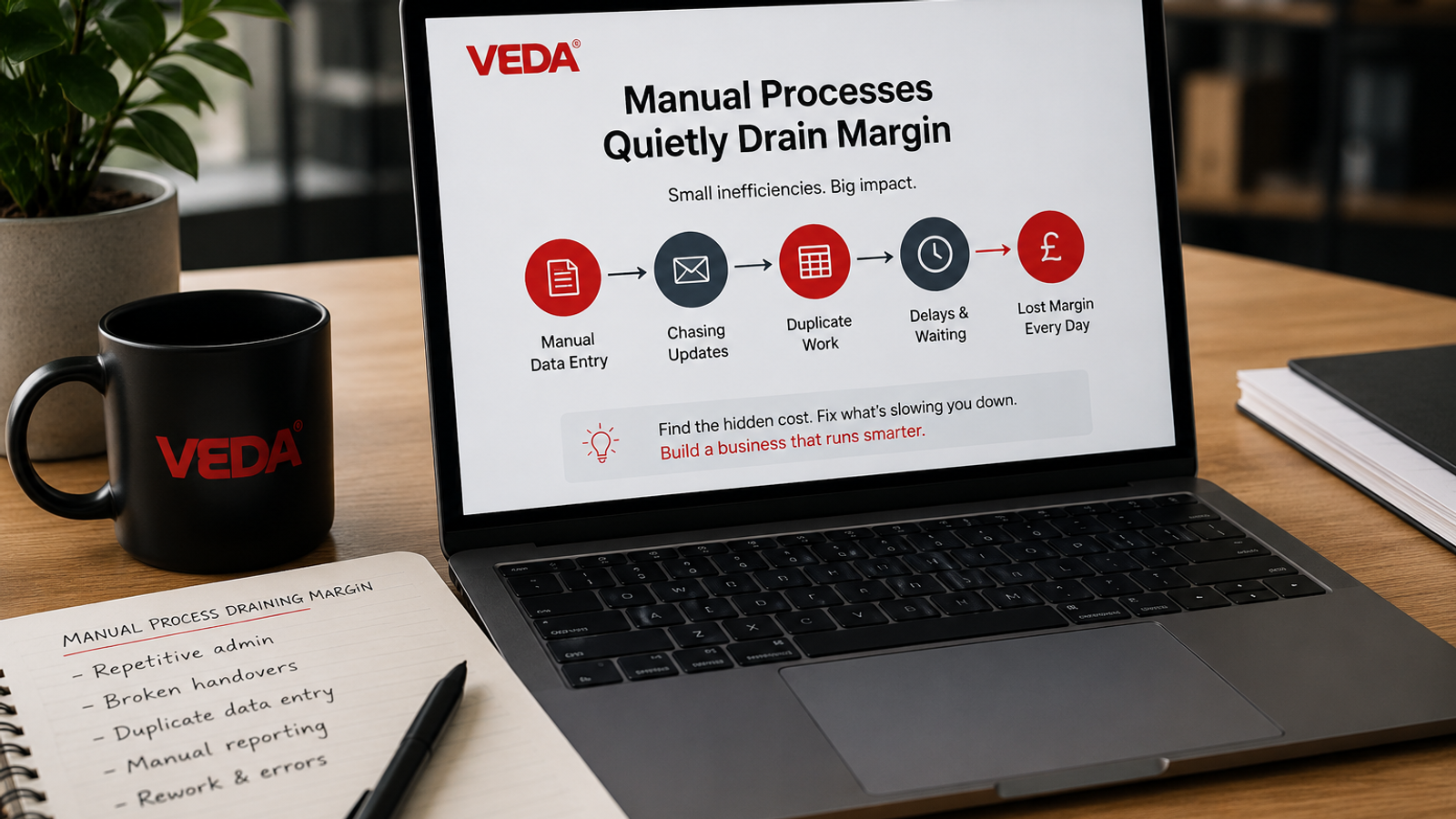
Where Manual Processes Quietly Drain Margin
Manual processes can quietly drain margin through duplicated admin, broken handovers, poor visibility and rework. Here’s where the drag really sits, why it compounds as you grow, and what to fix first.
9 min read · 18 June 2026
Systems & Operations
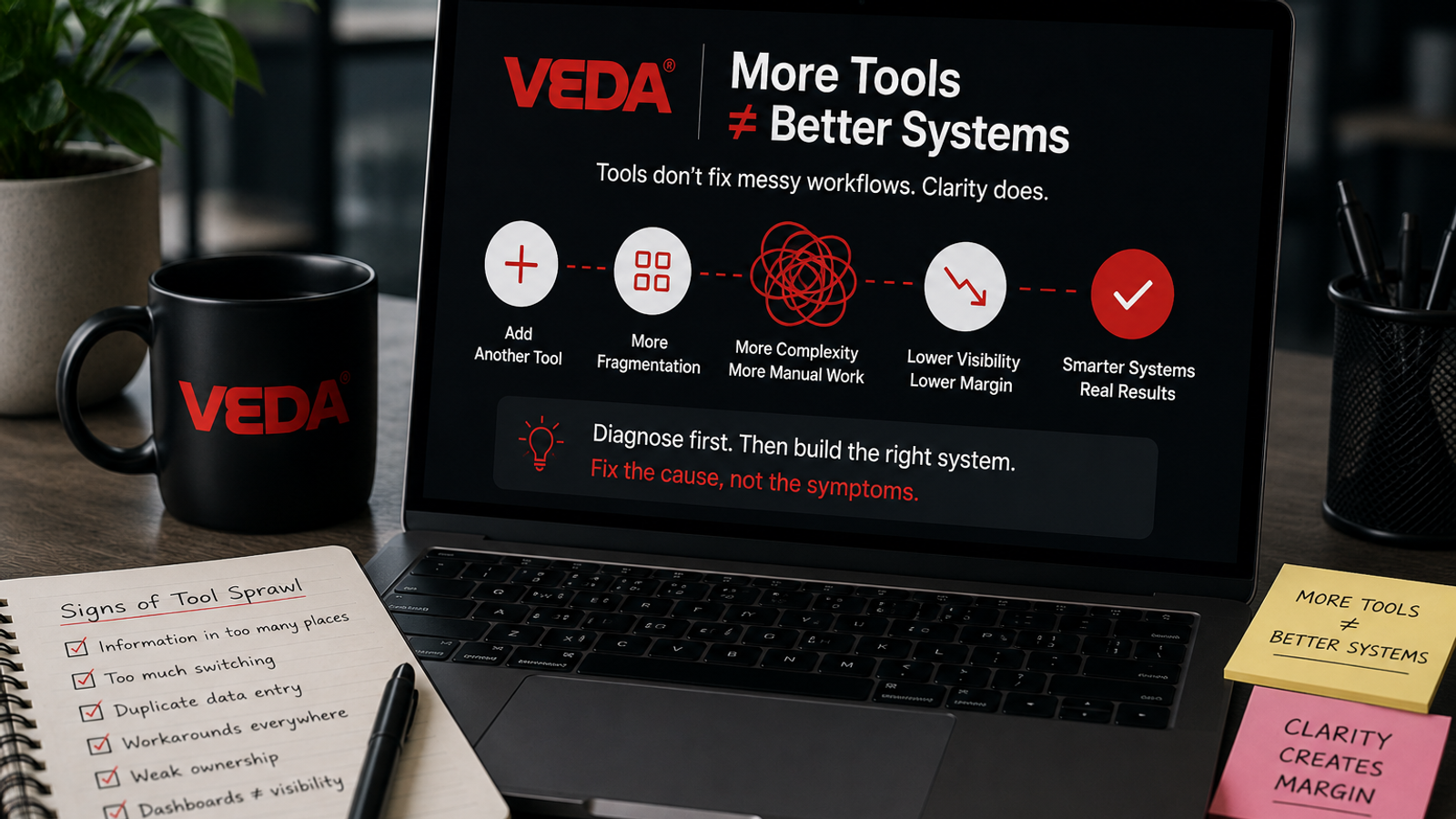
Why More Tools Don’t Always Create a Better System
More software does not always mean a better system. Here’s why growing SMEs end up with tool sprawl, fragmented workflows and dashboards that mask poor visibility — and what to diagnose before buying another platform.
10 min read · 18 June 2026

Business Efficiency
What Is a Business Efficiency Audit?
A Business Efficiency Audit helps growing SMEs find where time, margin and clarity are being lost — then decide which workflows, systems or automation to fix first. Here’s what it looks at, what you get, and when it’s the right place to start.
8 min read · 18 June 2026

Business Efficiency
Signs Your Growing Business Is Quietly Leaking Time and Margin
Working hard, staying busy, maybe even growing — yet the business feels heavier to run than it should. The leak is quiet because no single number shouts about it. Here are the everyday signs that time, margin and visibility are draining away, and the calm first step to seeing where.
9 min read · 24 June 2026

Business Efficiency
When Is a Business Process Review Actually Worth It?
You can feel the business could run better, but stopping to review how it works feels like effort you cannot spare. This guide helps you decide if and when a business process review is genuinely worth it, the signs it is time, and when to wait.
9 min read · 24 June 2026
Get Veda AI Edge.
Practical briefings on AI adoption, automation, intelligent products and AI-assisted search — what changed, why it matters and what to consider next. No hype, no AI theatre.
By joining you agree to receive Veda AI Edge from Veda AI. Unsubscribe any time.
Ready to find what’s worth fixing?
Start with a short call.
We’ll help you work out whether the right next step is the guide, the £995 + VAT Business Efficiency Audit, or a scoped implementation conversation.