What can you actually use a technology partnership for?
Illustrative uses for a partnership across enquiries, quoting, team handovers, management information and practical AI adoption.

An ongoing technology partnership can sound useful without making it obvious what your team would do with it. Does it mean building software? Getting advice about AI? Improving existing systems? Training staff?
Depending on the business need, it can involve all of those activities. The useful starting point is the work you want to make easier, more reliable or less costly to carry out.
Veda AI's Business Improvement Partnership brings consulting, AI and development into a monthly arrangement. Here are some illustrative ways that capacity could support a growing business, subject to investigation and agreed priorities.
Make enquiries easier to handle
A business may receive enquiries through a shared inbox, web forms and messages passed on by colleagues. Staff spend time working out who is responding and whether the customer has supplied enough information.
Partnership work could begin by understanding the enquiry journey and agreeing a clearer process. Useful changes might include better intake questions, a shared status and a connection to an existing customer system.
Where appropriate, AI could assist with a defined task such as preparing a draft response for someone to check. Whether that is worthwhile depends on the enquiry type, information available and level of judgement required.
The outcome to look for is a more dependable way to handle enquiries, with less avoidable chasing or repeated work.
Reduce the effort involved in quoting
Quotes can become slow when pricing information is difficult to find, calculations vary or approval depends on informal messages.
A partner can investigate those causes with the people preparing and approving quotes. The next useful change might be a consistent template, clearer approval rules, an integration or a calculation tool.
Testing matters because customer requirements and pricing exceptions rarely fit a single ideal example. Staff need to understand when the standard route applies and when someone must make a decision.
Review the effect on preparation time, corrections and waiting. Faster output is useful only if the quote remains accurate and commercially appropriate.
Improve handovers between teams
A sale becoming a job, a completed job becoming an invoice or a support request moving between departments can create repeated administration.
Information may arrive incomplete, be copied into another system or sit unnoticed while someone assumes another team is dealing with it.
A practical improvement could define the handover, identify the information required and make responsibility visible. Automation may then help move the work along or flag an exception.
The opportunity is broader than connecting two applications. It involves agreeing what should happen and making the systems support it. Reviewing the handover after introduction helps identify whether staff still need to fill gaps manually.
Make management information more useful
Managers may have access to plenty of data while still struggling to answer basic questions: which jobs are waiting, where capacity is tight or what needs attention this week?
Begin with the decisions the information should support. Then assess the relevant records, definitions and reporting process.
A useful first step could involve making an existing report dependable or reducing reconciliation, rather than commissioning a large dashboard. Where a new view is needed, test it against a real management question.
The relationship can then support further improvements as data quality develops and the business learns which information is useful in practice.
Help your team put AI to appropriate use
Staff may already be experimenting with AI without a shared view of suitable tasks, approved tools or how outputs should be checked.
An illustrative starting point could be a practical session around a particular role: preparing a first draft, summarising suitable material or organising information. The work should address what staff can use, which information is appropriate and where human judgement remains essential.
Follow-up can examine whether the approach fits the working day and whether guidance needs changing. Some tasks may prove unsuitable.
That makes staff capability part of business improvement, alongside automation and systems work. It also gives people a route to raise questions as they gain experience.
Investigate opportunities that need custom development
Some business problems will not be adequately served by configuring an existing product. A specialist workflow or an unmet customer need may justify custom software or a more specialised AI system.
Before making that investment, examine the requirement, alternatives, technical uncertainty and ongoing responsibilities. A substantial build may need several stages and capacity planned over a longer period.
An ongoing relationship can support that investigation and the work that follows, where agreed. It should also make it easier to identify when a simpler approach would meet the need.
The development decision should follow the value and feasibility of the opportunity.
Choose a starting point with enough value to matter
These examples are possible uses of a partnership, not a bundle of work promised within one month. The right sequence depends on your systems, priorities, available capacity and the contribution your team can make.
Look for a recurring problem that staff can demonstrate and leadership wants to resolve. Investigate it, agree a manageable improvement and decide how you will assess the result.
That creates a practical way to begin and a basis for choosing what comes next.
If you can recognise your business in several of these examples, explore Veda AI's monthly partnership options. Start the conversation with where work gets held up and what improvement would make a meaningful difference.
Related insights.

Business Efficiency
Technology retainer vs one-off project: which is right for your business?
Compare a defined project with an ongoing partnership and understand when continuity, monthly capacity and connected priorities can help your business.
5 min read · 19 October 2026
Business Efficiency
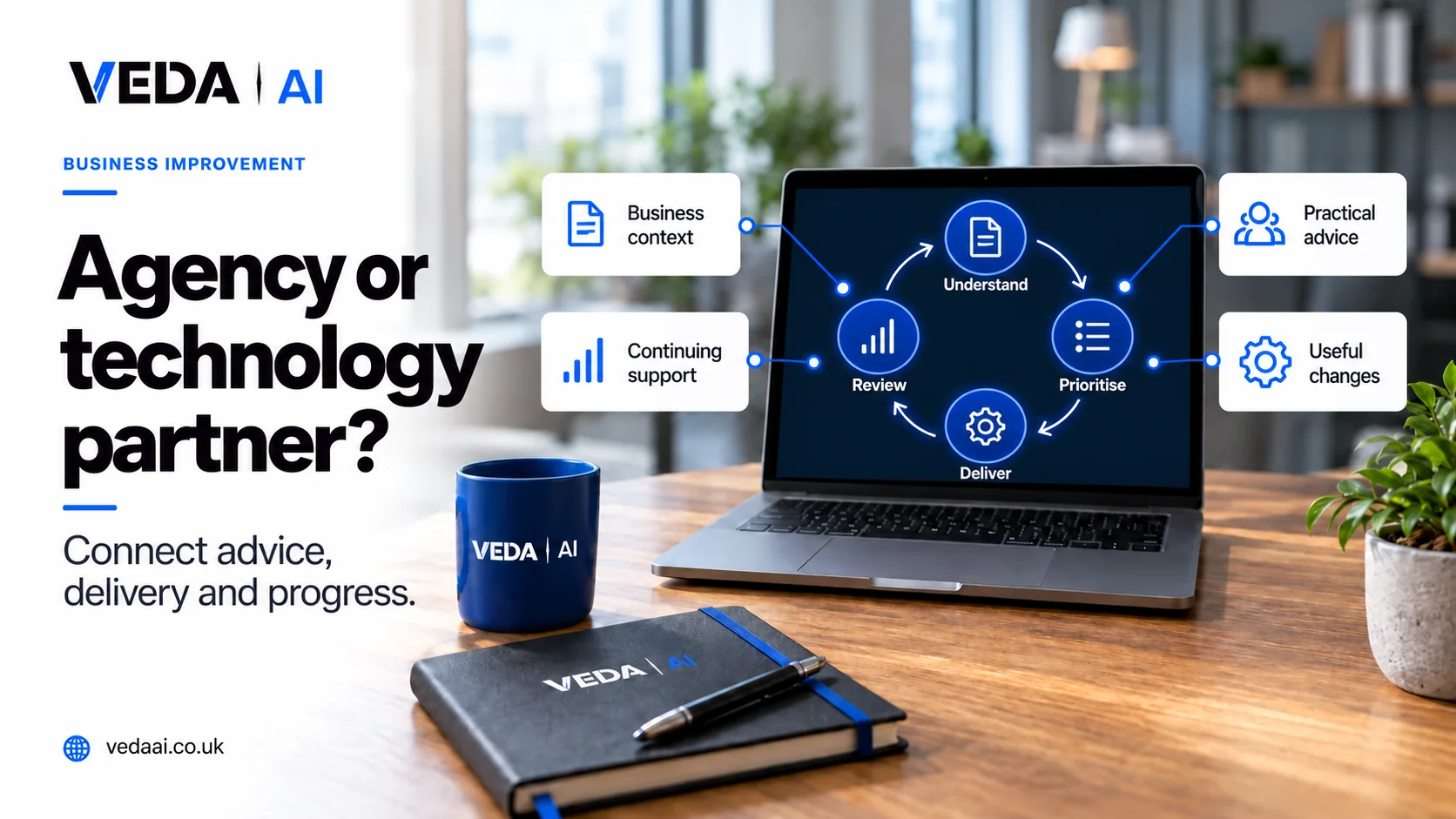
Software development agency or technology partner: what changes with an ongoing partnership?
Explore how an ongoing technology partnership connects practical advice, implementation and follow-through across changing business priorities.
5 min read · 19 October 2026
Business Efficiency
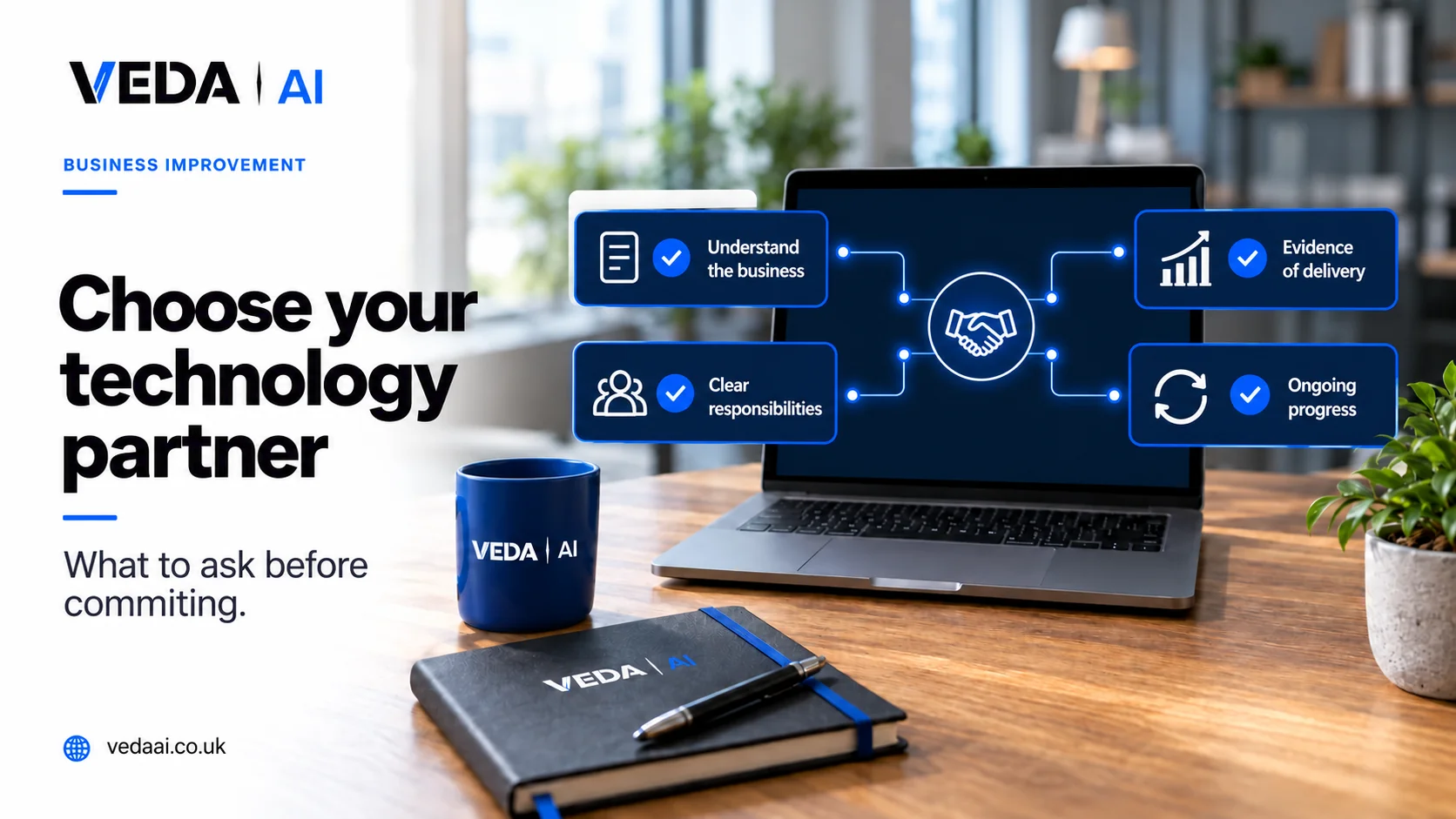
How to choose a technology partner for your business
The questions and evidence that help business owners choose a partner who can understand the operation and keep useful improvements moving.
5 min read · 19 October 2026
Get Veda AI Edge.
Practical briefings on AI adoption, automation, intelligent products and business improvement — what changed, why it matters and what to consider next. No hype, no AI theatre.
By joining you agree to receive Veda AI Edge from Veda AI. Unsubscribe any time.
Ready to find what’s worth fixing?
Turn the idea into steady improvement.
Work alongside a team that helps you prioritise and deliver AI, automation and software changes each month. Explore the Business Improvement Partnership or discuss the business on a free call.