What Can SMEs Actually Automate? Practical Examples
A practical catalogue of what growing SMEs can realistically automate — from quoting and order intake to dispatch and reporting — with grounded operational examples and what each is worth. Plus the part most pitches skip: automate a good process, not a broken one.

Most owners have already worked out that some of what their business does every day does not really need a person doing it. The quote that gets re-typed into the job system. The job number that gets written on a whiteboard, then a spreadsheet, then an email. The customer who phones to ask where their order is, because nothing told them.
The real question is not whether to automate. It is what you can actually automate that is worth the effort. Generic answers like "automate your business" are useless. You need concrete examples tied to the work you recognise.
This is a practical catalogue: the kinds of work that automate well, an operational example for each, and what it tends to be worth in plain terms. It is the companion to the harder question of where to start, which we cover separately.
What business processes can be automated, and what cannot
Automation suits work that is repetitive, rule-based, high-volume and low-judgement. If a task follows the same steps every time, with clear inputs and a predictable output, a machine can almost certainly do it more reliably than a busy person doing it between phone calls.
Where the work needs experience, negotiation or a judgement call, automation is the wrong tool. That is closer to where AI sits: handling language, drafting, summarising and the lighter judgement around the edges. The two often work together, but they solve different problems, and conflating them is how businesses end up with software that does not fit how they work.
A simple test before you automate anything: could you write down the rule a new starter would follow? If yes, it is a candidate. If the honest answer is "it depends, you have to know the customer," leave a person on it.
The categories worth automating, with grounded examples
These are the areas where operational SMEs — trade, print, signage, fabrication, installation-led businesses — tend to find the most obvious wins. None of them are exotic. They are the parts of the day that quietly eat time and create errors.
Quoting and estimating
If you produce quotes by hand each time — pulling material prices, adding labour, applying a margin, formatting it into a document — much of that is rules. A configured quoting flow can take the inputs (size, material, finish, quantity) and produce a consistent, priced quote in minutes rather than the back-of-the-van version that gets revised three times.
What it is worth: faster turnaround on enquiries, fewer pricing mistakes that quietly erode margin, and quotes that look the same whoever sends them. It also takes pressure off the one estimator everyone waits on.
Order intake and job creation
This is where a lot of operational drag hides. An order comes in by email, phone or a form, and someone re-types it into the job system, creates the job number, and tells production. Every step is a chance to mistype, miss a detail or lose a day.
The bigger move is to let ordering happen at the edge rather than through one central person. When customers or branches can place orders themselves into a structured system, the job is created cleanly at source and the bottleneck disappears.
That is exactly the shift in our work with Powerleague: a print ordering process that ran through a central bottleneck became decentralised, self-serve ordering, with jobs coming in clean and consistent. The case study has the detail.
What it is worth: less re-keying, fewer wrong orders going into production, faster job creation, and far less dependence on one person to keep the queue moving.
Data entry and re-keying between systems
If the same information lives in your accounts package, your job system and a spreadsheet, someone is keeping them in step by hand. That is pure, error-prone overhead. Connecting the systems so data flows once removes the re-typing entirely.
What it is worth: time back every week, numbers that actually agree across systems, and an end to the small discrepancies that take an afternoon to chase down.
Approvals, routing and handoffs
Think of a proof that needs sign-off before it goes to the machine, or a discount that needs a manager's nod. When that lives in someone's inbox, it stalls. A routing flow sends the right item to the right person, chases if it sits too long, and records the decision.
What it is worth: fewer jobs stuck waiting on an approval nobody noticed, a clear audit trail, and managers who are not the human bottleneck on every decision.
Status updates and customer notifications
A surprising amount of office time goes on telling people where their order is. "It is in production." "It is on the van today." "It is ready to collect." These follow the job status, so they can fire automatically as the job moves.
What it is worth: fewer interrupting "where is my order" calls, customers who feel kept in the loop, and staff who are not pulled off the work to answer the same question all day.
Scheduling and dispatch
Allocating jobs to fitters, vans or machines is partly judgement and partly rules. The rules part — availability, location, capacity, priority — can be handled automatically, leaving the human to make the calls that genuinely need a human.
What it is worth: tighter routing, fewer clashes, better use of the people and kit you already have, and less of the morning lost to working out who goes where.
Document generation
Job sheets, proofs, delivery notes, invoices — these are templates filled with data you already hold. Generating them automatically from the job record removes a fiddly, repetitive task and the typos that come with it.
What it is worth: consistent paperwork produced in seconds, fewer invoicing errors and delays, and a clean record attached to every job without anyone assembling it by hand.
Reporting and reconciliation
If someone spends Friday afternoon building the same management report, or matching deliveries against invoices line by line, that is rules-based work. Reports can be generated on a schedule, and reconciliations can flag only the exceptions that need a human eye.
What it is worth: visibility you get without paying for it in someone's time, and attention focused on the genuine mismatches rather than the ninety per cent that tie out fine.
Stock and reorder triggers
Running out of a common material mid-job is expensive and avoidable. When stock levels are tracked, reorder points can trigger purchase prompts automatically, so the order goes in before the shelf is empty rather than after.
What it is worth: fewer stoppages waiting on materials, less cash tied up in over-ordering as a safety net, and less reliance on one person remembering what is low.
The catch: automate a good process, not a broken one
Here is the part most automation pitches skip. Automating a bad process does not fix it. It just makes the mess happen faster, at scale, with less chance to catch it. If your quoting logic is inconsistent, automating it bakes the inconsistency in.
So the order of operations matters. Clarify and tidy the process first. Make sure the steps make sense, the rules are agreed, and the inputs are clean. Then automate the version that actually works — not the version that has built up by habit over years.
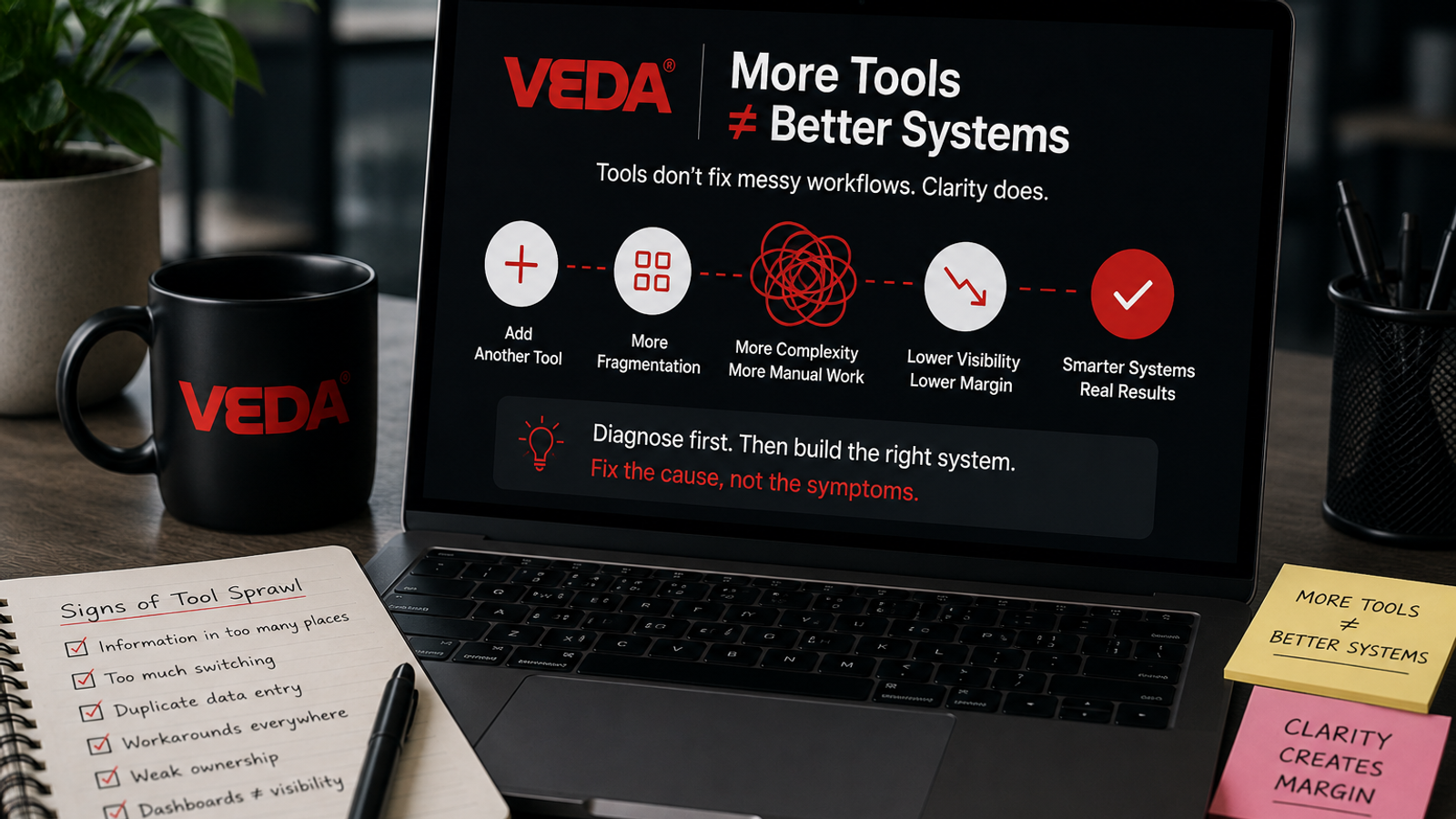
It is also worth being honest about tools. Adding another piece of software does not, by itself, create a better system; it often adds another place data lives and another login to manage. We have written about why more tools do not always create a better system, because this is where a lot of automation budgets quietly disappear.
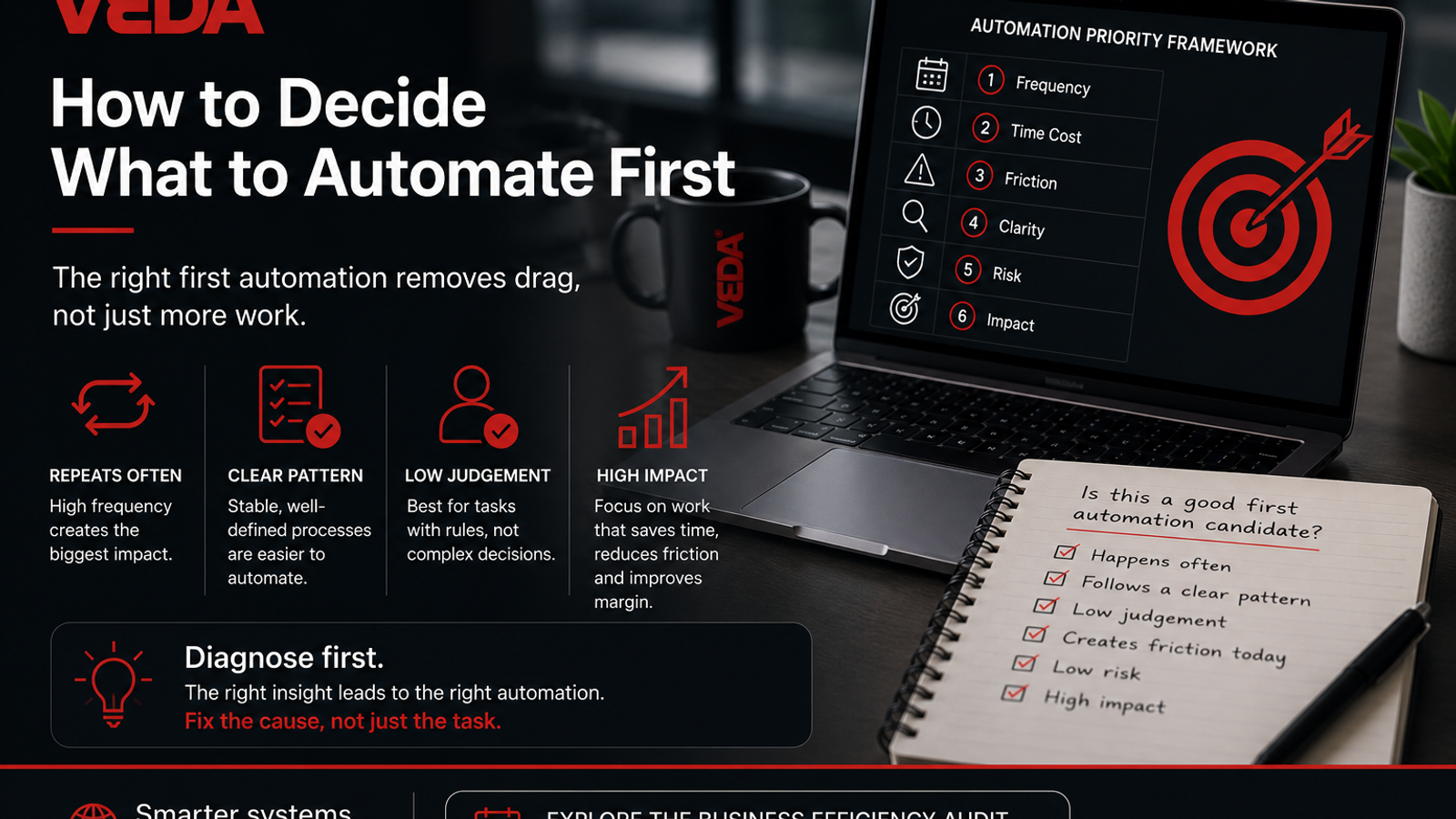
And you cannot do all of this at once. Sequencing sensibly — picking the change that pays back soonest and unblocks the most — is its own decision. If you want a method for that, our guide on how to decide what to automate first walks through it.
All of this rests on one thing: a clear picture of how the work actually flows today. Getting that picture before you change anything is precisely what a Business Efficiency Audit is for. It is the gateway, because automating the right thing matters far more than automating everything.
How Veda approaches it
Our approach is deliberately practical. We start by understanding the real workflow, find where time and errors actually accumulate, and then build automation and smarter systems around the process that works — not around a tool we want to sell.
That is what happened with Powerleague: the change was not "more software," it was moving ordering off a central bottleneck and out to self-serve, so jobs arrived clean and the people in the middle were freed up. The same logic applies whether you are estimating signage, scheduling fitters or generating job sheets.
The categories above are a menu, not a to-do list. Most operational businesses do not need all of them. They need the two or three that are quietly costing the most, done properly, on a foundation that is sound.
A sensible next step
If a few of these examples felt close to home, the practical move is not to buy a tool. It is to get clear on where the friction actually sits, then automate the right parts in the right order. You can see how we approach automation and smarter systems, and if you are not yet sure where to start, a Business Efficiency Audit is the natural first step.

Written by
Rian Patel
Founder, Veda AI
Rian Patel is the founder of Veda AI, helping growing SMEs improve business efficiency with practical AI, automation and smarter systems.
Related insights.
Automation & AI
How to Decide What to Automate First
Not sure what to automate first? Here’s how growing SMEs can prioritise automation by frequency, friction, clarity, risk and impact — and why diagnosing the workflow beats starting with a tool.
10 min read · 18 June 2026
Systems & Operations
Why More Tools Don’t Always Create a Better System
More software does not always mean a better system. Here’s why growing SMEs end up with tool sprawl, fragmented workflows and dashboards that mask poor visibility — and what to diagnose before buying another platform.
10 min read · 18 June 2026
Get Veda AI Edge.
Practical briefings on AI adoption, automation, intelligent products and AI-assisted search — what changed, why it matters and what to consider next. No hype, no AI theatre.
By joining you agree to receive Veda AI Edge from Veda AI. Unsubscribe any time.
Ready to find what’s worth fixing?
Start with a short call.
We’ll help you work out whether the right next step is the guide, the £995 + VAT Business Efficiency Audit, or a scoped implementation conversation.