What Is a Business Efficiency Audit?
A Business Efficiency Audit helps growing SMEs find where time, margin and clarity are being lost — then decide which workflows, systems or automation to fix first. Here’s what it looks at, what you get, and when it’s the right place to start.

Most growing businesses know when something feels off.
Work is getting done. Revenue may even be moving in the right direction. But the business feels heavier than it should.
People are chasing updates. Admin is creeping up. Jobs take longer to move through the system. Important information lives in too many places. The team is working hard, but the business still feels harder to run than it ought to.
That is usually the point where owners start looking for answers.
Sometimes they think they need more staff. Sometimes they think they need better software. Sometimes they think they need AI, automation, or a complete systems overhaul.
But before any of that, there is a more important question to answer:
What is actually causing the drag?
That is where a Business Efficiency Audit comes in.
A Business Efficiency Audit is a structured way to find where time, money and clarity are being lost
A Business Efficiency Audit is a practical review of how your business actually operates day to day.
It looks at how work moves through the business, where bottlenecks appear, where people rely on manual workarounds, where communication breaks down, and where time or margin is quietly being lost.
It is not a vague consultancy exercise.
It is not a generic “digital transformation” workshop.
And it is not AI for the sake of AI.
A good audit helps you understand three things clearly:
- what is happening now
- where the inefficiency actually sits
- what needs fixing first
That clarity matters, because most growing businesses do not lack effort. They lack visibility.
Why businesses usually need one
As businesses grow, complexity often grows faster than systems do.
A small team can get away with workarounds for a while. People know what is in someone’s head. Everyone can chase the same spreadsheet. Problems get solved through memory, speed and goodwill.
But once the business grows, that stops scaling.
What used to feel manageable starts turning into:
- duplicated admin
- unclear handovers
- too many manual checks
- delays in delivery or decision-making
- inconsistent processes
- poor visibility across jobs, projects or operations
- managers and founders becoming the glue holding everything together
That is where time starts disappearing.
The problem is that it rarely disappears in one obvious place. It leaks out in small amounts across multiple people, tools and processes. A few minutes here, a duplicated task there, a delayed handover somewhere else.
On their own, those things can look harmless.
Across a growing business, they start to cost real money.
What a Business Efficiency Audit actually looks at
The exact shape of an audit depends on the business, but in practice it usually focuses on a few core areas.
1. Workflows and handovers
How does work move through the business?
Where does it start? Where does it pause? Where does it get stuck? Where are people waiting for information, repeating work, or relying on memory instead of process?
A lot of inefficiency lives in the gaps between steps rather than within the steps themselves.
A quote might be prepared quickly, but then wait for approval. A job might be completed on site, but the information needed for invoicing might not reach the right person. A customer update might depend on someone manually checking three different places.
Those handovers matter.
2. Systems and tools
What systems are in place, and are they actually helping?
Many businesses already have plenty of tools: spreadsheets, inboxes, WhatsApp messages, shared drives, project boards, finance systems and industry-specific platforms.
The issue is often not that there are no tools.
The issue is that the tools do not support the workflow properly.
A Business Efficiency Audit looks at whether the current setup is helping people work clearly, or simply adding another layer of complexity.
3. Manual processes
Where are people spending time on tasks that could be simplified, improved or removed?
This might include repetitive admin, duplicate data entry, manual chasing, avoidable checks, or work that only exists because the system around it is weak.
Not everything should be automated. Some processes need better ownership, clearer steps or a simpler way of working.
But many growing businesses are carrying manual effort they do not need to carry.
4. Visibility and decision-making
Can the right people see what they need to see?
Many operational issues come back to poor visibility. Leaders do not have a clear picture of what is happening. Teams are working from partial information. Problems surface late. Progress is hard to track. Decisions are made from instinct rather than reliable operational insight.
An audit helps expose where visibility is missing and why.
5. Operational friction and commercial impact
Where is inefficiency actually costing the business?
Sometimes the cost is obvious. Sometimes it is quieter.
It can show up as slower delivery, reduced capacity, avoidable errors, delayed invoicing, inconsistent customer experience, or the founder being pulled into too many low-value decisions.
The goal is not just to say, “this process is messy.”
The goal is to understand why it matters commercially.
What you get from a Business Efficiency Audit
A proper audit should not leave you with a vague set of observations.
It should leave you with something you can actually use.
That usually includes:
- a clearer picture of how work is really happening
- visibility into where time or margin is being lost
- identification of bottlenecks, gaps and weak handovers
- prioritised opportunities for improvement
- a practical roadmap for what to fix first
In other words, it should move you from:
“We know something feels inefficient.”
to:
“We now know where the drag is, what it is costing us, and what to do next.”
That is what makes the audit valuable. It turns a general sense of frustration into a clear direction.
What a Business Efficiency Audit is not
It is worth being clear about what it is not.
A Business Efficiency Audit is not:
- a generic tech sales exercise
- a recommendation to automate everything
- a promise that software is always the answer
- a pile of jargon about AI, innovation or transformation
- a theoretical report with no practical next step
Sometimes the right answer is process improvement.
Sometimes it is clearer communication or better ownership.
Sometimes it is automation.
Sometimes it is software.
Sometimes it is AI.
And sometimes the real issue is that the business needs better structure before any new technology gets introduced.
The point of the audit is to work that out properly.
Who it is for
A Business Efficiency Audit is usually most useful for businesses that are growing, operationally stretched, or starting to feel the cost of messy systems.
It tends to be especially relevant where:
- the team has grown but the way the business operates has not caught up
- more work is coming in, but it is not translating cleanly into more capacity or margin
- people are relying on workarounds
- leaders are spending too much time chasing, checking or unblocking
- the business knows it needs to improve, but does not yet know where to start
For many growing SMEs, that is the point where an audit becomes far more useful than buying another tool or making another reactive hire.
Signs your business might need one
You do not need a major crisis to justify an audit.
Often the signs are quieter than that.
For example:
- work feels more complicated than it should
- the team is busy, but outcomes are not improving enough
- there are too many spreadsheets, inboxes or manual processes involved
- simple tasks require too much coordination
- information gets lost between teams or stages
- the founder or leadership team is still central to too many operational decisions
- there is a sense that the business could run better, but nobody has had time to step back and diagnose why
If that sounds familiar, an audit is often the most sensible starting point.
Why this matters before AI, automation or software
One of the biggest mistakes businesses make is jumping to solutions before they have properly understood the problem.
That is where a lot of wasted spend comes from.
A business starts looking at AI because it wants efficiency, but the real issue is poor workflow design.
It starts buying automation tools, but the underlying process is inconsistent.
It commissions software, but the business has not yet defined what the system actually needs to support.
A Business Efficiency Audit helps prevent that.
It creates enough clarity to make better decisions about what is worth changing, what is not, and what order those changes should happen in.
That is why it is such a useful starting point.
What happens after the audit
The audit is not the end goal. It is the decision point.
Once the inefficiencies are clear, the business can move forward with more confidence.
That may lead to:
- workflow redesign
- smarter systems
- targeted automation
- improved reporting or visibility
- better use of existing tools
- bespoke software where it is genuinely justified
- practical AI adoption where it fits the problem
The key difference is that those next steps are based on diagnosis rather than guesswork.
Final thought
Most growing businesses are losing time and money somewhere in the way they operate.
The problem is not always effort. It is often a lack of clarity.
A Business Efficiency Audit gives you a structured way to see where the drag is, understand what it is costing you, and decide what needs fixing first.
That makes it one of the most useful places to start if the business feels harder to run than it should.
Ready to find out where the drag is?
If your business is growing but the way it operates is starting to feel messy, manual or harder than it should, the best next step is to start with a Business Efficiency Audit.
It is designed to help you understand where time, margin and clarity are being lost — and what to fix first.

Written by
Rian Patel
Founder, Veda AI
Rian Patel is the founder of Veda AI, helping growing SMEs improve business efficiency with practical AI, automation and smarter systems.
Related insights.

Business Efficiency
Why Growing SMEs Lose Time as They Scale
Growing SMEs often lose time as workflows, systems and handovers fail to keep up. Here’s where operational drag really comes from as you scale — and how to diagnose what to fix first, before reaching for more tools, hires or AI.
8 min read · 18 June 2026
Business Efficiency
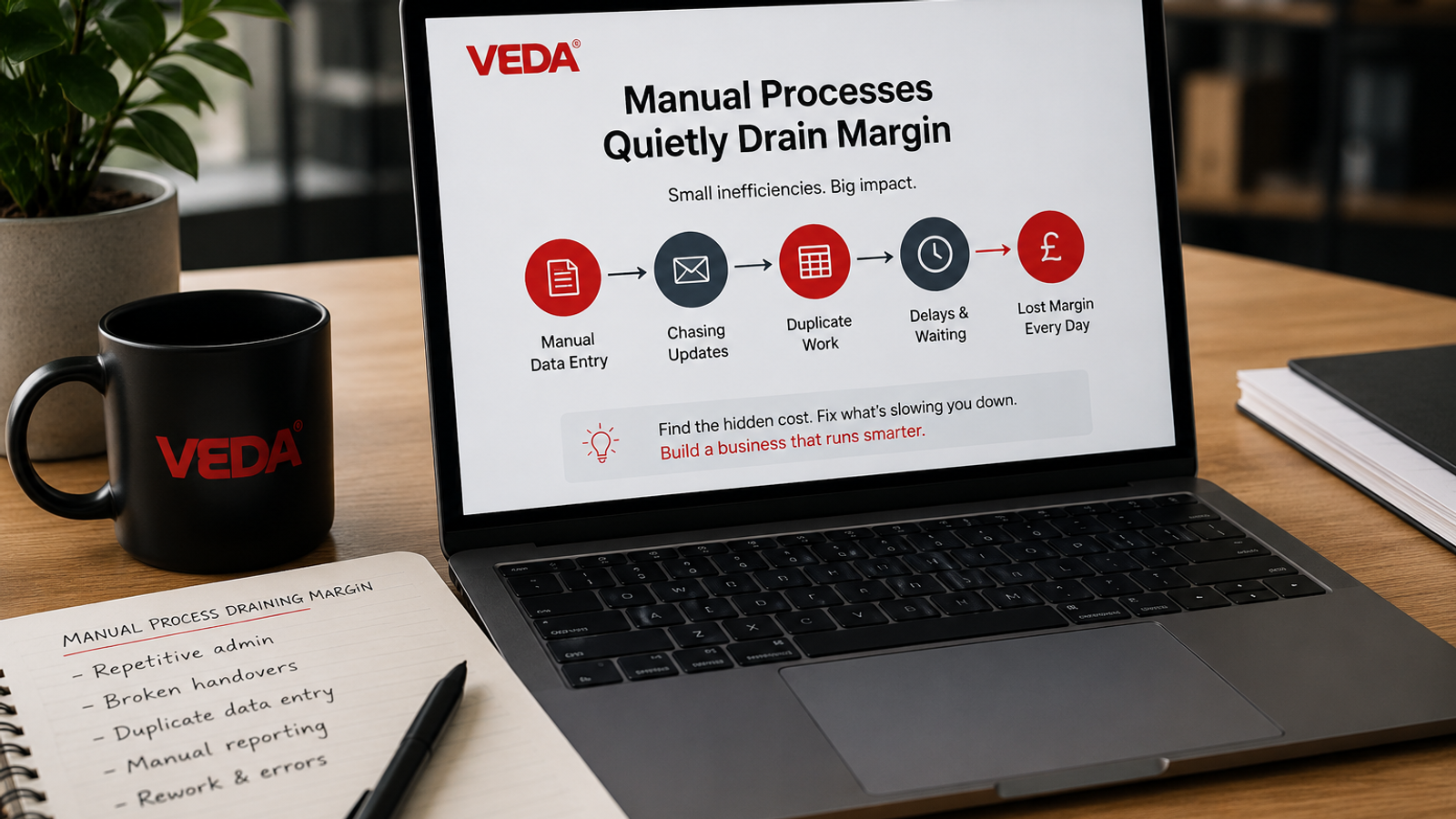
Where Manual Processes Quietly Drain Margin
Manual processes can quietly drain margin through duplicated admin, broken handovers, poor visibility and rework. Here’s where the drag really sits, why it compounds as you grow, and what to fix first.
9 min read · 18 June 2026
Automation & AI
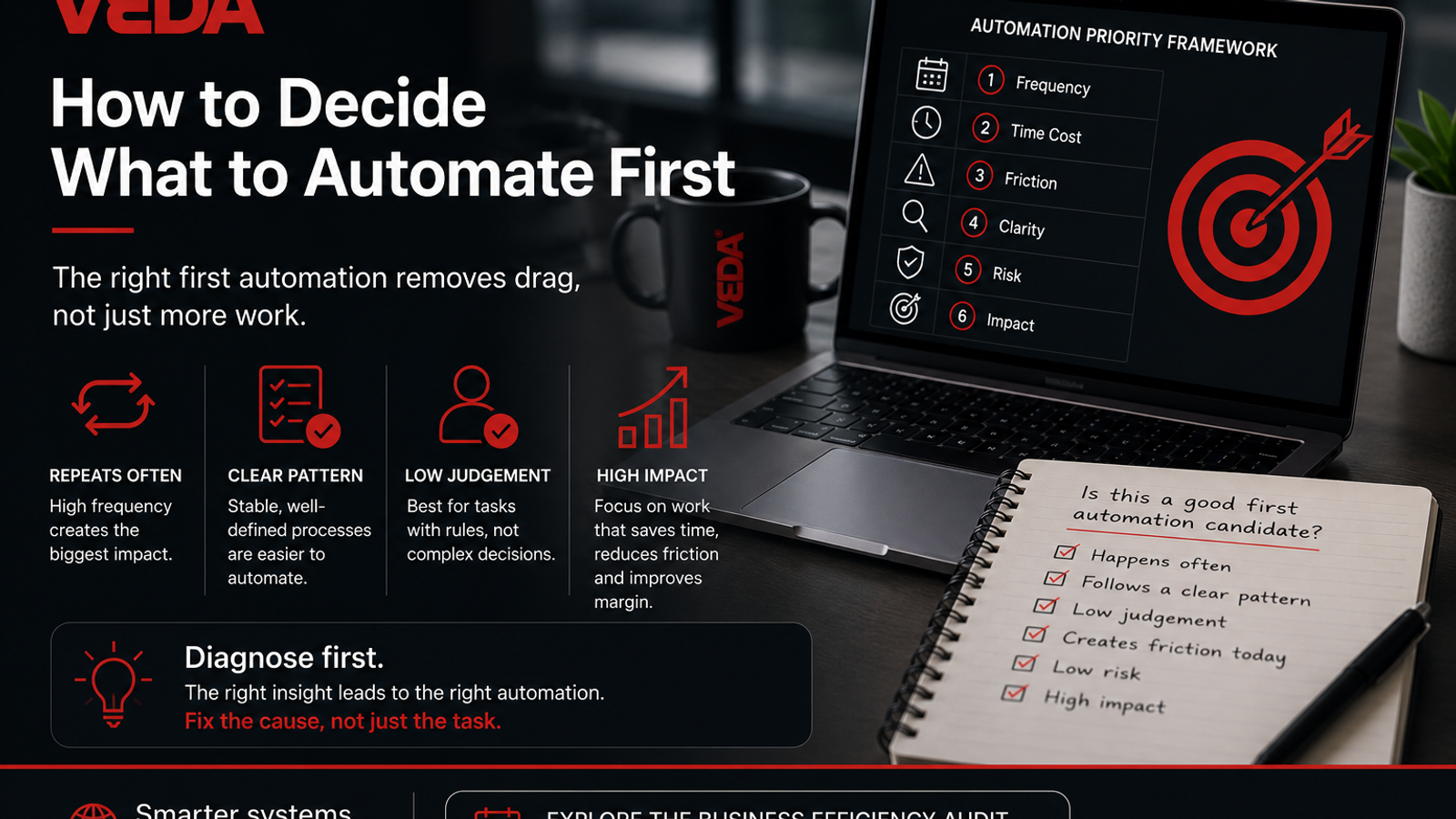
How to Decide What to Automate First
Not sure what to automate first? Here’s how growing SMEs can prioritise automation by frequency, friction, clarity, risk and impact — and why diagnosing the workflow beats starting with a tool.
10 min read · 18 June 2026

Business Efficiency
When Is a Business Process Review Actually Worth It?
You can feel the business could run better, but stopping to review how it works feels like effort you cannot spare. This guide helps you decide if and when a business process review is genuinely worth it, the signs it is time, and when to wait.
9 min read · 24 June 2026
Get Veda AI Edge.
Practical briefings on AI adoption, automation, intelligent products and AI-assisted search — what changed, why it matters and what to consider next. No hype, no AI theatre.
By joining you agree to receive Veda AI Edge from Veda AI. Unsubscribe any time.
Ready to find what’s worth fixing?
Start with a short call.
We’ll help you work out whether the right next step is the guide, the £995 + VAT Business Efficiency Audit, or a scoped implementation conversation.