When Is a Business Process Review Actually Worth It?
You can feel the business could run better, but stopping to review how it works feels like effort you cannot spare. This guide helps you decide if and when a business process review is genuinely worth it, the signs it is time, and when to wait.
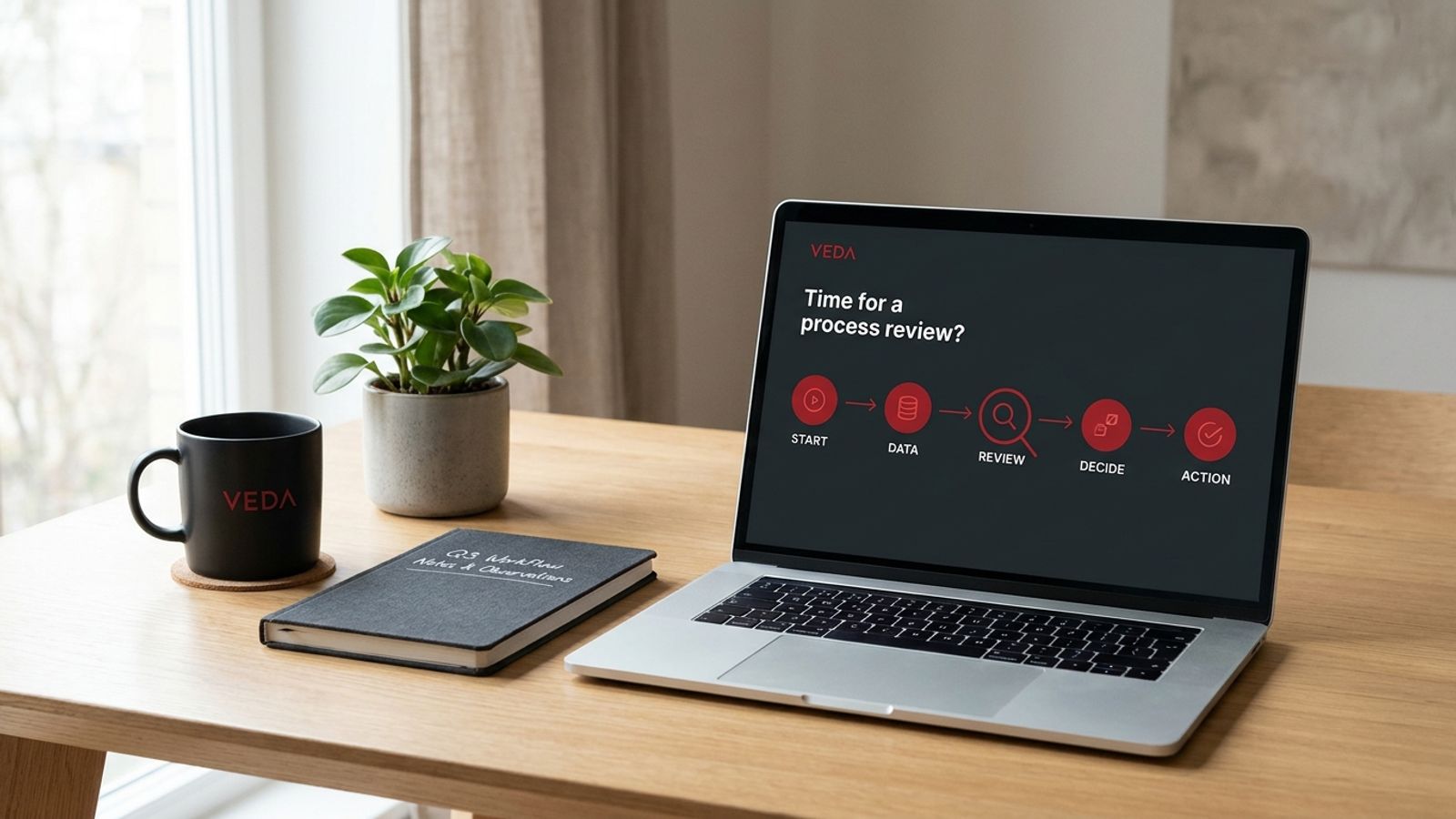
Most growing businesses know when something feels off. The work still goes out, the customers are still served, but it takes more effort than it should, and you cannot quite say where the effort is going.
You can sense the business could run better. The trouble is that stopping to look at how it actually runs feels like a luxury when you are already flat out keeping it moving.
That tension is exactly what makes a business process review easy to keep putting off. So the honest question is not whether reviewing how you work is a good idea in the abstract. It is whether it is worth it for you, now.
What a business process review actually means
A business process review is a structured look at how work really flows through your business: from an enquiry coming in, to a quote, to a job being scheduled, made, delivered and invoiced. Not how it is meant to work on paper, but how it happens on a normal week.
The point is to find where work stalls, where it gets handed back and forth, where information goes missing, and where time and margin quietly leak out. Often the leaks are not dramatic. They are the small re-keying, chasing and double-checking that nobody notices because everyone has always done it.
A small example makes it concrete. An enquiry comes in by email, gets copied into a quoting spreadsheet, then re-typed into a job sheet, then read off again by whoever schedules the work. Each retype is a chance for a wrong measurement, an old price or a missed detail, and when something goes wrong on the floor, nobody can say which version was right. None of that feels like a problem on any single job. Across a year, it is hours of rework and a steady trickle of avoidable mistakes.
This is different from simply trying to be more efficient. Being more efficient usually means working harder or faster inside the existing way of doing things. A review steps back and asks whether the way of doing things is the problem in the first place.
If you want the structured definition of how this is done properly, with stages and outputs, our companion piece on what a business efficiency audit involves covers it in full.
The signs it is worth doing now
A business process review earns its place when the way you work has stopped keeping up with the business you have become. These are the signals worth taking seriously.
Growth has outpaced the way you work
The systems and habits that got you here were built for a smaller, simpler operation. More jobs, more people and more moving parts now run through processes that were never designed for this volume. Things do not break outright, but everything takes a little more holding together.
You keep firefighting the same issues
If the same problems come round every week, the wrong job prioritised, a spec misread, a delivery slipping, you are not having bad luck. You are looking at a process that produces those failures by design. Recurring firefighting is one of the clearest signs the underlying flow needs attention, not another patch.
Handoffs and onboarding are painful
Watch what happens when work passes between people, between sales and production, between the office and the floor, between a job finishing and an invoice going out. If handoffs need chasing, or a new starter takes months to become useful because so much lives in people's heads, the process is carrying risk you cannot see day to day.
Margin is tightening even as revenue grows
This is the one that should make you stop. If turnover is up but the money left at the end feels harder to find, the cost of running the work is climbing faster than the work itself. Inefficient process is one of the most common reasons, and it rarely shows up cleanly in the accounts.
It hides in places the accounts do not separate out: the hours spent re-doing a job that was quoted wrong, the overtime to recover a slipped schedule, the materials wasted on a misread spec. Each lands somewhere general, like labour or stock, so the real cost of how you work never appears as a line you can question.
Decisions are made on gut because there is no clear view
When you cannot easily see which jobs are profitable, where the bottleneck is this month, or how much capacity you actually have, you end up deciding by instinct. That works for a while. As the business grows, the gap between what you sense and what is true gets wider and more expensive.
Too much depends on one or two people
If a handful of people simply know how it all works, and a holiday or a resignation would be genuinely frightening, your process exists mostly as undocumented knowledge. A review makes that knowledge visible so the business depends on a system, not on memory.
You have added tools but nothing got smoother
New software was supposed to help, yet the team still keeps a spreadsheet on the side, still re-enters the same data, still works around the system rather than through it. That usually means a tool was layered onto a broken process. The process needs sorting first.
If several of these feel familiar, it is worth understanding why they tend to arrive together. We cover the underlying pattern in why growing SMEs lose time as they scale.
When it is not worth it yet
A review is not always the right move, and it is worth being honest about when it is not. Doing one at the wrong moment wastes effort and attention you cannot spare.
- You are in the middle of a cashflow emergency. If the immediate problem is money this month, deal with the cash first. A structured review needs a bit of breathing room to be useful, and survival has to come before optimisation.
- You are about to replace a core system anyway. If you already know you are moving accounting, job management or your main operational platform, much of how you work is going to change with it. Review once the new shape is settled, not against a setup you are about to retire.
- There is a single obvious fix. If you can already name the one bottleneck and you know how to fix it, just fix it. You do not need a full review to justify a change you can already see clearly.
- You are genuinely too early or too small. If the whole operation still fits comfortably in a few heads and a couple of tools, the overhead of a formal review may outweigh what it would find. Keep it in mind for when complexity starts to bite.
There is also a quieter version of the wrong moment: when nobody senior actually wants to change anything. A review can map the problems perfectly, but if the people who would have to act on it are not ready to, you end up with an accurate report and no follow-through. The findings are only worth having if there is the appetite to act on them.
A review is worth doing when complexity has outgrown your visibility, not as a reflex whenever something feels hard.
What you actually get from a review
When the timing is right, the value of a business process review is not a thick document. It is clarity and a sensible order of operations.
- Clarity on how work really flows, including the steps and workarounds that have become invisible to the people doing them every day.
- A prioritised list of what is costing you time and margin, separated from the things that merely feel annoying.
- A sensible sequence, so you fix the things that unblock everything else first, rather than tackling whatever shouts loudest.
- A clear view of where better systems fit later, once the process underneath is sound.
That last point matters more than it sounds. A good review tells you where automation and smarter systems will genuinely help, and, just as importantly, where they would only speed up a broken process. Tools come after the picture is clear, not before.
How to do this with low risk
The reason owners hesitate is rarely the idea itself. It is the fear of opening a project with no clear end, or of committing to change before anyone agrees what is actually wrong. A review should remove that risk, not add to it.
A good review is deliberately contained. It works from how things run today rather than asking you to stop and document everything first, it talks to the people who actually do the work rather than only the people who manage it, and it produces a decision you can act on rather than an open-ended programme. You should know at the outset roughly how long it will take and what you will have at the end.
That is what the Business Efficiency Audit is built to do. It is a structured, practical way to get an honest picture of how your business runs and where the friction really sits, before you spend money or effort changing anything. You come out with a prioritised view, not a vague sense that things could be better.
It is worth seeing what that looks like in practice. Our work with SportVision was, at its heart, an operational review: it took friction the team could feel but could not quite pin down, and turned it into a prioritised, roadmapped picture of what to fix first.
That is the shift a review is meant to deliver. Not more opinions about what might be wrong, but a clear, ordered answer to where to begin.
So, is it worth it for you?
If you are in survival mode, mid-replatform, or you can already name the one fix, hold off. The review will be more useful later.
But if growth has outrun the way you work, if you keep firefighting the same issues, if margin is tightening and decisions are running on gut, then the cost of not looking is already higher than the cost of the review. The drag is real whether or not you measure it.
When you are ready to turn that felt friction into a clear, prioritised picture, a Business Efficiency Audit is the natural place to start. It is a low-risk first step that tells you what to fix, in what order, before you change a thing.

Written by
Rian Patel
Founder, Veda AI
Rian Patel is the founder of Veda AI, helping growing SMEs improve business efficiency with practical AI, automation and smarter systems.
Related insights.

Business Efficiency
What Is a Business Efficiency Audit?
A Business Efficiency Audit helps growing SMEs find where time, margin and clarity are being lost — then decide which workflows, systems or automation to fix first. Here’s what it looks at, what you get, and when it’s the right place to start.
8 min read · 18 June 2026

Business Efficiency
Why Growing SMEs Lose Time as They Scale
Growing SMEs often lose time as workflows, systems and handovers fail to keep up. Here’s where operational drag really comes from as you scale — and how to diagnose what to fix first, before reaching for more tools, hires or AI.
8 min read · 18 June 2026
Get Veda AI Edge.
Practical briefings on AI adoption, automation, intelligent products and AI-assisted search — what changed, why it matters and what to consider next. No hype, no AI theatre.
By joining you agree to receive Veda AI Edge from Veda AI. Unsubscribe any time.
Ready to find what’s worth fixing?
Start with a short call.
We’ll help you work out whether the right next step is the guide, the £995 + VAT Business Efficiency Audit, or a scoped implementation conversation.