Why business improvements stall—and how an ongoing technology partner helps
Why worthwhile improvements lose momentum, and how continuing advice, delivery and review can help them become established.
An improvement gets discussed, everyone agrees it matters, and someone makes a promising start. Then a busy period arrives. A decision waits, another priority takes over, and the work slips into the background.
Months later, the team raises the same problem again.
This can happen with an automation idea, a new reporting process, an AI trial or a change to an existing system. The business recognises the opportunity, but the work lacks the continuing attention needed to become useful.
An ongoing technology partnership can help sustain that attention, provided the relationship includes clear priorities, practical delivery and a regular look at what is happening.
The improvement was too broad to act on
“Reduce admin” may describe an important ambition, but it leaves a lot of decisions unresolved. Where should the team begin? Which task is causing the greatest difficulty? What would a useful first result look like?
When the next action is unclear, immediate operational work naturally takes precedence.
A partner can help investigate the ambition and turn it into something manageable. For illustration, reducing administration might begin with removing repeated entry from a particular order handover. The business can then judge that change before deciding how much further to take it.
This gives the team a concrete priority that can survive beyond the meeting where the idea was first discussed.
Advice and implementation became separate efforts
A review may identify sensible recommendations without making it easy for anyone to carry them out.
The business still needs to translate the advice into decisions, arrange resources and brief whoever will make the changes. If nobody has time to coordinate that work, a valuable report can remain on the shelf.
An ongoing partner with the relevant delivery capability can help maintain the connection. The reasoning behind the recommendation is carried into the work, and questions discovered during implementation can feed back into the plan.
That does not remove the need for internal approval. It gives the business a clearer route from agreeing that something matters to doing something about it.
New requests kept pushing existing work aside
Improvement work needs a way to handle changing priorities. Without one, the latest request can repeatedly displace the most important task.
Imagine an illustrative reporting improvement interrupted by several unrelated requests for dashboards, software advice and AI demonstrations. Each request may be reasonable, but the original work never reaches the point where anyone can use it.
A regular planning conversation can make those trade-offs visible. Decide what needs to change immediately, what can wait and what will be delayed as a consequence.
The partner should explain what fits within the available capacity. A shorter list of completed, useful changes is often easier to assess than many initiatives moving a little at a time.
The improvement reached the system but missed the people
A new workflow may be ready while the team is still unsure how it affects their job. An AI tool may be available without anyone knowing which tasks it is appropriate for.
Leave that gap unresolved and staff will often return to familiar methods, especially when work is busy.
Build adoption into the improvement itself. Give people time to practise real tasks, explain how exceptions should be handled and make help easy to find. Involve managers so the expected way of working is consistent.
Continuing attention creates an opportunity to identify where guidance, training or a small technical change would make the new approach easier to use.
Nobody returned to the original problem
Completing a task can create a sense of progress even when the underlying difficulty remains.
If the aim was to reduce time spent answering routine customer updates, return to that work after the change. Are staff still searching several systems? Are customers receiving useful information? Has another bottleneck appeared?
Choose evidence that is practical to collect and acknowledge what it cannot yet prove. You may need more time or better information before judging the result.
An ongoing review gives those questions a place. It also gives the business a chance to adjust or stop an approach that is not helping.
Improvement needs a repeatable rhythm
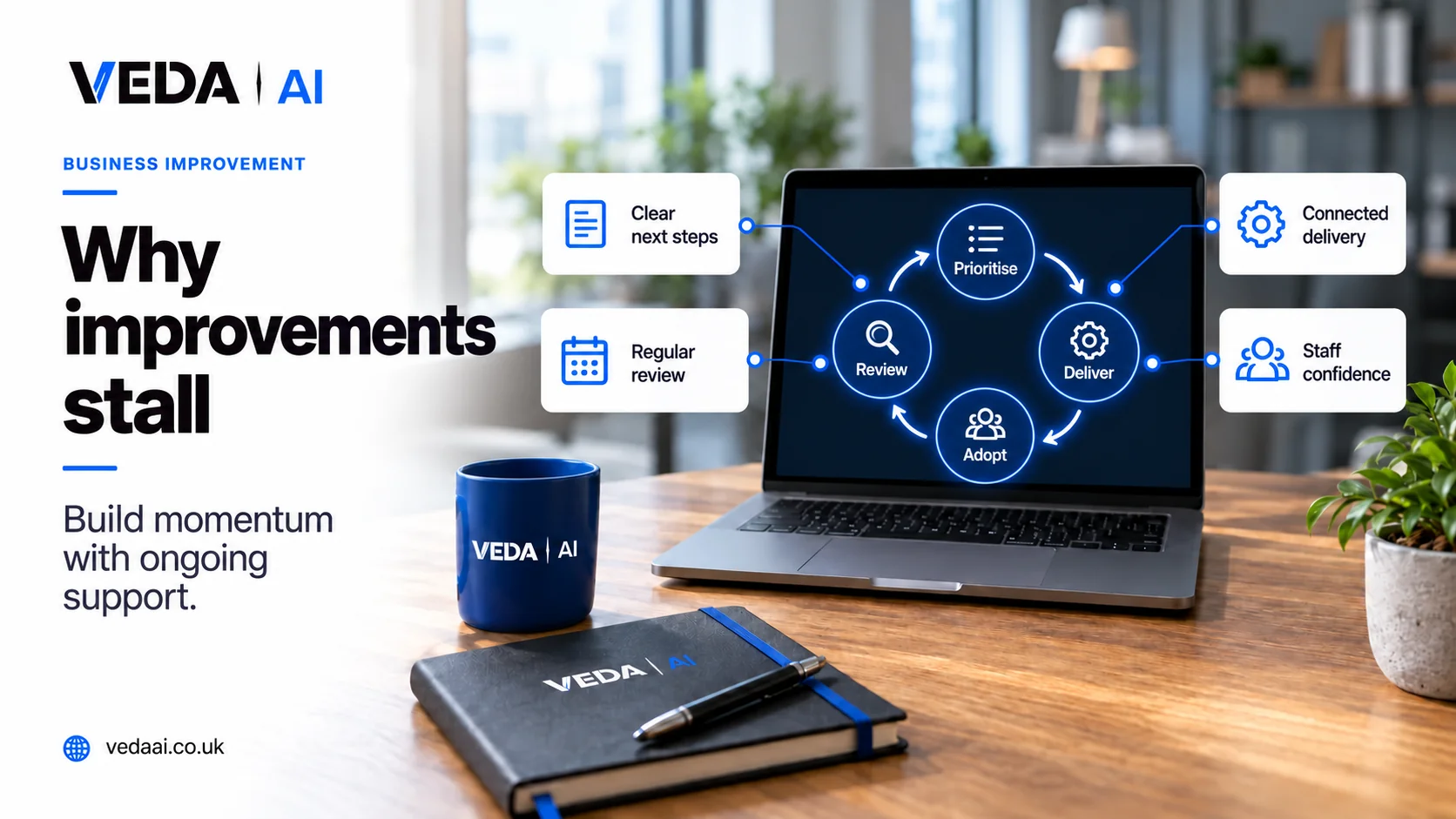
A useful cycle is to identify a priority, deliver an appropriate change, help people use it and review what happened. The next cycle should build on what the business learned.
Veda AI's Business Improvement Partnership provides a monthly structure for advice, delivery and review. The work can continue across connected priorities as the business's needs develop.
The cadence matters because it gives unfinished questions somewhere to return to. A delayed decision becomes visible, staff feedback can inform the next step, and the roadmap reflects what is happening in practice.
Reserved time still needs active prioritisation and timely input from your team. The relationship creates the structure; both sides have to use it.
Restart with the problem that keeps coming back
If improvement work has stalled, choose a recurring issue and ask why previous attempts have not become established. Was the next step unclear? Did delivery need a skill nobody had? Were people expected to change without enough support?
Use the answer to shape the help you need, rather than simply starting another initiative.
If your business would benefit from continuing support to investigate, deliver and follow through, explore the partnership options. Bring an improvement that keeps being discussed and the obstacles that have prevented it from sticking.
Related insights.

Business Efficiency
Technology retainer vs one-off project: which is right for your business?
Compare a defined project with an ongoing partnership and understand when continuity, monthly capacity and connected priorities can help your business.
5 min read · 19 October 2026

Business Efficiency
Software development agency or technology partner: what changes with an ongoing partnership?
Explore how an ongoing technology partnership connects practical advice, implementation and follow-through across changing business priorities.
5 min read · 19 October 2026

Business Efficiency
How to choose a technology partner for your business
The questions and evidence that help business owners choose a partner who can understand the operation and keep useful improvements moving.
5 min read · 19 October 2026
Get Veda AI Edge.
Practical briefings on AI adoption, automation, intelligent products and business improvement — what changed, why it matters and what to consider next. No hype, no AI theatre.
By joining you agree to receive Veda AI Edge from Veda AI. Unsubscribe any time.
Ready to find what’s worth fixing?
Turn the idea into steady improvement.
Work alongside a team that helps you prioritise and deliver AI, automation and software changes each month. Explore the Business Improvement Partnership or discuss the business on a free call.