What Is an AI Search Prompt Set—and Why Does It Matter?
Visibility numbers only mean something relative to the questions they were measured against. The prompt set is that contract — and most reports never show you theirs.
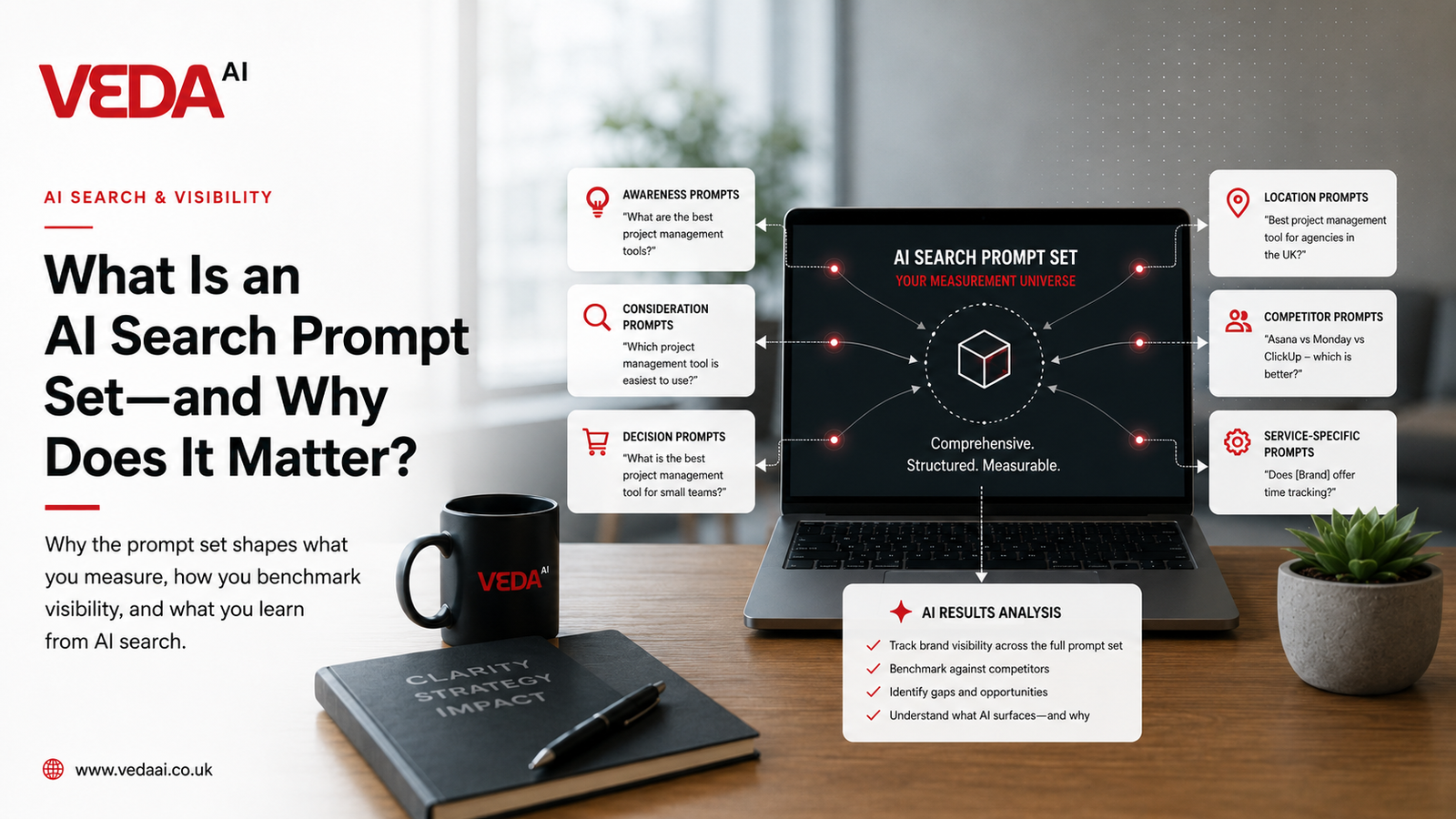
A prompt set is the defined list of questions your AI visibility is measured against. It is the measurement contract: change the questions and every number changes with them, which is why a visibility percentage quoted without its prompt set tells you almost nothing.
This is the part of AI visibility work that most reports skip, and it is the part that determines whether anything else is worth reading. A tool can generate you a score in minutes. Whether that score reflects the questions your buyers actually ask is a separate matter entirely.
Why prompts are not keywords
Conventional keyword research deals in fragments: “business efficiency audit”, “workflow automation Yorkshire”. People type those into a search box because search boxes reward brevity.
People do not talk to an assistant that way. They give context, constraints and intent in one go — “we’re a 60-person manufacturer in Hull, our quoting process is manual and slow, who could help us fix that?” The unit of competition is a whole situation, not a phrase.
Three practical consequences follow:
- One prompt can span several conventional keywords at once, so keyword-level reporting under-describes what happened.
- Phrasing changes answers. The same intent asked two ways can return different firms, which means single-shot testing is unreliable.
- Context shapes the shortlist. Sector, size and geography in the question narrow the field before your marketing gets a say.
Google describes using a “query fan-out” technique in its AI features, issuing multiple related searches behind one question. That is a useful mental model: behind each prompt sits a cluster of implied queries, not a single lookup.
The four dimensions a serious prompt set covers
1. Commercial topics
The problems you are genuinely hired to solve, phrased as a buyer would describe the symptom rather than as you would name the service. Buyers rarely search for your service name. They describe what hurts.
2. Buyer stage
The same person asks different questions as they move. A useful set spans all three rather than clustering at one end:
- Problem-aware — “why does our quoting take so long?” You are competing with explanation, not with suppliers.
- Solution-aware — “what does a business efficiency audit involve?” You are competing on method and credibility.
- Supplier-aware — “who does this well for mid-sized manufacturers in the North?” This is where being named matters commercially.
Sets that only measure supplier-aware prompts flatter or panic you, and explain nothing. Sets that only measure problem-aware prompts feel encouraging and never convert.
3. Location
Geography changes answers where it plausibly matters to a buyer. For a UK business, “in the UK”, “in Yorkshire” and “near Hull” are three different measurement contexts, and being strong in one says little about the others. Include location variants only where a real buyer would use them — adding a town to every prompt manufactures precision that does not exist.
4. Competitors
Direct comparisons — “X vs Y”, “alternatives to X”, “is X any good” — are worth measuring because they are asked, and because being absent from a comparison involving you is a specific, fixable problem.
The disclosure test
Ask any provider for their prompt set before you look at their numbers. If they will not show it, the number cannot be checked, cannot be reproduced, and cannot be compared with anything measured later.
There is no single correct formula
It would be convenient to claim a fixed recipe — so many prompts per stage, so many locations, a magic total. There is no such standard, and any provider presenting one as authoritative is presenting a house style as an industry rule.
What can be said with more confidence is what makes a set defensible:
- It is written down before measurement begins, not assembled afterwards to fit the result.
- It is small enough to re-measure consistently and large enough to survive one odd answer.
- It reflects where revenue actually comes from, not where volume is highest.
- It is held stable between measurements, so change means something.
- It is reviewed deliberately — and when it changes, the baseline is understood to have reset.
That last point causes more confusion than any other. A visibility figure measured against a revised prompt set is not an improvement or a decline. It is a different measurement wearing the same label.
A worked example (hypothetical)
A specialist accountancy firm serving construction SMEs might build a set spanning: problem-aware prompts about CIS compliance and cash flow on retentions; solution-aware prompts about what a construction-specialist accountant does differently; supplier-aware prompts asking who serves construction firms in the North West; and two comparison prompts naming the incumbents.
Roughly twenty questions, weighted toward the supplier-aware end because that is where the commercial decision sits. Not four hundred prompts scraped from a keyword tool. This example is illustrative rather than a client engagement.
Common mistakes
- Vanity prompts — asking “who is the best AI consultancy in the UK” and celebrating. Nobody buys from that question.
- Brand-name prompts — asking about yourself by name proves recall, not discovery.
- Volume over relevance — hundreds of prompts nobody asks, producing a stable but meaningless denominator.
- Silent revision — quietly changing the set between reports so the trend line flatters.
- Ignoring phrasing variance — measuring once and treating a single answer as fact.
How this fits the wider measurement
The prompt set defines the universe. What you then count within it — appearance frequency, position, sentiment, who else is named — is covered in measuring share of voice against competitors, and establishing where you currently stand against that set is the job of an AI Search Visibility Audit. Where the prompt set sits inside a full diagnostic is set out in what an AI visibility audit should measure.
Key takeaways
- The prompt set defines what “visibility” means for your business. No set, no meaningful number.
- Prompts carry context; keywords do not. They are not interchangeable.
- Cover commercial topics, all three buyer stages, plausible locations and real competitors.
- No industry-standard formula exists. Beware anyone presenting theirs as one.
- Hold the set stable, or accept that the baseline has reset.
Written by
Rian Patel
Founder, Veda AI
Practical thinking from real work with growing SMEs — written by the Veda AI team.
Related insights.
AI Search & Visibility
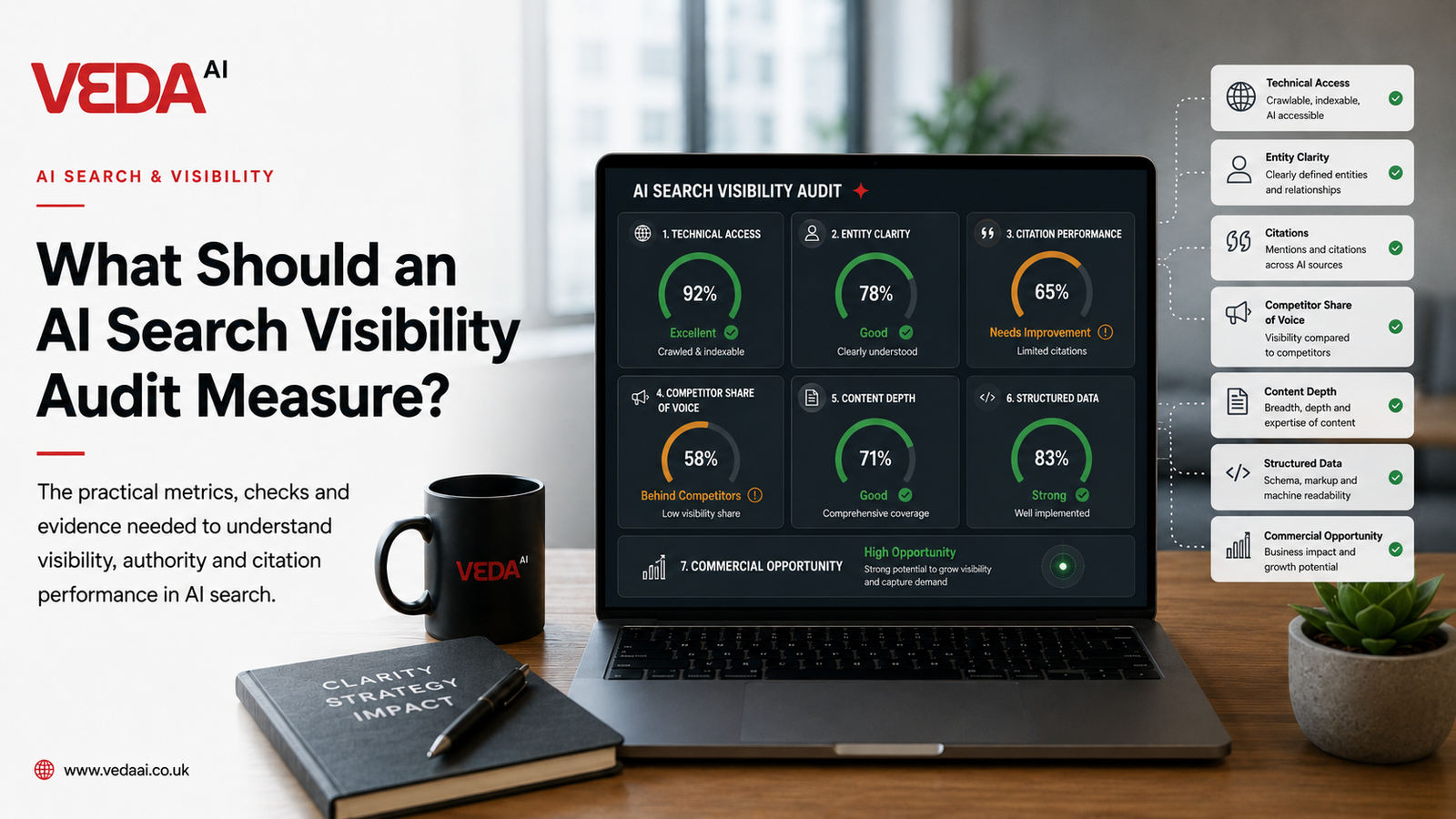
What Should an AI Search Visibility Audit Measure?
Most so-called AI audits are website checklists with new labels. A real one starts with commercially relevant questions and ends with a measurable baseline.
10 min read · 1 August 2026
AI Search & Visibility
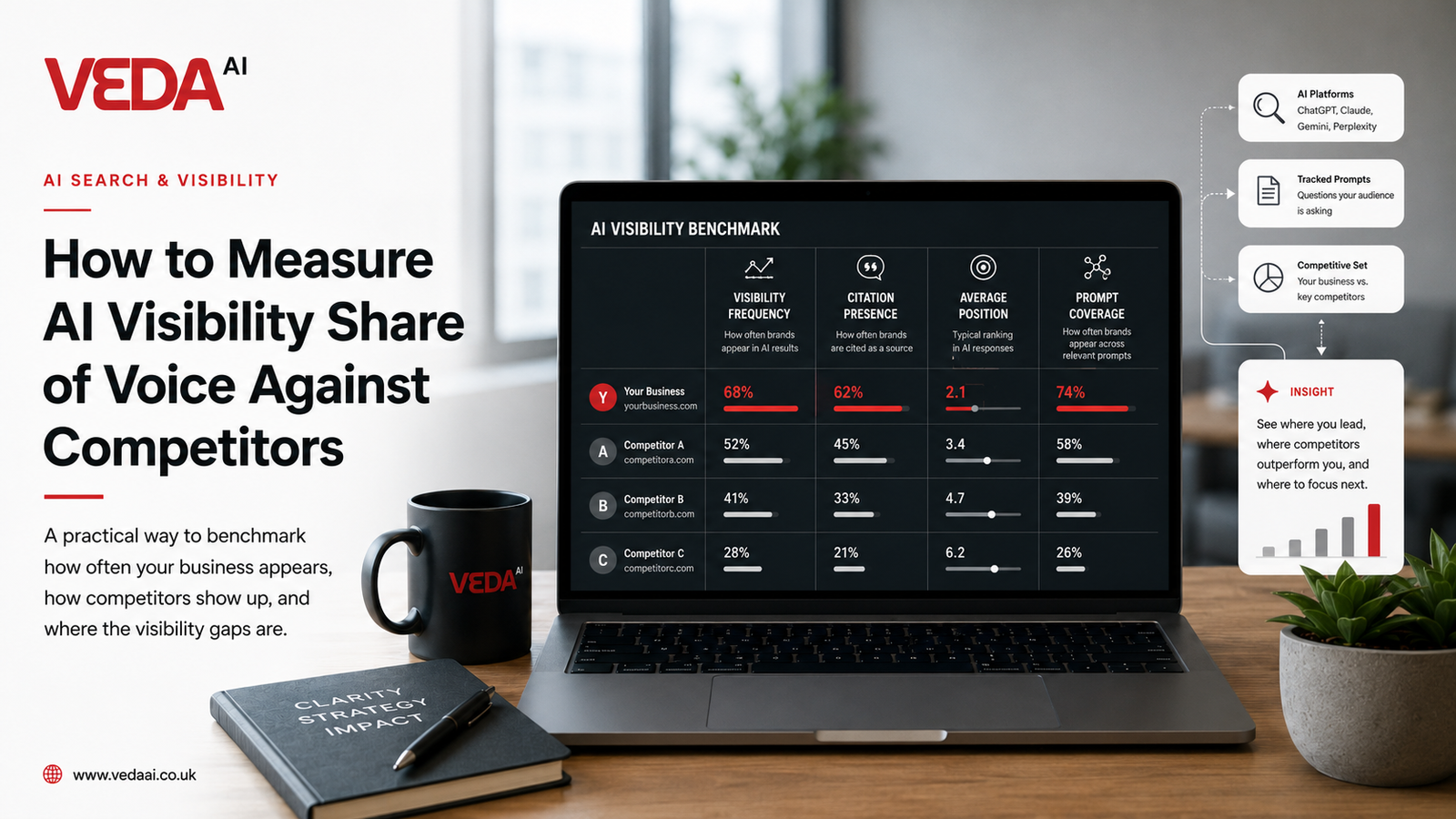
How to Measure AI Visibility Share of Voice Against Competitors
A single share-of-voice percentage is only as meaningful as the prompt set behind it. Here is what is actually countable across AI surfaces — and what is not.
9 min read · 1 August 2026
AI Search & Visibility
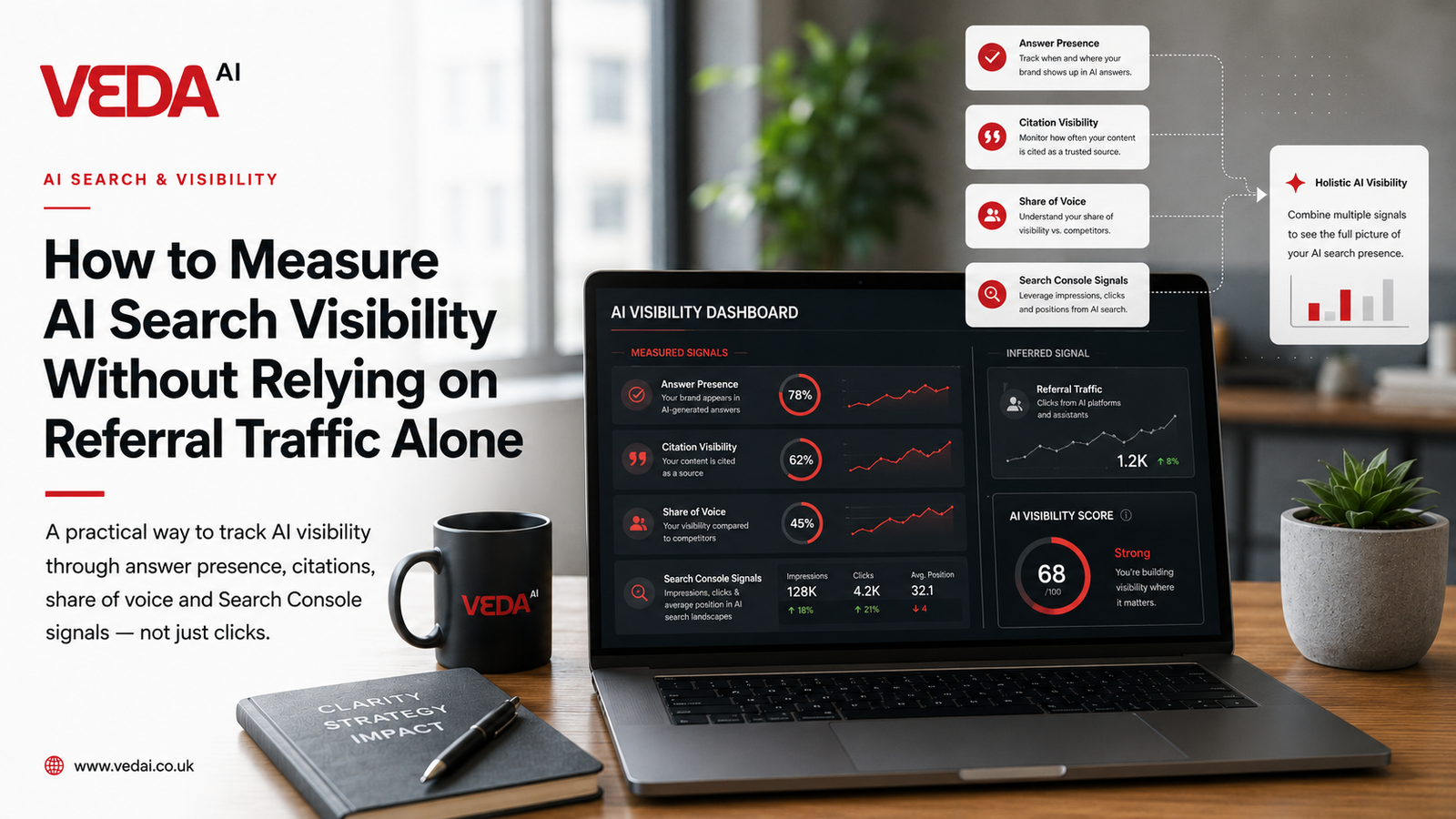
How to Measure AI Search Visibility Without Relying on Referral Traffic Alone
Waiting for AI referral traffic to prove the work is like judging a billboard by its click-through rate. The useful signals sit earlier in the chain.
10 min read · 1 August 2026
Get Veda AI Edge.
Practical briefings on AI adoption, automation, intelligent products and AI-assisted search — what changed, why it matters and what to consider next. No hype, no AI theatre.
By joining you agree to receive Veda AI Edge from Veda AI. Unsubscribe any time.
Ready to find what’s worth fixing?
Start with a short call.
We’ll help you work out whether the right next step is the guide, the £995 + VAT Business Efficiency Audit, or a scoped implementation conversation.