How to Measure AI Search Visibility Without Relying on Referral Traffic Alone
Waiting for AI referral traffic to prove the work is like judging a billboard by its click-through rate. The useful signals sit earlier in the chain.
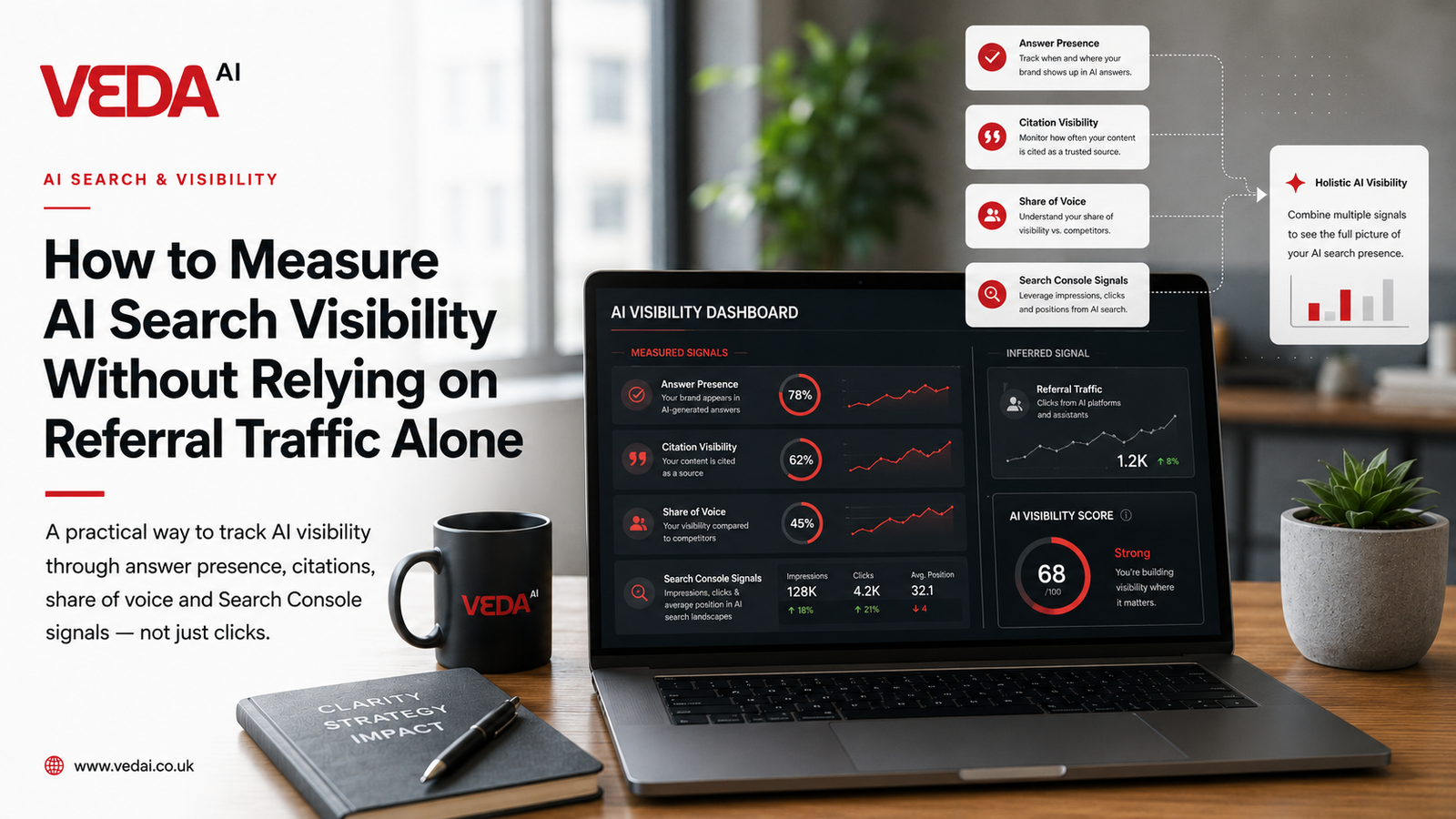
Referral traffic from AI assistants is a lagging, incomplete measure of AI visibility. A fuller picture runs along a chain: prompt visibility, share of voice, citation presence, description accuracy, branded demand, then referrals and assisted conversions. The early links move first and are measurable directly; the later ones are partly inferred.
Being explicit about which is which is the difference between a measurement framework and a dashboard that quietly overstates what it knows.
The measurement chain
1. Prompt visibility — measured directly
Whether you are named across your fixed prompt set. The earliest signal to move and the most controllable. It depends entirely on the set, which is why the prompt set is the foundation of everything downstream.
2. Share of voice — measured directly, no standard formula
Your presence relative to competitors across that set. Countable, but with no industry-standard calculation, as covered in measuring share of voice.
3. Citation presence — measured where surfaces expose it
Whether your pages appear as sources. Directly observable on surfaces that show sources, and not observable at all on those that do not. Do not report it as complete.
4. Description accuracy and sentiment — measured, qualitative
What is said about you when you are named. Requires reading answers rather than counting them, which is slower and more useful than most teams expect.
5. Branded demand — measured directly, attribution unclear
Branded search volume and direct visits. If AI answers introduce you to people, some will look you up rather than click. The movement is measurable; the cause is inferred.
6. Referral traffic — measured directly, incomplete
Sessions arriving from assistant domains. Real but partial: not every surface passes a referrer, some interactions never produce a click, and users often arrive later by another route.
7. Assisted conversion and revenue context — inferred
Whether enquiries mention having asked an assistant, and whether qualified enquiry volume moves. Asking "how did you hear about us" on a form remains one of the more honest instruments available.
The reporting discipline
Label every metric as measured or inferred, and say which surfaces it covers. A report that presents inferred branded-demand movement with the same confidence as a session count is misleading, even when every number in it is accurate.
What platform reporting does and does not cover
Coverage is uneven, and pretending otherwise leads to false comparisons.
- Google — Search Console now includes generative AI performance reporting, giving dedicated views of impressions within AI features on Search. That covers Google’s own surfaces.
- Other assistants — reporting varies and is generally less complete. There is no equivalent first-party console for most of them.
- Analytics platforms — can only report what reaches them. Referrer behaviour differs by surface, and absence of a referral is not proof of absence of influence.
You will encounter confident claims about exactly how much AI-driven traffic is hidden or stripped. Treat unsourced figures of that kind with suspicion; the honest position is that attribution is incomplete by an amount that is not precisely known. Google itself cautions against third-party tools claiming internal metrics.
Why referral traffic under-reports
Several ordinary mechanisms reduce what analytics attributes, none of which requires a conspiracy.
- An answer may satisfy the question entirely, so no click occurs — the influence is real and invisible.
- A user may read an answer, then search your brand name later and arrive as branded organic or direct.
- Referrer behaviour varies by surface and by how the link is opened.
- Conversations happen across sessions and devices, so the introduction and the visit may be days apart.
What follows is that a low assistant-referral number is weak evidence of low AI visibility. It is one narrow measurement of one narrow behaviour, and treating it as the verdict is the most common reporting error in this area.
Two questions worth asking of any report
- “Against which prompt set?” — without it, no visibility figure can be compared to anything, including its own previous value.
- “Which of these are measured and which inferred?” — a report that will not separate the two is asking to be trusted rather than checked.
Building a report that survives scrutiny
- Fix the prompt set and hold it stable.
- Record prompt visibility and share of voice on a fixed cadence.
- Record citation presence per surface, noting where it cannot be observed.
- Track branded search and direct traffic as context, labelled as inferred.
- Segment assistant referrals where identifiable, without treating them as the headline.
- Capture self-reported attribution at enquiry.
- Report movement against the baseline, not absolutes.
What to expect to move first
Roughly in order: description accuracy, then prompt visibility on narrower questions, then share of voice on competitive ones, then branded demand, then referrals and enquiries. Judging the work by the last two in the first quarter is judging it by the slowest signal available — which is why timelines need to be set at the outset. That starting position, measured against a defined question set, is what an AI Search Visibility Audit establishes.
Key takeaways
- Referral traffic is lagging and incomplete — not a primary measure.
- Measure the chain: visibility, share of voice, citations, description, branded demand, referrals, assisted conversion.
- Label every metric measured or inferred, and name the surfaces it covers.
- Google reports on its own AI surfaces; most others do not have an equivalent.
- Be sceptical of precise claims about how much AI traffic is hidden.
Written by
Rian Patel
Founder, Veda AI
Practical thinking from real work with growing SMEs — written by the Veda AI team.
Related insights.
AI Search & Visibility
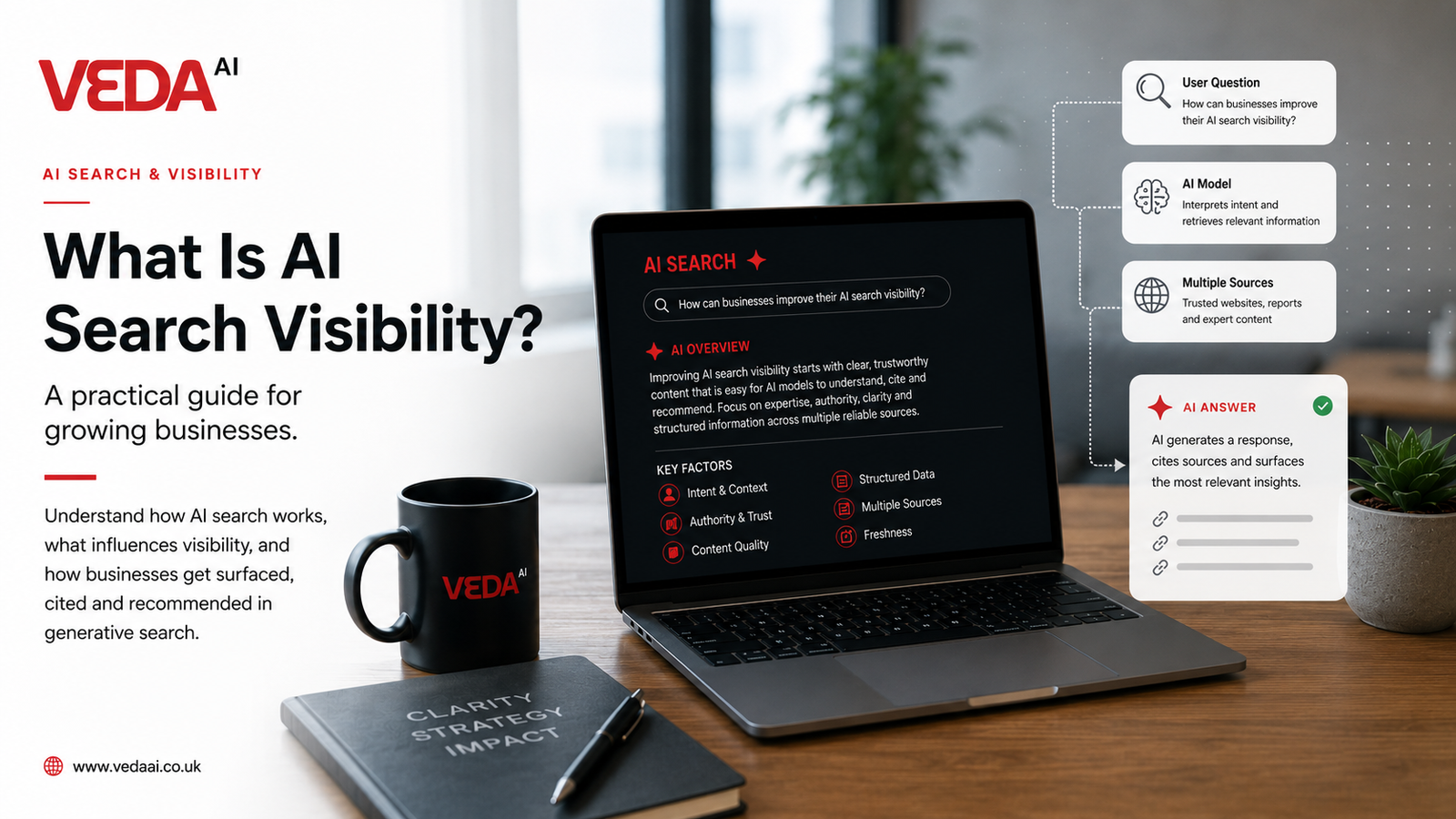
What Is AI Search Visibility? A Practical Guide for Growing Businesses
AI assistants now answer buyer questions directly. Visibility is no longer only about ranking — it is about whether a system can understand and recommend you.
9 min read · 31 July 2026
AI Search & Visibility
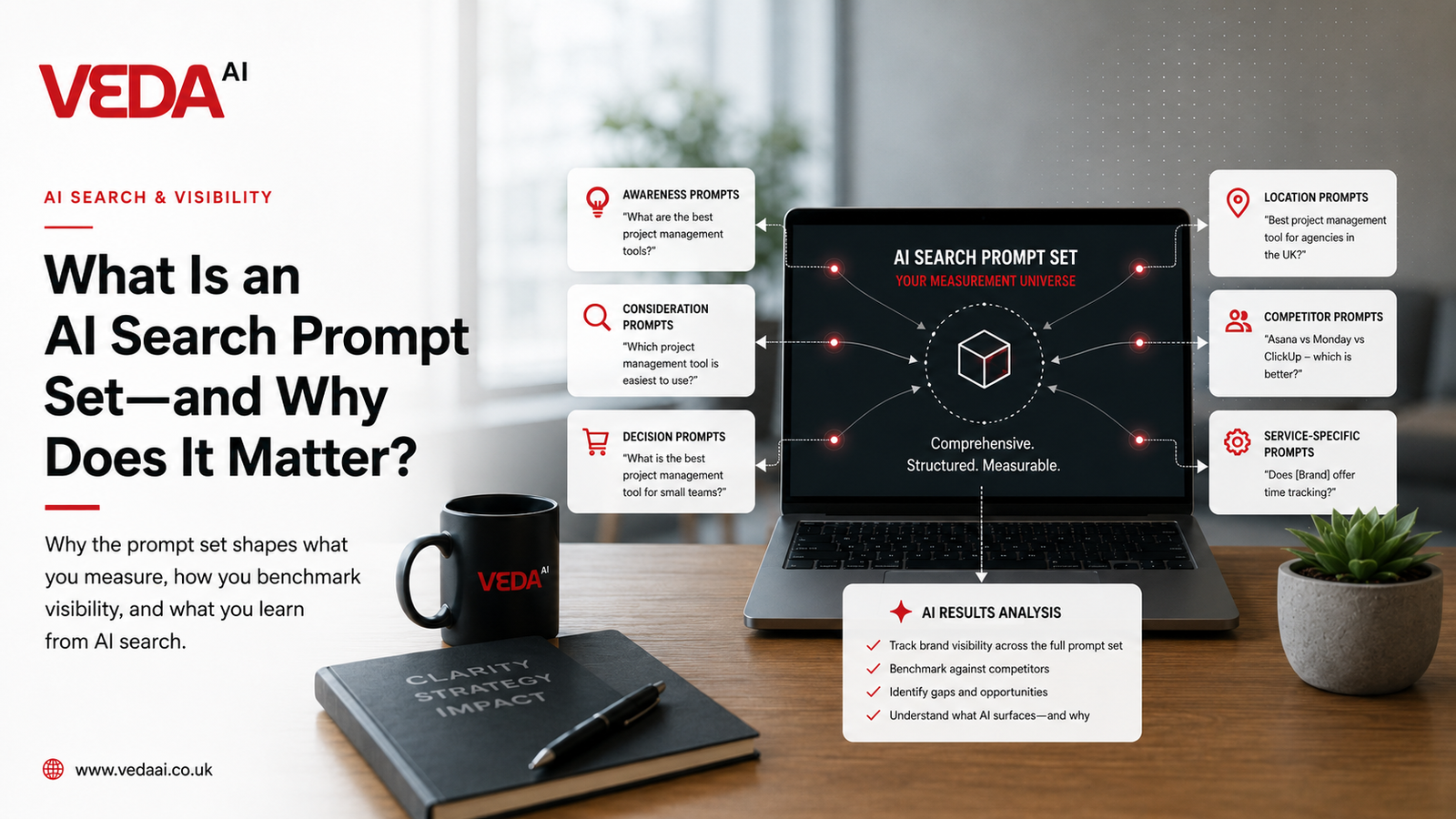
What Is an AI Search Prompt Set—and Why Does It Matter?
Visibility numbers only mean something relative to the questions they were measured against. The prompt set is that contract — and most reports never show you theirs.
9 min read · 1 August 2026
AI Search & Visibility
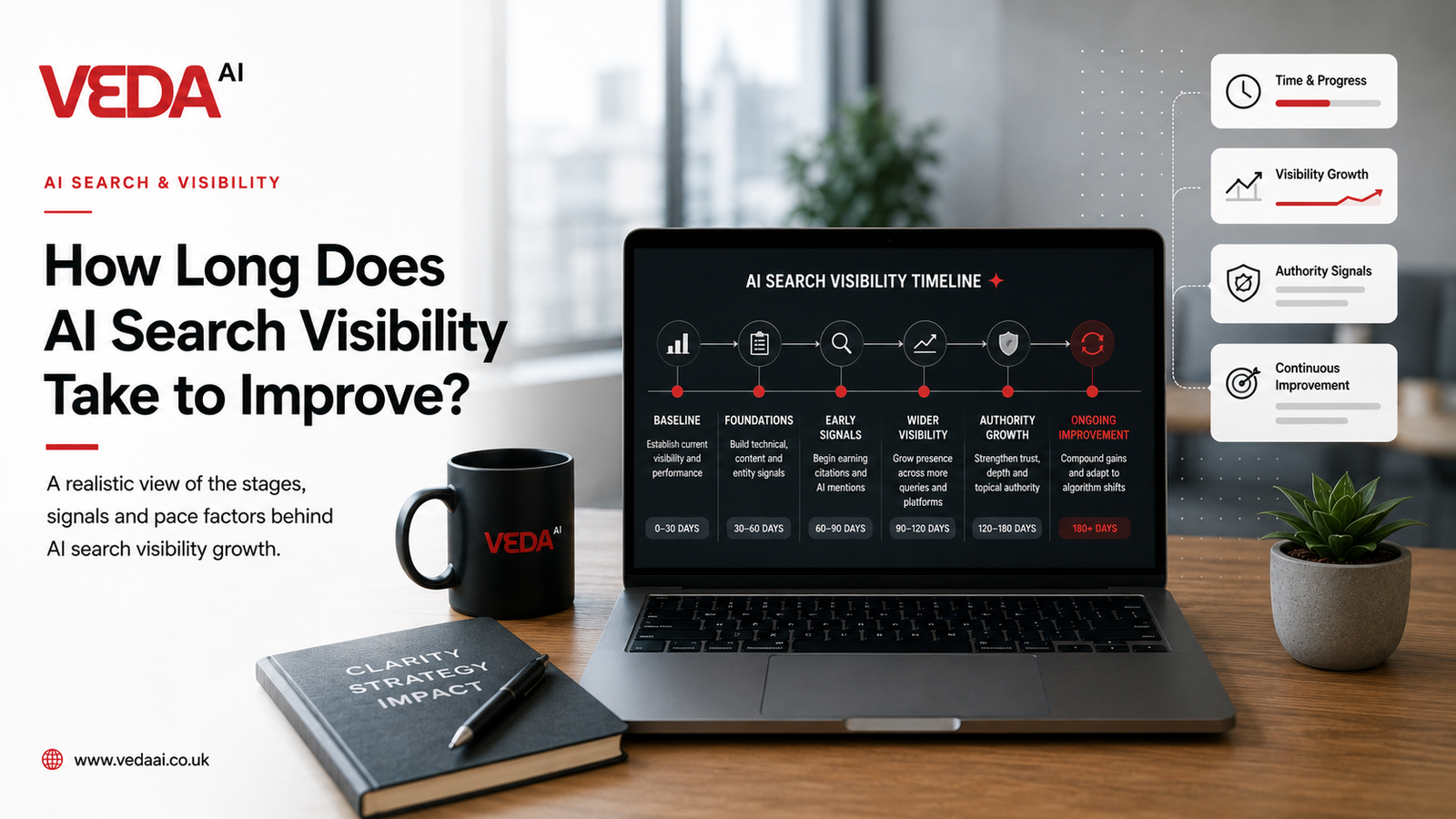
How Long Does AI Search Visibility Take to Improve?
The honest answer is that it depends on five things — and that the early signals are visible long before the commercial ones.
9 min read · 1 August 2026
Get Veda AI Edge.
Practical briefings on AI adoption, automation, intelligent products and AI-assisted search — what changed, why it matters and what to consider next. No hype, no AI theatre.
By joining you agree to receive Veda AI Edge from Veda AI. Unsubscribe any time.
Ready to find what’s worth fixing?
Start with a short call.
We’ll help you work out whether the right next step is the guide, the £995 + VAT Business Efficiency Audit, or a scoped implementation conversation.