What Should an AI Search Visibility Audit Measure?
Most so-called AI audits are website checklists with new labels. A real one starts with commercially relevant questions and ends with a measurable baseline.
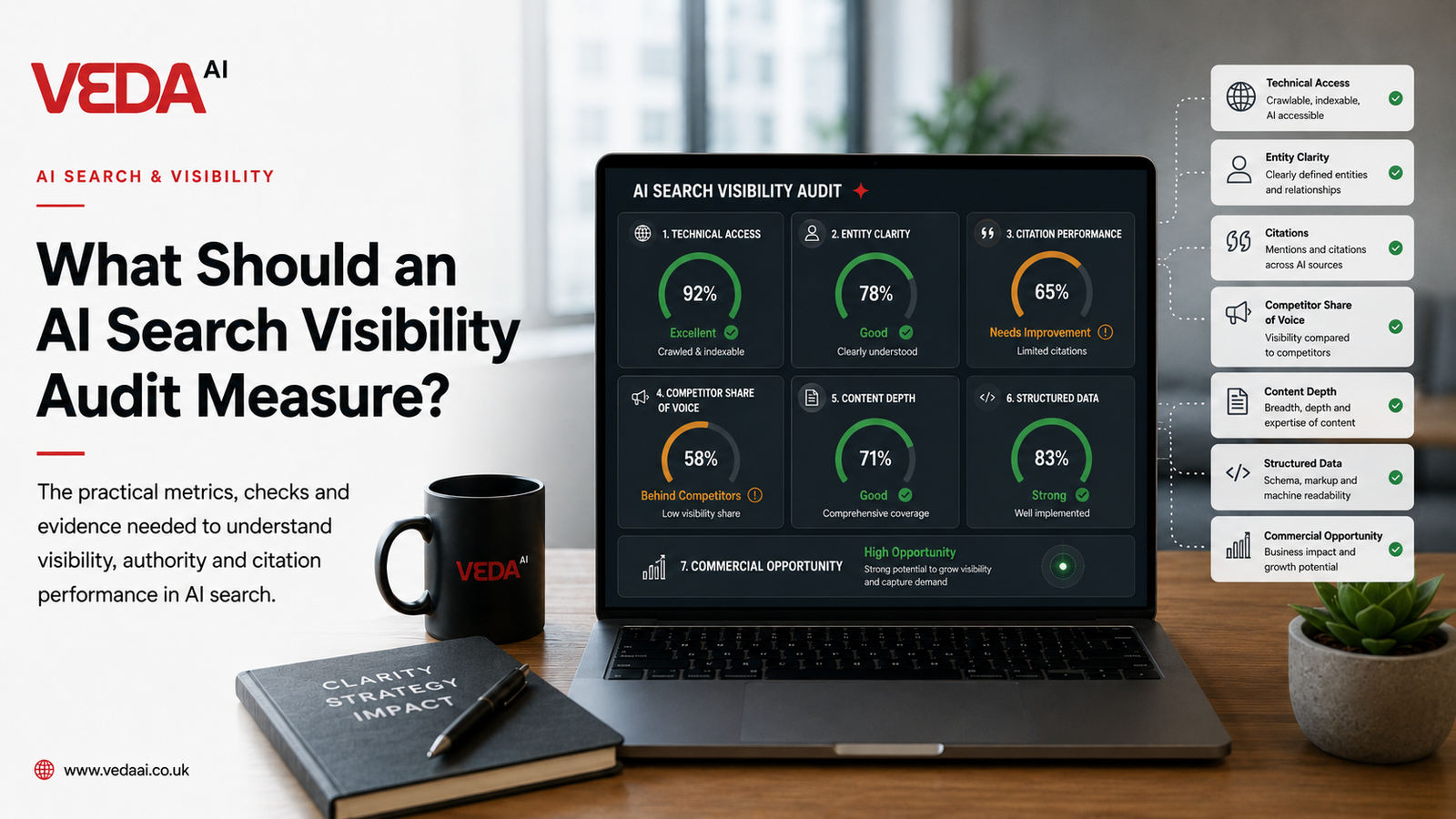
A credible AI search visibility audit should measure nine things: whether AI systems can access your site, whether they understand what you do, which commercially relevant questions you are visible for, how often, in what position, described how, against whom, supported by which sources, and what specifically to change first. Anything that stops at a website checklist is not measuring AI visibility.
This matters because the term is being applied to very different things. Some audits are a technical crawl with an AI-flavoured cover page. Others are a screenshot of one ChatGPT conversation. Neither gives you something you can act on or measure again in ninety days.
The nine things a real audit covers
1. Technical access
Whether the relevant crawlers can reach your content, and whether that reflects a decision or an accident. Because OpenAI operates distinct crawlers for training, search surfacing and user-triggered fetching, this is a policy question as much as a technical one. On Google’s side it means confirming indexation and snippet eligibility, which its guidance names as prerequisites for generative features.
2. Entity clarity
Whether a system can determine what you do, who you serve, where and with what credibility — from your site and from the wider web, consistently.
3. The prompt set
The defined set of commercially relevant questions the audit measures against. This is the single most important design decision in the whole exercise, because it determines what “visibility” even means for your business. An audit that will not show you its prompt set is not showing you its method.
4. Visibility frequency
How often you appear across that set, and on which surfaces. One appearance in twenty questions is a different problem from fifteen.
5. Position and prominence
Whether you are named first, named among several, or mentioned in passing. Being the third of five is not the same commercial outcome as being the recommendation.
6. Description accuracy and sentiment
What the answer says about you. Being named inaccurately — wrong sector, wrong size, wrong specialism — is its own problem, and one that markup and content can genuinely fix.
7. Competitive picture
Who else is named, and for which questions. This is where the commercial value usually sits, because it converts a vague concern into a specific list of questions a named competitor currently owns. It is one of the things an AI Search Visibility Audit establishes.
8. Source and citation analysis
Which sources the answers lean on. If the same five publications, directories or listings recur across a category, they are the map for the off-site work.
9. A prioritised plan and a baseline
What to change, in what order, and the recorded starting position to measure against later. Without the baseline, none of the rest can be shown to have worked.
The test to apply
Ask a prospective provider two questions: which prompts will you measure, and what will you record as the baseline? An audit that cannot answer both is a report, not a diagnostic.
How to tell a real audit from a checklist
- A checklist inspects your website and grades it. It can be produced without knowing your market.
- A diagnostic asks the questions your buyers ask, records what comes back, compares you with the firms being named instead, and traces the sources behind those answers.
The second requires knowing your commercial context. That is why the prompt set has to be built with you rather than generated from a keyword tool.
What an audit cannot tell you
Being clear about the limits is part of doing this honestly.
- It cannot predict whether you will be recommended tomorrow. Answers vary by phrasing and change over time.
- It cannot give you a single authoritative visibility percentage. Any number depends entirely on the prompt set it was measured against.
- It cannot see inside a model’s weighting. Anyone claiming to is claiming access nobody has.
- It cannot cover every assistant equally. Coverage and measurability differ by platform.
Google makes a related point in its own guidance, advising site owners to be wary of third-party tools that promise ranking success or claim to use internal metrics. The same caution applies here.
What you should receive
- The prompt set, in full, with the reasoning behind it.
- Your recorded visibility across it, by question.
- The competitors named instead of you, and where.
- The sources those answers relied on.
- The specific access, clarity and evidence gaps found.
- A prioritised plan, separating what is quick from what takes months.
- A baseline you can re-measure against.
How often to repeat it
An audit is a point-in-time measurement of something that moves. Repeating it too often produces noise; repeating it too rarely means you cannot tell whether work is landing.
- Baseline before any work begins.
- First re-measure at around ninety days, once entity and evidence changes have had time to be crawled and absorbed.
- Then on a regular cadence — quarterly suits most growing businesses.
- Re-measure the same prompt set each time. Changing the questions changes the number and destroys comparability.
That last point is the one most often got wrong. A visibility percentage measured against a different prompt set is not an improvement or a decline. It is a different measurement.
How this fits a wider programme
An audit is a diagnosis, not a treatment. It should tell you whether your problem is access, understanding, evidence, source coverage or competitive strength — the five causes we set out in why your business is missing from AI answers — and what to do first. At Veda AI that diagnosis-before-solutions sequence is how the CLARITY Method works across every engagement.
For why measurement is harder here than in conventional reporting, and what still transfers from it, see our comparison of SEO and AI search visibility. For what can and cannot be tracked once that baseline exists, see measuring AI search visibility beyond referral traffic.
Key takeaways
- Nine areas: access, entity clarity, prompt set, frequency, position, description, competitors, sources, plan.
- The prompt set is the measurement contract. No prompt set, no meaningful number.
- A baseline is what makes later improvement demonstrable.
- No audit can promise inclusion, and none can see inside a model.
Written by
Rian Patel
Founder, Veda AI
Practical thinking from real work with growing SMEs — written by the Veda AI team.
Related insights.
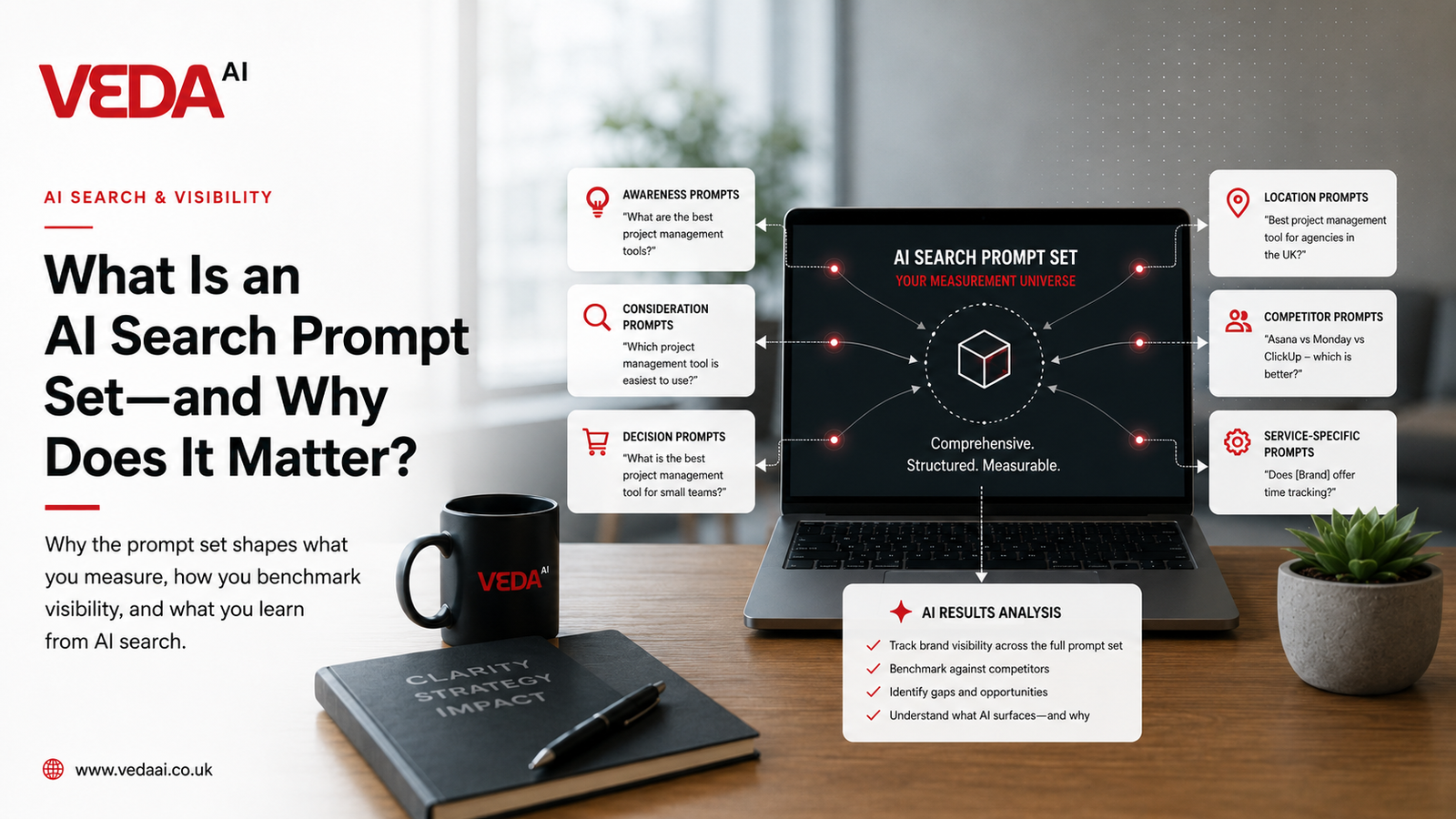
AI Search & Visibility
What Is an AI Search Prompt Set—and Why Does It Matter?
Visibility numbers only mean something relative to the questions they were measured against. The prompt set is that contract — and most reports never show you theirs.
9 min read · 1 August 2026
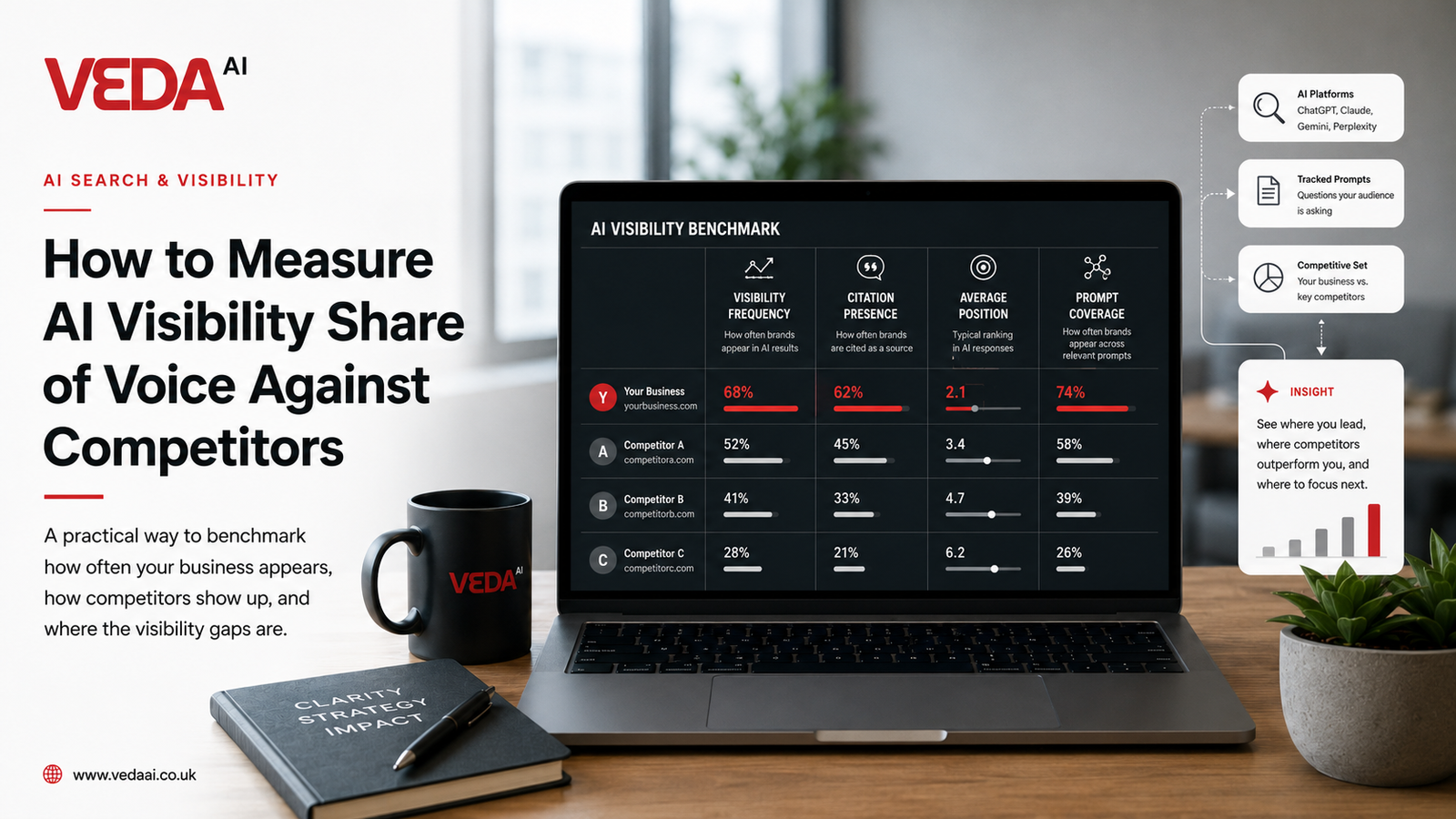
AI Search & Visibility
How to Measure AI Visibility Share of Voice Against Competitors
A single share-of-voice percentage is only as meaningful as the prompt set behind it. Here is what is actually countable across AI surfaces — and what is not.
9 min read · 1 August 2026
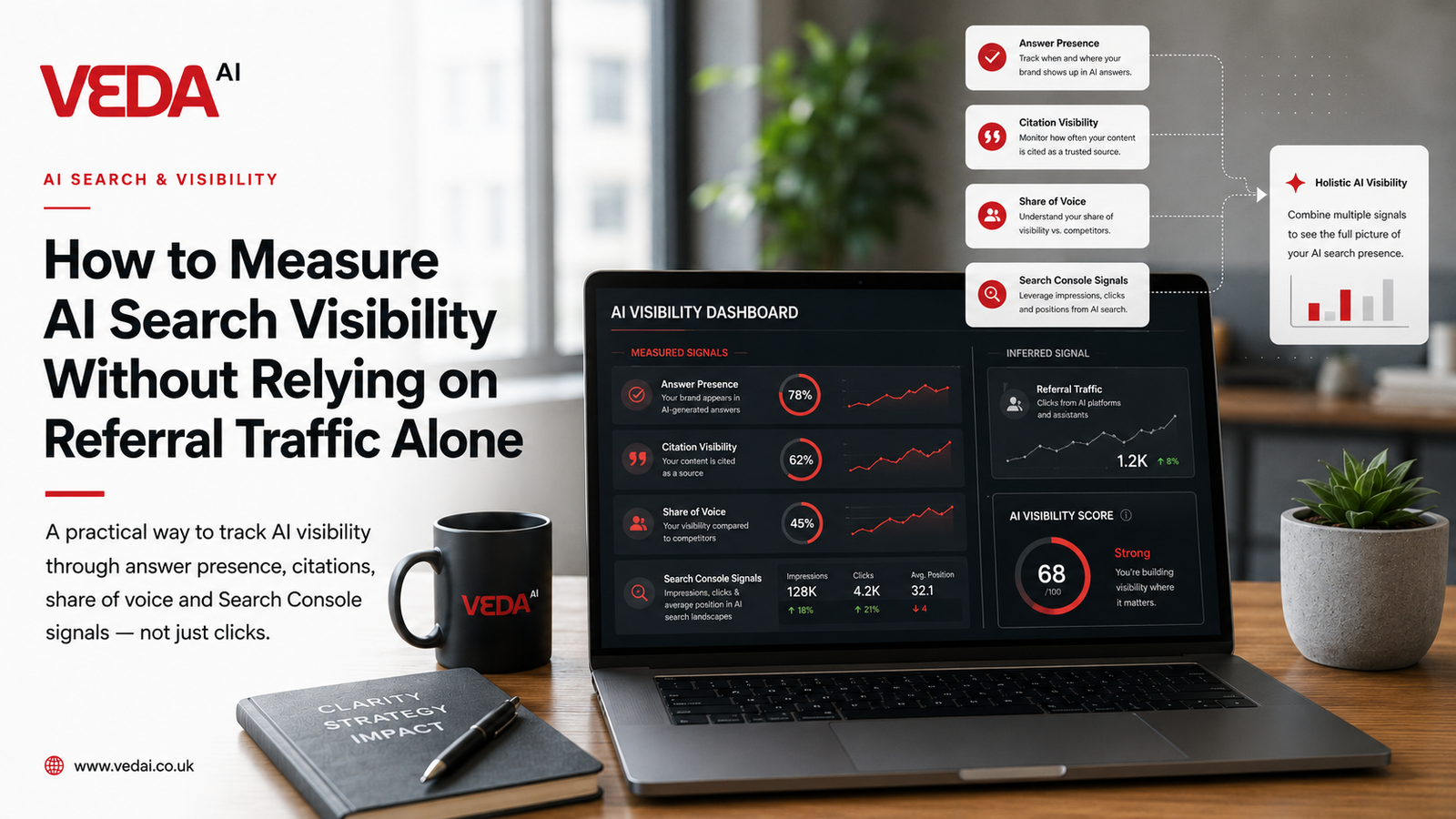
AI Search & Visibility
How to Measure AI Search Visibility Without Relying on Referral Traffic Alone
Waiting for AI referral traffic to prove the work is like judging a billboard by its click-through rate. The useful signals sit earlier in the chain.
10 min read · 1 August 2026
Get Veda AI Edge.
Practical briefings on AI adoption, automation, intelligent products and AI-assisted search — what changed, why it matters and what to consider next. No hype, no AI theatre.
By joining you agree to receive Veda AI Edge from Veda AI. Unsubscribe any time.
Ready to find what’s worth fixing?
Start with a short call.
We’ll help you work out whether the right next step is the guide, the £995 + VAT Business Efficiency Audit, or a scoped implementation conversation.