How to Measure AI Visibility Share of Voice Against Competitors
A single share-of-voice percentage is only as meaningful as the prompt set behind it. Here is what is actually countable across AI surfaces — and what is not.
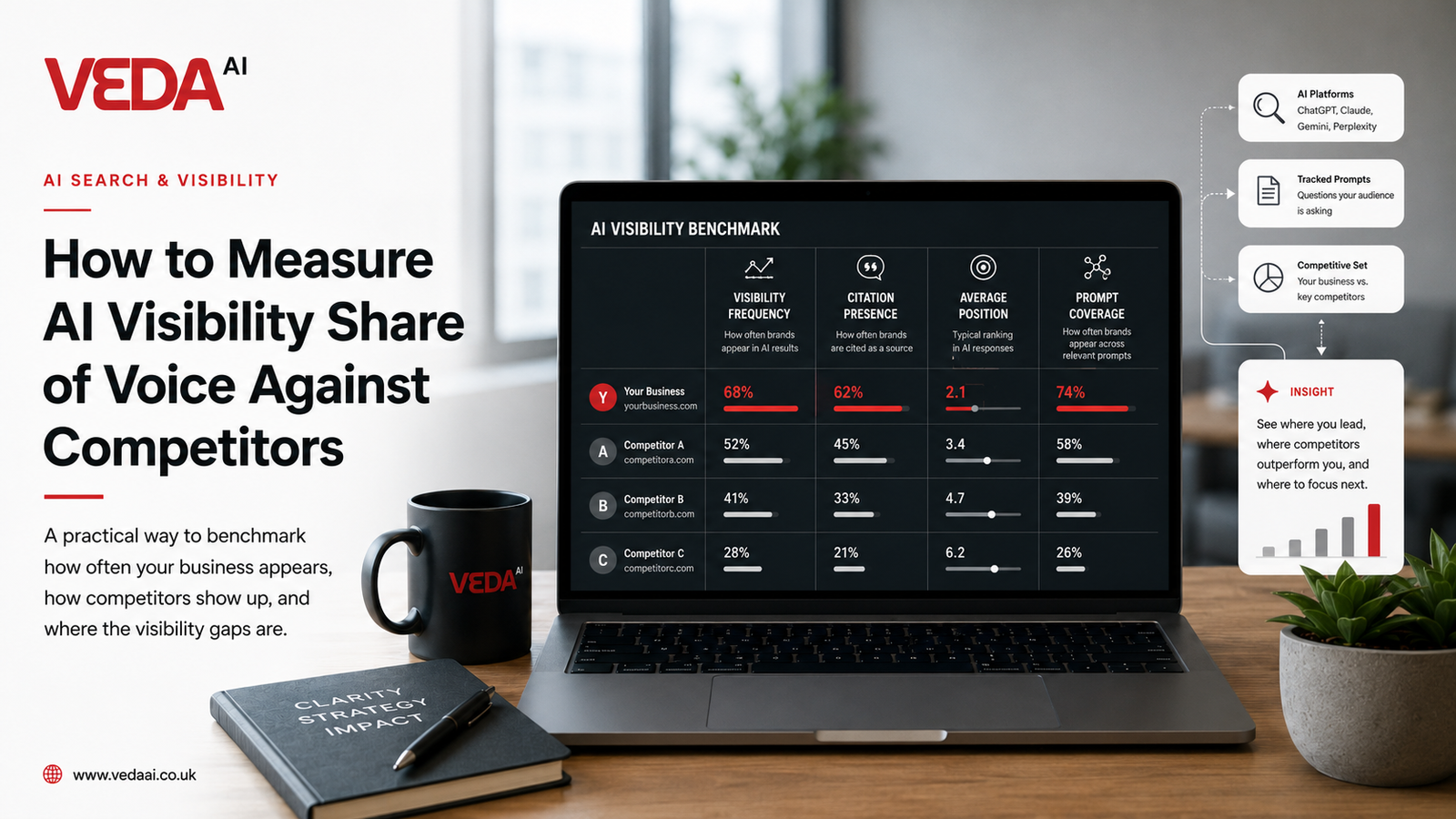
AI visibility share of voice is how often your business is named across a defined set of buyer questions, compared with the competitors named instead. There is no industry-standard calculation, and any percentage is only meaningful relative to the prompt set and surfaces it was measured on.
That is a less satisfying answer than a single number on a dashboard. It is also the honest one, and it is the difference between a metric you can act on and one you can only quote.
Why there is no standard formula
Conventional share of voice has agreed inputs — impressions, spend, ranking positions — that different tools measure comparably. AI-mediated discovery has none of that. Assistants differ in what they expose, answers vary with phrasing, and there is no shared definition of what counts as an appearance.
So before comparing any two numbers, three things have to match:
- The prompt set — the denominator. Covered in full in our guide to AI search prompt sets.
- The surfaces — which assistants were asked. Coverage and measurability differ between them.
- The counting rule — whether a passing mention counts the same as a recommendation.
Two providers can measure the same business in the same week and report very different figures without either being dishonest. They counted different things.
What can honestly be counted
Appearance frequency
The proportion of prompts in which you are named at all. The simplest measure, and the most robust to re-run. It answers “are we in the conversation”, not “are we winning it”.
Recommendation position
Where you appear when you do — named first, named among several, or mentioned in passing. Being third of five is a materially different commercial outcome from being the answer, and a frequency-only metric hides that entirely.
Competitive set
Which businesses are named instead of you, and for which prompts. This is usually the most commercially useful output of the whole exercise, because it converts “we have a visibility problem” into “these four firms own these six questions”.
Citation presence, where visible
Whether sources are shown alongside an answer, and whether yours is among them. This varies by surface and cannot be assumed. Being cited as evidence is not the same as being recommended as a supplier — a distinction we cover in what AI search visibility means.
Sentiment and description accuracy, where measurable
What the answer says about you when it names you. Being described as a generalist when you are a specialist is a visibility problem that a frequency count scores as a success.
Frequency alone flatters
A business named in eighteen of twenty prompts, always last and always described vaguely, will report excellent share of voice and win nothing. Position and description are where the commercial truth usually sits.
What cannot honestly be claimed
- That every assistant exposes the same metrics. They do not, and coverage differs by platform.
- That one measurement is stable. Answers vary with phrasing and change over time.
- That a percentage is comparable across providers, unless the prompt set, surfaces and counting rule are identical.
- That any of it reveals model weighting. Nobody outside these companies has that.
Google addresses part of the measurement gap for its own surfaces — Search Console now includes generative AI performance reporting. That covers Google. It does not cover ChatGPT, Copilot or Perplexity, and no single tool authoritatively covers all of them.
Google also advises site owners to be wary of third-party tools that promise ranking success or claim to use internal metrics. That caution transfers directly to AI visibility tooling.
A practical comparison method
- Fix the prompt set and write it down.
- Decide which surfaces you will measure, and accept the coverage limits of each.
- Ask each prompt more than once, and in more than one phrasing, to reduce single-answer noise.
- Record, per prompt: were you named, in what position, described how, alongside whom, with which sources shown.
- Aggregate by competitor rather than only by yourself — the gap list is the actionable output.
- Re-measure the identical set on a fixed cadence, and report movement rather than a headline percentage.
Reporting movement against a stable set is far more defensible than reporting an absolute figure. It also survives the reasonable question “compared with what?”.
Reading the result honestly
Four patterns come up repeatedly, and they mean different things.
- High frequency, low position — you are known but not preferred. Usually an evidence and differentiation problem rather than a technical one.
- Low frequency, good position when named — you are credible but under-corroborated. The gap is source coverage, not proposition.
- Strong on one surface, absent on another — check crawler access before concluding anything about content.
- Named accurately for one service, wrongly for another — an entity clarity problem confined to part of your offer.
Each points somewhere different, which is why a single headline percentage is a poor instrument. The value is in the breakdown.
Turning the gap into work
A competitor appearing consistently where you do not is a lead, not a verdict. The next question is why — and the answer usually lies in which sources those answers rely on. Identifying them is part of an AI Search Visibility Audit.
The gap list is where a share-of-voice number becomes something you can act on. Working through which sources AI systems cite for the competitors named instead of you is the next step.
Key takeaways
- No industry-standard share-of-voice calculation exists for AI answers.
- Any percentage is meaningless without its prompt set, surfaces and counting rule.
- Count frequency, position, competitive set, citations where visible and description accuracy.
- Assistants do not expose the same metrics; do not assume parity.
- Report movement against a stable set, not a headline number.
Written by
Rian Patel
Founder, Veda AI
Practical thinking from real work with growing SMEs — written by the Veda AI team.
Related insights.
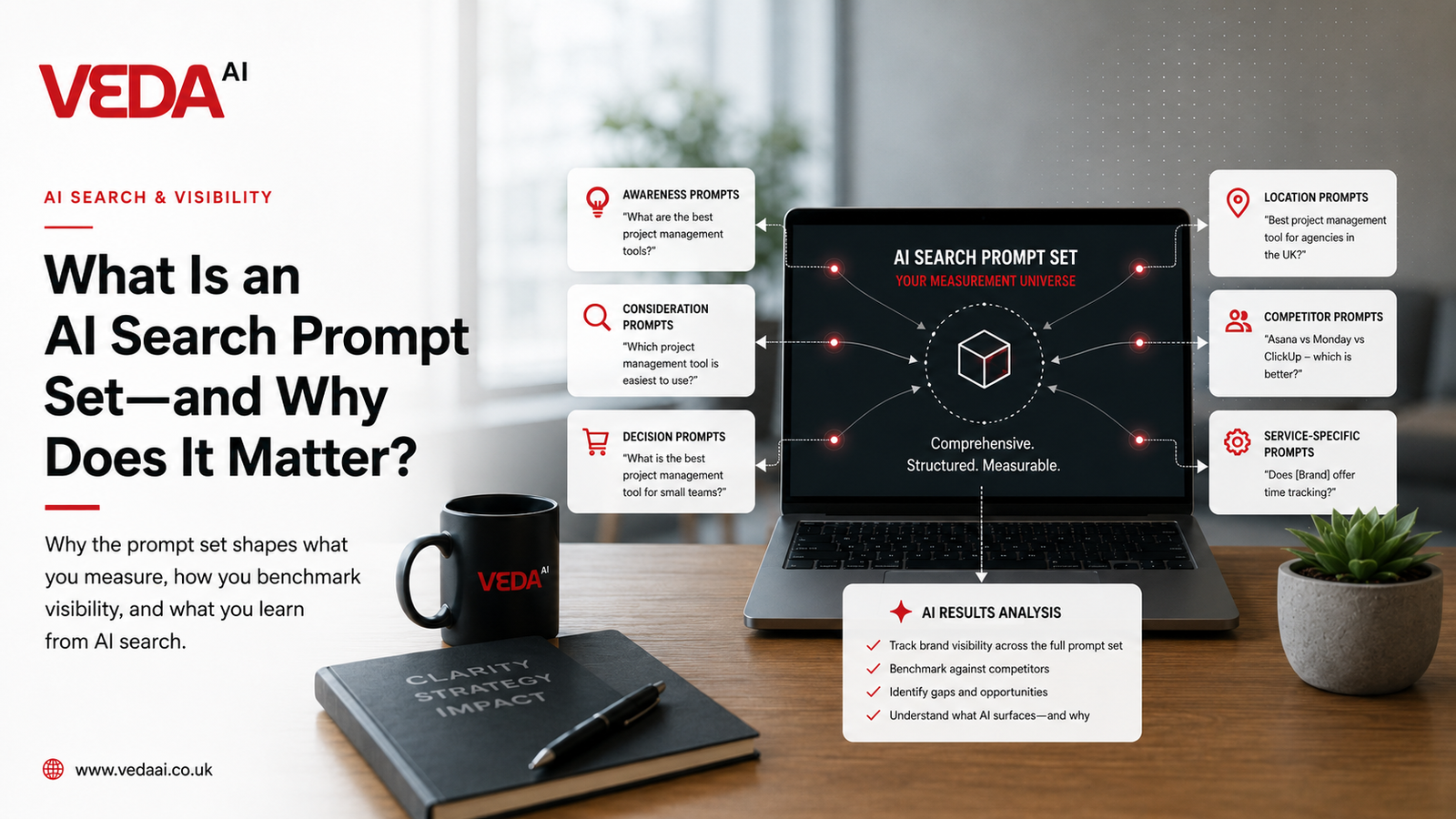
AI Search & Visibility
What Is an AI Search Prompt Set—and Why Does It Matter?
Visibility numbers only mean something relative to the questions they were measured against. The prompt set is that contract — and most reports never show you theirs.
9 min read · 1 August 2026
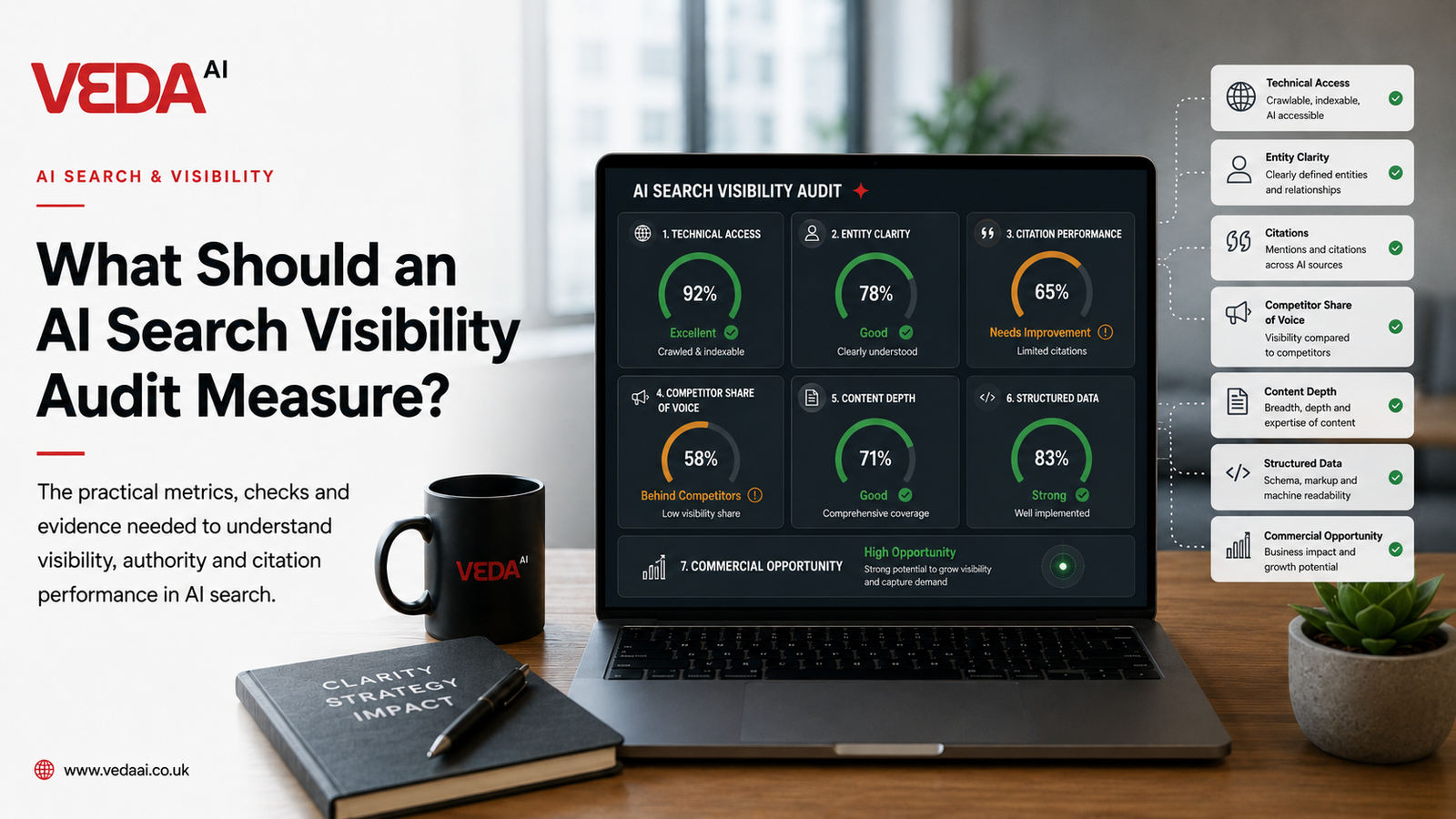
AI Search & Visibility
What Should an AI Search Visibility Audit Measure?
Most so-called AI audits are website checklists with new labels. A real one starts with commercially relevant questions and ends with a measurable baseline.
10 min read · 1 August 2026
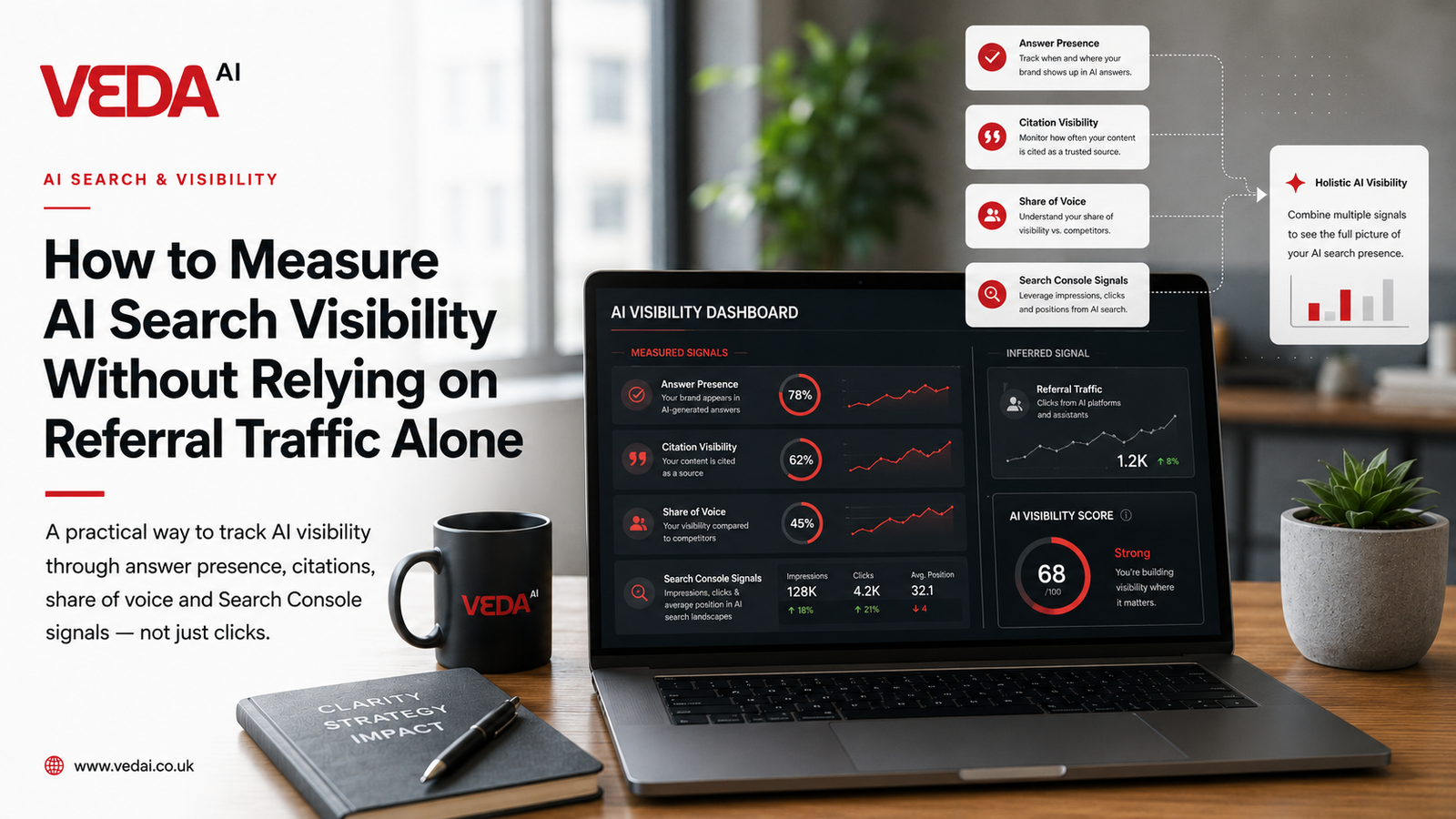
AI Search & Visibility
How to Measure AI Search Visibility Without Relying on Referral Traffic Alone
Waiting for AI referral traffic to prove the work is like judging a billboard by its click-through rate. The useful signals sit earlier in the chain.
10 min read · 1 August 2026
Get Veda AI Edge.
Practical briefings on AI adoption, automation, intelligent products and AI-assisted search — what changed, why it matters and what to consider next. No hype, no AI theatre.
By joining you agree to receive Veda AI Edge from Veda AI. Unsubscribe any time.
Ready to find what’s worth fixing?
Start with a short call.
We’ll help you work out whether the right next step is the guide, the £995 + VAT Business Efficiency Audit, or a scoped implementation conversation.