How Long Does AI Search Visibility Take to Improve?
The honest answer is that it depends on five things — and that the early signals are visible long before the commercial ones.
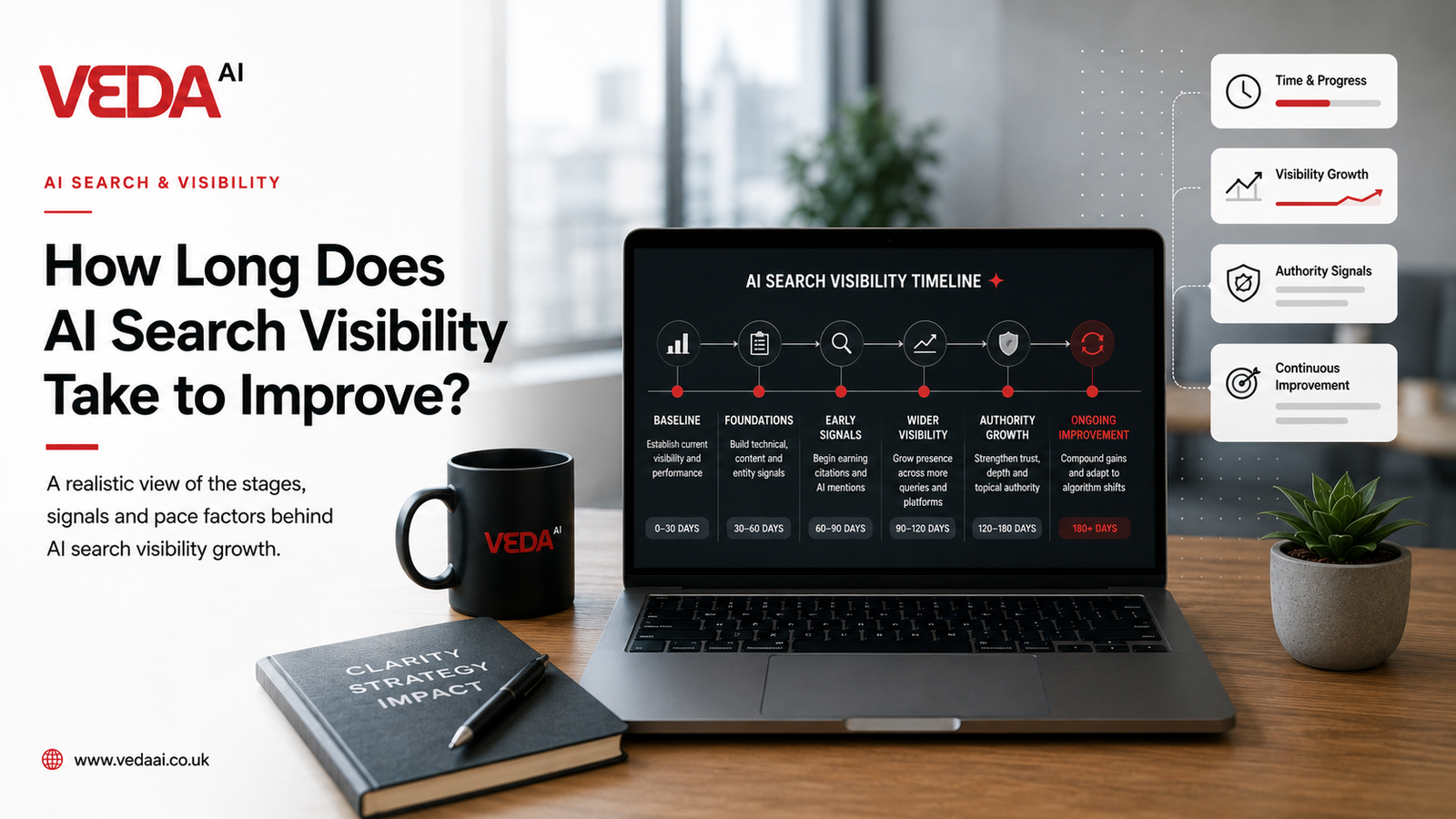
There is no fixed timeline for AI search visibility, and any provider quoting one — thirty days, ninety days, six months — is presenting a guess as a commitment. What can be said honestly is which stages happen in what order, which signals move early, and which five factors set the pace for a particular business.
That is less comfortable than a number, but it is the position the evidence supports. Nobody publishes model refresh schedules or citation mechanics, so nobody can promise a date.
The stages, in order
Access and crawling
If crawler policy is the problem, changing it is immediate — but being crawled again is not. Google requires a page to be indexed and snippet-eligible before it is eligible for generative features, so this stage gates everything after it.
Indexing and re-indexing
Changed pages have to be recrawled and reprocessed. This is ordinary search infrastructure and behaves as it always has: days to weeks, varying with site authority and crawl frequency.
Entity clarification
Making the business consistently described takes as long as the slowest source you do not control. Your own site changes today; a directory listing changes when they process it; an old profile changes when someone updates it. Weeks to months, and largely an administrative effort.
Third-party mentions
Earned coverage runs on other people’s editorial calendars. Approaches, publication and then discovery each add time. Months, realistically, and unevenly.
Citation acquisition and answer change
The slowest and least predictable stage. It depends on sources being crawled, weighed and used, none of which is visible to you.
Repeated measurement
A single re-measure proves little, because answers vary by phrasing. Confidence comes from the same prompt set measured repeatedly, which by definition takes several cycles.
Why re-measuring too early misleads
Measure a fortnight after changes and you are mostly sampling phrasing variance. Two measurements a quarter apart against a stable prompt set tell you more than six measurements a fortnight apart.
Leading indicators and lagging outcomes
Leading — visible early
- Crawlability and indexation resolved.
- Description accuracy improving where you were previously mischaracterised.
- Prompt visibility on narrower, less contested questions.
- External profiles brought into agreement.
Lagging — visible late
- Share of voice on competitive supplier-aware questions.
- Citation presence where sources are exposed.
- Branded search movement.
- Assistant-attributed enquiries.
The separation matters commercially. A programme judged only on lagging outcomes in its first quarter will look like a failure even when every leading indicator is moving correctly. The full chain is set out in measuring AI visibility beyond referrals.
Five factors that set the pace
- Existing authority — an established, well-cited business moves faster than an unknown one.
- Competition — displacing entrenched incumbents on contested questions is slow; owning a specific niche can be quick.
- Technical condition — a site with access or indexation problems has a fast first win available.
- Content quality — Google’s guidance is explicit that recycled material is not what its models are looking for. Genuinely distinctive material moves further.
- Off-site position — a business already present in its category’s sources starts much closer than one absent from all of them.
A business whose only problem is a robots.txt line can see change within weeks. A business that is genuinely unknown in a crowded market should think in quarters, and should be told so before it commissions anything.
What a client should see in the first quarter
Not results, necessarily — but evidence that real work is happening and being measured.
- A documented prompt set and a recorded baseline.
- Access and indexation issues found and resolved.
- Entity inconsistencies identified and corrected where controllable.
- A source map showing who is cited in your category and where you are absent.
- A prioritised plan separating quick wins from long work.
- A first re-measure against the identical set, reported as movement.
If none of that exists at ninety days, the problem is the programme, not the timeline. Sequencing diagnosis before delivery — and being explicit about what is not yet known — is how the CLARITY Method works across our engagements. Sustaining that work over the quarters it takes is our AI Search & Visibility service.
Two illustrative shapes
Fast case. A regional professional-services firm discovers its robots.txt blocks the crawler that surfaces sites in ChatGPT search. Access is restored, pages are recrawled, and prompt visibility on its narrower service questions moves within weeks. The constraint was technical and singular.
Slow case. A newer consultancy in a crowded market has clean technical foundations, thin proof and no presence in any source its category relies on. Entity work lands in weeks, corroboration accumulates over quarters, and competitive supplier-aware questions move last. Nothing is broken; the position simply has to be built.
Both examples are illustrative rather than client engagements. Most businesses sit between them, usually closer to the second.
What nobody can promise
- A date by which you will be recommended.
- A guaranteed citation in any assistant.
- A fixed percentage improvement.
- That gains, once made, are permanent. Answers change as competitors act and sources shift.
Key takeaways
- No fixed timeline exists; the stages are sequential and the last is the least predictable.
- Leading indicators move in weeks; lagging outcomes take quarters.
- Pace depends on authority, competition, technical condition, content quality and off-site position.
- Expect a baseline, a source map and a plan in the first quarter — not results.
- Anyone promising a date is guessing.
Written by
Rian Patel
Founder, Veda AI
Practical thinking from real work with growing SMEs — written by the Veda AI team.
Related insights.
AI Search & Visibility
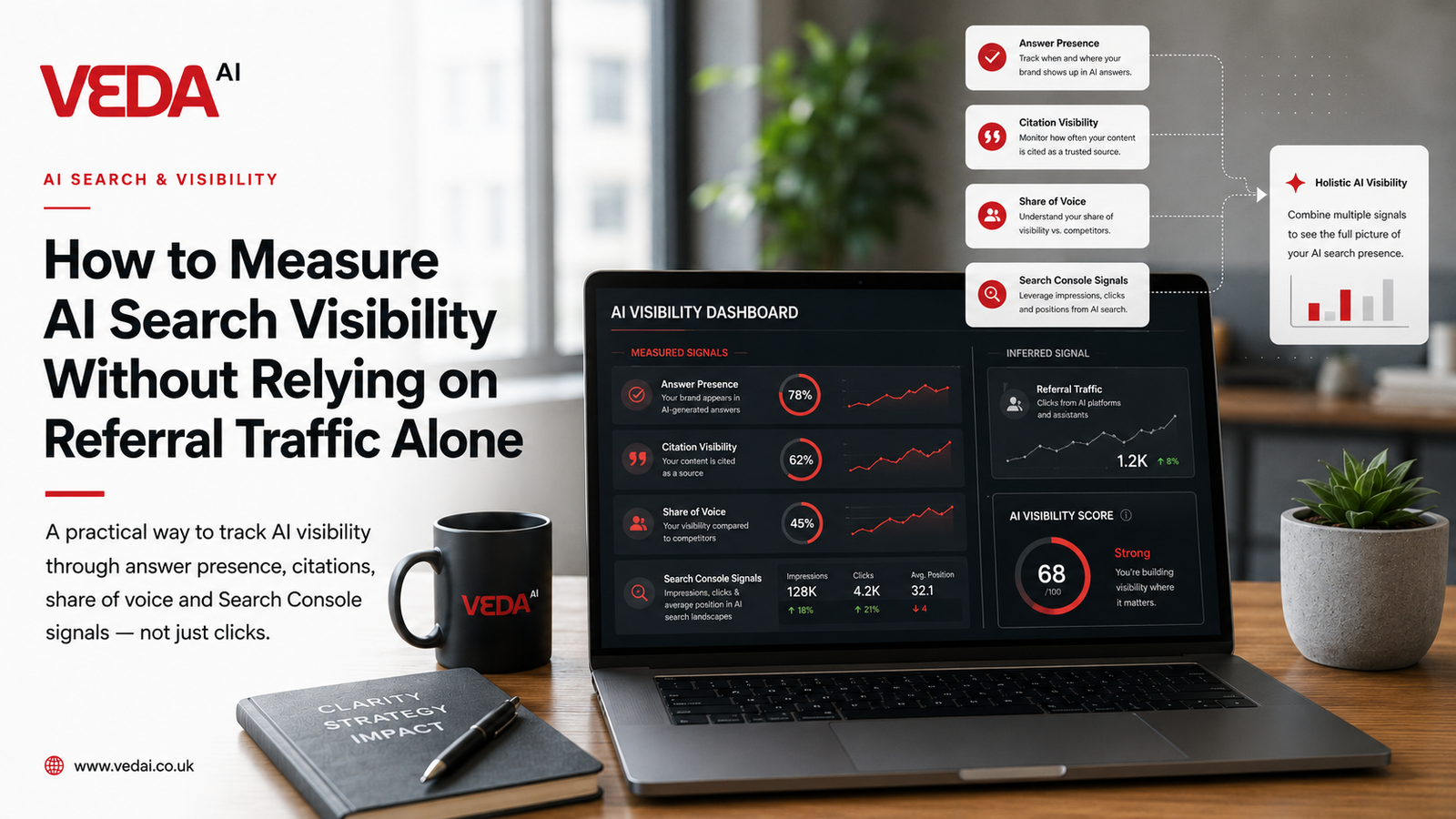
How to Measure AI Search Visibility Without Relying on Referral Traffic Alone
Waiting for AI referral traffic to prove the work is like judging a billboard by its click-through rate. The useful signals sit earlier in the chain.
10 min read · 1 August 2026
AI Search & Visibility
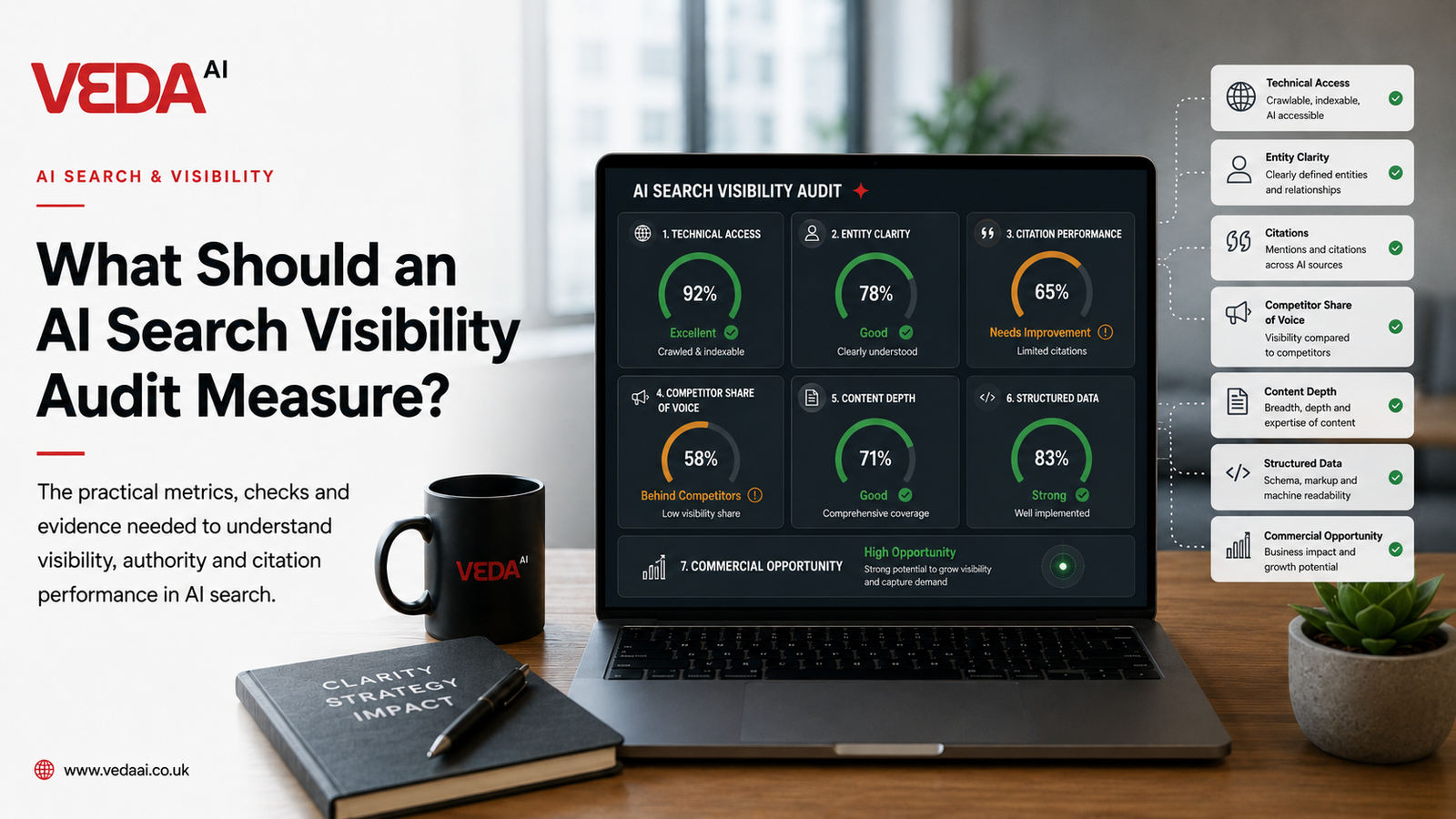
What Should an AI Search Visibility Audit Measure?
Most so-called AI audits are website checklists with new labels. A real one starts with commercially relevant questions and ends with a measurable baseline.
10 min read · 1 August 2026
AI Search & Visibility
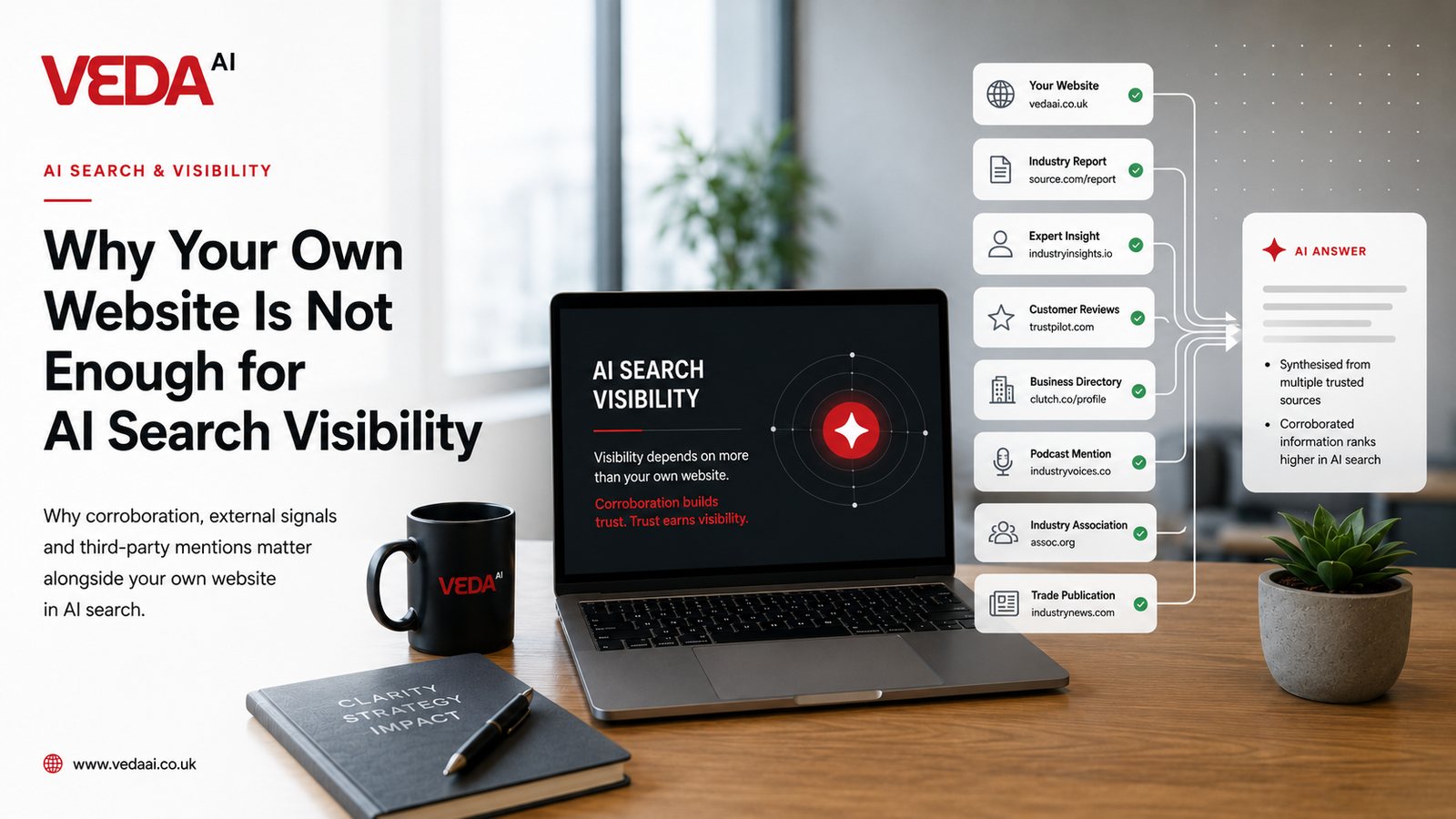
Why Your Own Website Is Not Enough for AI Search Visibility
A website is a claim. Corroboration is what makes a claim usable. That gap explains most of the AI visibility problems a good site cannot fix.
9 min read · 1 August 2026
Get Veda AI Edge.
Practical briefings on AI adoption, automation, intelligent products and AI-assisted search — what changed, why it matters and what to consider next. No hype, no AI theatre.
By joining you agree to receive Veda AI Edge from Veda AI. Unsubscribe any time.
Ready to find what’s worth fixing?
Start with a short call.
We’ll help you work out whether the right next step is the guide, the £995 + VAT Business Efficiency Audit, or a scoped implementation conversation.