Why Your Own Website Is Not Enough for AI Search Visibility
A website is a claim. Corroboration is what makes a claim usable. That gap explains most of the AI visibility problems a good site cannot fix.
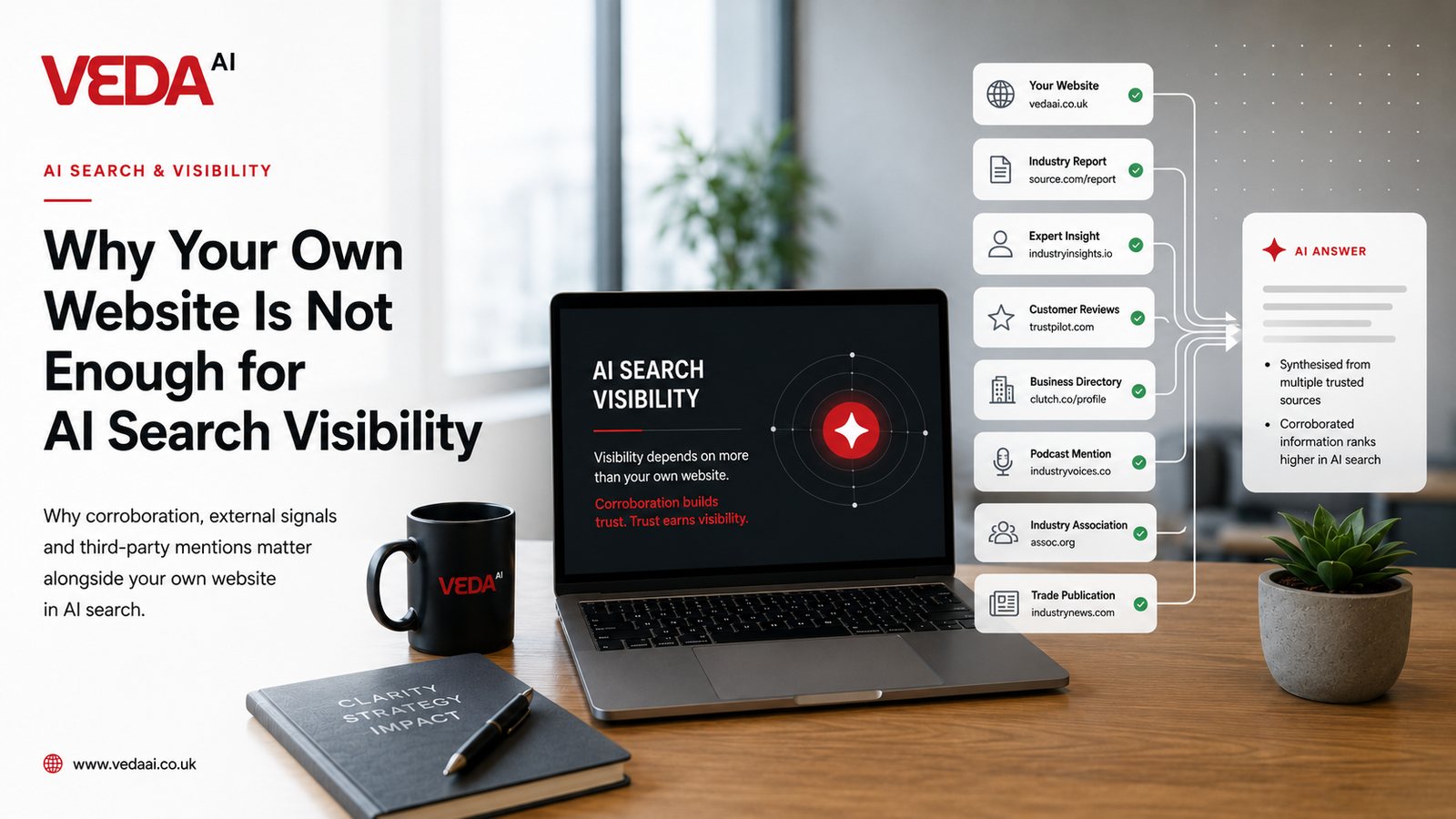
Your website is what you say about yourself. AI answers are assembled from many sources, most of which you do not own. That gap is why a genuinely good site can still leave a business absent from the answers that matter.
This is the single largest departure from conventional SEO thinking, where the site is the asset and everything else is a link. Here, what other people say is not a supporting signal. It is a substantial part of the evidence.
Owned truth and corroborated truth
Owned truth is everything you publish: services, case studies, team, claims. It is necessary, it is fully under your control, and it is inherently self-interested. Every competitor also says they are excellent.
Corroborated truth is the same information appearing where you did not write it: a directory listing, an association membership, a trade publication, a review, a podcast appearance, a comparison article. It costs something to obtain, which is exactly why it carries weight.
A system trying to recommend a supplier is weighing risk on a stranger’s behalf. Two firms both claiming excellence, one corroborated and one not, are not equally safe answers.
Where corroboration actually comes from
Reviews and ratings platforms
Sector-relevant ones, with real reviews. Volume matters less than authenticity and recency, and fabricated reviews are both detectable and a schema policy breach if marked up.
Industry roundups and comparison articles
The "best X for Y" content that already exists in your category. If a set of these consistently lists five firms and you are not among them, that is a specific, addressable gap.
Trade and regional media
Coverage that ties your organisation to a sector, a place and a specialism. Regional trade press is often more attainable and more topically precise than national coverage.
Podcasts and expert commentary
Named people saying substantive things. This corroborates the individuals as well as the company, which matters because people are entities too.
Associations, accreditations and memberships
Third-party registers that independently confirm you exist, operate in a sector and meet some standard. Under-rated, because they are stable and unambiguous.
Why consistency is the hard part
Ten external mentions that describe your business ten slightly different ways can be worse than three that agree. Conflicting descriptions give a system no basis for choosing which is right, so it may use none of them confidently.
What third-party mentions do not do
This is where the discipline needs to be honest, because the temptation to over-promise is considerable.
- A mention does not cause a citation. There is no mechanism by which publishing a guest article guarantees an assistant will reference you.
- Not all sources carry equal weight, and no one outside these companies knows the weighting.
- Different assistants draw on different sources and different retrieval systems. Being well covered where one looks says little about another.
- Coverage does not compensate for a weak proposition. It amplifies whatever is there.
What corroboration does is make you a safer, better-evidenced answer where you are already plausible. That is a real effect and a modest one, and it compounds slowly.
Different systems, different sources
It is worth resisting the assumption that all AI answers work alike. Google states its generative features are rooted in its core Search ranking and quality systems, and that content must be indexed and snippet-eligible. OpenAI documents a separate crawler for surfacing sites in ChatGPT search, distinct from its training crawler.
The practical consequence: access, coverage and measurability differ by platform, and a strategy tuned entirely to one is fragile. Breadth of credible corroboration is more robust than optimising for a single assistant’s current behaviour.
A proportionate off-site programme
- Fix consistency first. Make the one-line description of the business identical everywhere it already appears.
- Claim and correct what exists — directories, registers, association listings, old profiles.
- Identify the sources already shaping answers in your category, rather than guessing.
- Earn a small number of genuinely relevant placements, chosen for topical precision over reach.
- Make your people visible and quotable, so commentary opportunities are answerable.
- Re-measure against the same prompt set, and expect movement over quarters rather than weeks.
Step three is where most programmes go wrong by substituting activity for analysis. Finding which sources actually matter is a specific exercise, covered in competitor citation analysis.
The order corroboration tends to arrive in
Useful to know, because the cheapest wins come first and are often skipped in favour of the glamorous ones.
- Registers and listings — Companies House, associations, accreditations. Cheap, stable, entirely factual.
- Review platforms — inviting honest reviews from existing clients. Requires nothing but asking.
- Partner and supplier pages — firms you already work with often list partners. Frequently overlooked.
- Local and trade press — attainable with a genuine story, and topically precise.
- Commentary and podcasts — requires a person willing to be quotable.
- Independent roundups — the hardest, because inclusion is someone else’s editorial decision.
A business that has done none of the first three has no business chasing the last one.
Where this connects to the rest
Source coverage is one of five reasons a business goes missing from AI answers — see why your business is missing from ChatGPT. It only works if the underlying identity is coherent, which is entity clarity. Our own approach to making people and evidence visible is on the leadership and case studies pages. Building that external picture deliberately is part of our AI Search & Visibility service.
Key takeaways
- Your site is a claim; corroboration is what makes it usable.
- Reviews, roundups, trade media, commentary and registers all contribute.
- Mentions do not cause citations — no such guarantee exists.
- Different assistants use different sources and retrieval systems.
- Consistency across sources matters more than volume of them.
Written by
Rian Patel
Founder, Veda AI
Practical thinking from real work with growing SMEs — written by the Veda AI team.
Related insights.
AI Search & Visibility
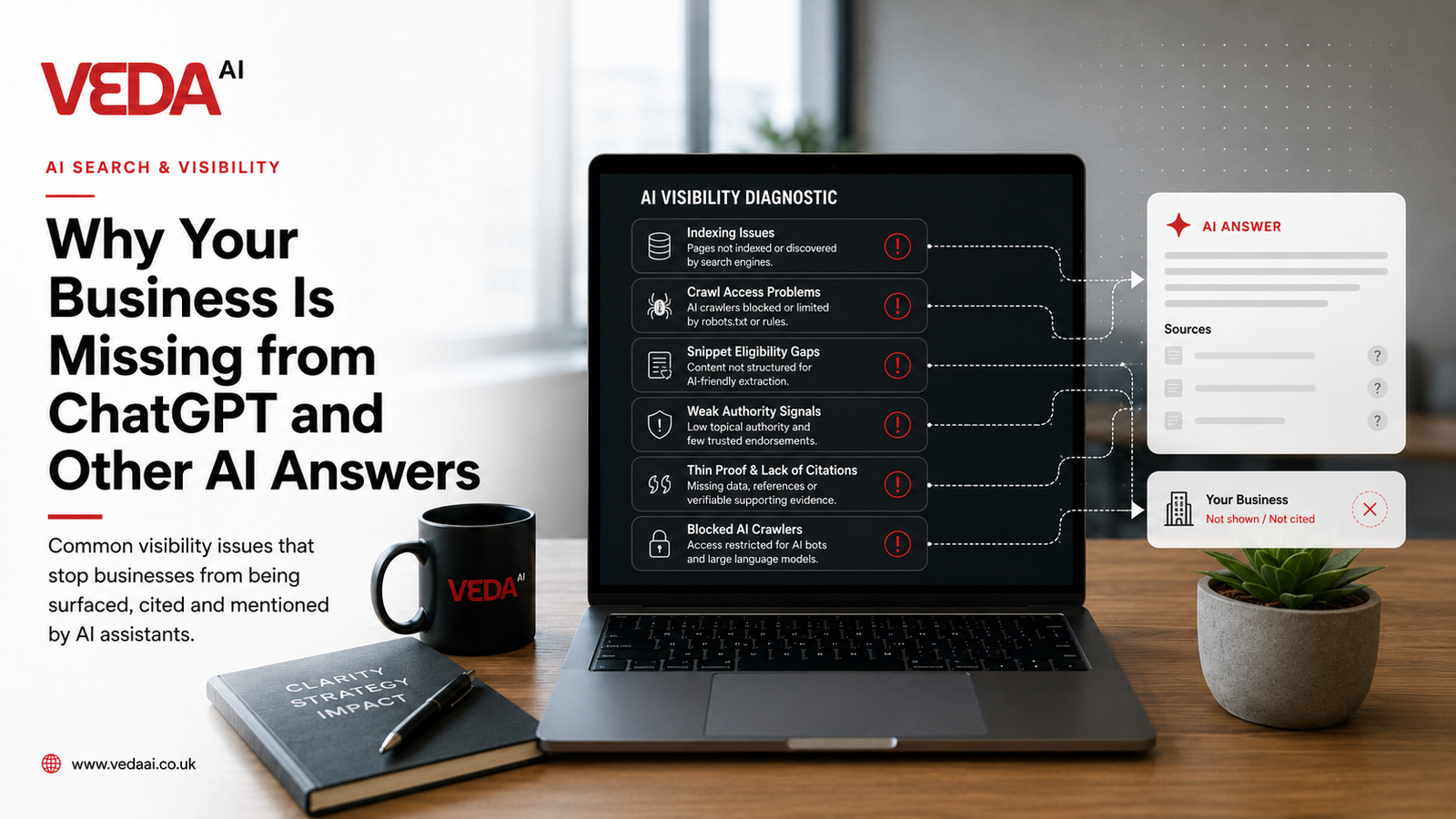
Why Your Business Is Missing from ChatGPT and Other AI Answers
Being absent from AI answers is rarely mysterious. It is usually access, understanding, evidence, source coverage or competition — and they need different fixes.
10 min read · 1 August 2026
AI Search & Visibility
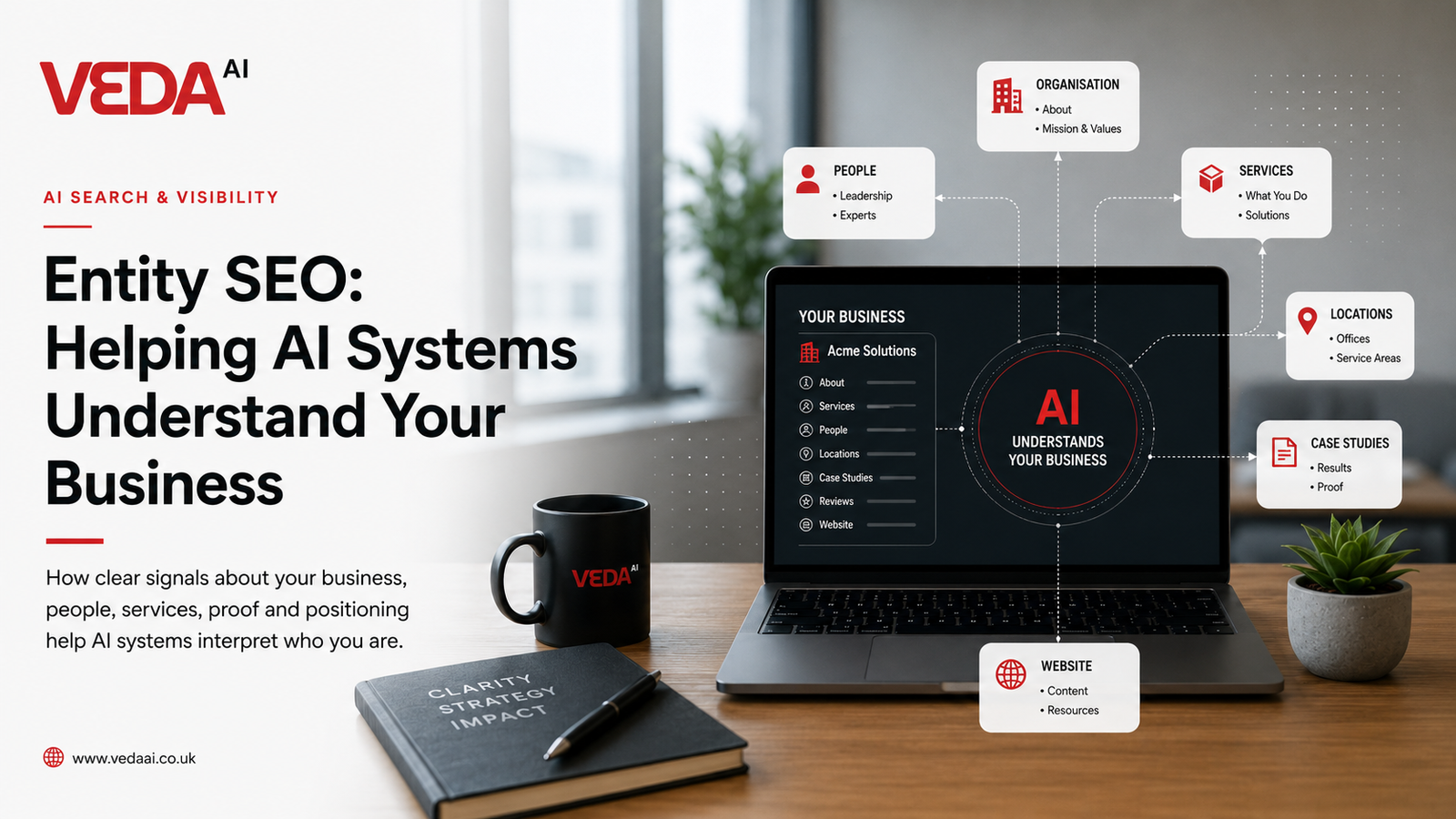
Entity SEO: Helping AI Systems Understand Your Business
Keyword optimisation makes a page findable. Entity clarity makes a business identifiable — and that is what determines whether a system can describe you at all.
9 min read · 1 August 2026
AI Search & Visibility
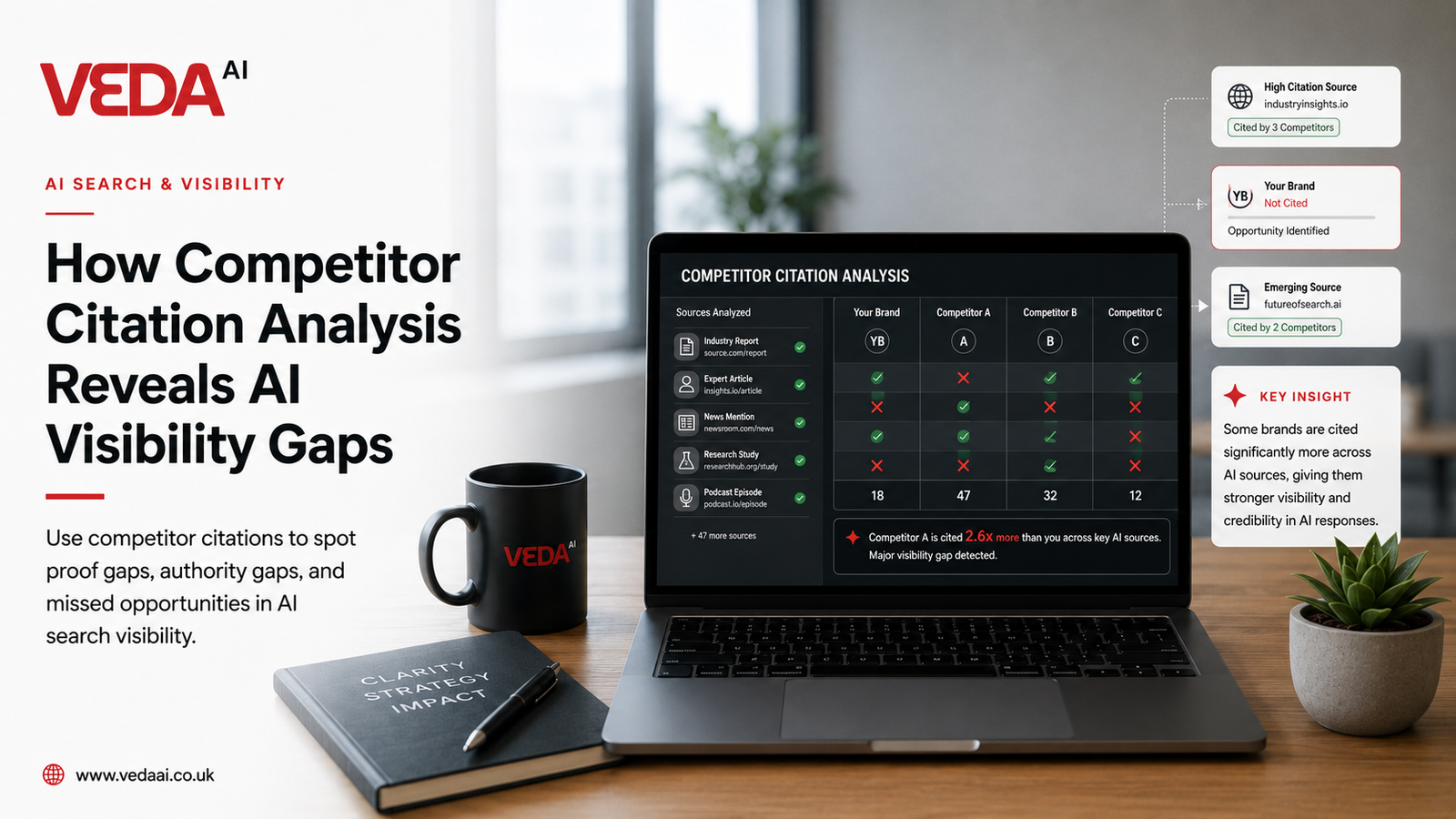
How Competitor Citation Analysis Reveals AI Visibility Gaps
The sources behind a competitor’s recommendation are a map. Some of that map is earnable, some is not — and knowing which is the whole point of the exercise.
9 min read · 1 August 2026
Get Veda AI Edge.
Practical briefings on AI adoption, automation, intelligent products and AI-assisted search — what changed, why it matters and what to consider next. No hype, no AI theatre.
By joining you agree to receive Veda AI Edge from Veda AI. Unsubscribe any time.
Ready to find what’s worth fixing?
Start with a short call.
We’ll help you work out whether the right next step is the guide, the £995 + VAT Business Efficiency Audit, or a scoped implementation conversation.