How Competitor Citation Analysis Reveals AI Visibility Gaps
The sources behind a competitor’s recommendation are a map. Some of that map is earnable, some is not — and knowing which is the whole point of the exercise.
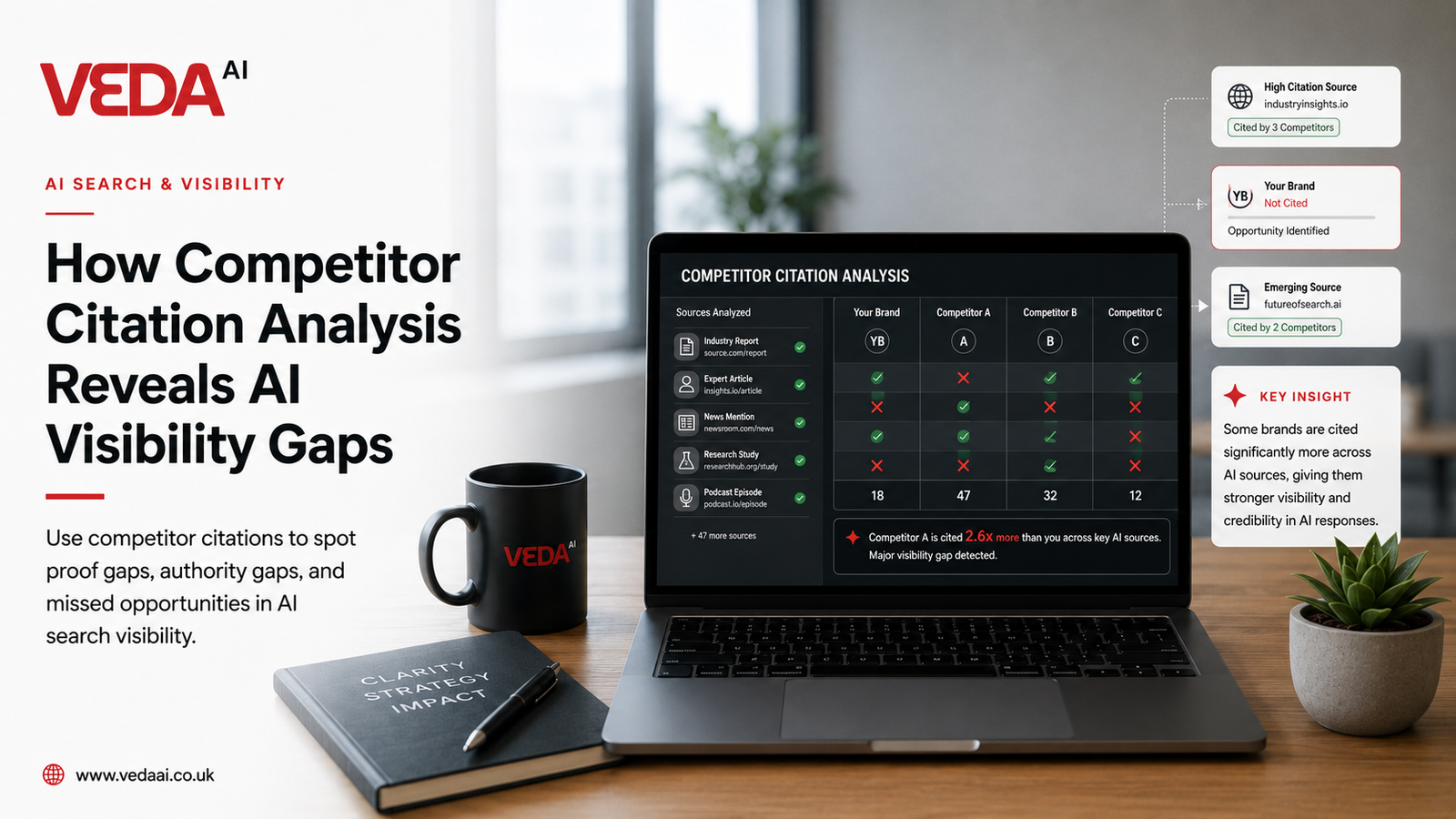
Competitor citation analysis means asking the questions your buyers ask, recording which businesses are recommended, and tracing which sources those answers lean on. The output is a map of where your category’s credibility currently lives — and which parts of it you can realistically reach.
It is the most directly actionable exercise in AI visibility work, because it converts a vague concern into a specific list: these firms, these questions, these sources.
How it works, in public terms
- Take a fixed prompt set — the same one used for baseline measurement.
- Record who is named for each prompt, and in what position.
- Where sources are shown, record them. Where they are not, infer cautiously from what the answer asserts.
- Group the sources: your competitors’ own sites, directories, editorial roundups, trade media, review platforms, associations.
- Compare against your own coverage of the same sources.
- Classify each gap by type, because the type determines the remedy.
None of this requires special access. It requires a stable prompt set, patience with phrasing variance, and honest recording. The value is in the discipline, not in any secret method.
Four kinds of gap
Owned gaps
The answer needs something your site does not say. You have no page addressing the question, or the page exists but never states plainly what a buyer needs to know. Fixable quickly and entirely within your control.
Proof gaps
You make the claim, but nothing evidences it. Competitors have named work in the sector; you have a services page. Fixable, but at the speed of client permission rather than publishing.
Source gaps
The sources shaping answers in your category do not mention you at all. Nothing on your site fixes this. It requires being present where the conversation already happens.
Authority gaps
You are present, but consistently outweighed. A competitor is genuinely more established or better corroborated. This closes slowly, if at all, and is worth being realistic about.
Why the classification matters
Nearly all wasted spend in this area comes from applying the wrong remedy: publishing more content against a source gap, or chasing coverage against an owned gap that a single clear page would have fixed.
Editorial opportunities versus placements you cannot buy — or should not
Not every source on the map is reachable, and treating them alike leads to bad decisions.
- Genuinely earnable — trade commentary, expert contribution, association membership, legitimate directory listings, review platforms where customers can be invited honestly.
- Editorially controlled — independent roundups and comparison articles. You can make yourself a credible candidate; you cannot require inclusion.
- Vendor-controlled — some directories and comparison sites operate paid placement. That is a legitimate marketing decision, but it should be recognised as advertising rather than earned authority.
- Not appropriate — paying for undisclosed editorial, fabricating reviews, or manufacturing coverage. Beyond the ethics, it is fragile and detectable.
A useful analysis labels which category each source falls into. A list of two hundred "opportunities" that quietly mixes all four is not a plan.
What the findings should change
- Content — built from real gaps rather than keyword volume. If four questions have no adequate page anywhere, that is a content brief.
- PR and commentary — targeted at the publications already shaping answers, not at reach for its own sake.
- Partnerships and associations — membership of the registers that recur in your category.
- Review strategy — inviting honest reviews on the platforms that actually surface, not whichever is easiest.
- Outreach — approaching roundup authors with a genuine reason to be considered, and accepting no as an answer.
Reading a source map
Once the sources are grouped, three patterns tend to explain most of the picture.
- One dominant source — a single directory or publication recurs behind most answers. High leverage, and worth verifying it is genuinely editorial rather than paid.
- A long tail with no centre — answers draw on many places with little overlap. Suggests the category has no established authority, which is an opportunity if you can become one.
- Competitor-owned sources — answers lean on competitors’ own content because nobody independent has written about the category. The fix is publishing genuinely better material, not chasing placements that do not exist.
The third is more common in specialist B2B than people expect, and it is the most encouraging finding, because it is addressable with work you control.
Honest limits
- Not every citation can be earned. Some sources will never include you, for editorial or commercial reasons.
- Displacement is not guaranteed. Appearing in a source a competitor uses does not remove them from the answer.
- Source visibility varies. Some surfaces show sources clearly, others do not, and inference has limits.
- Answers change. A map is a snapshot, useful for a period rather than permanently.
Google advises site owners to be wary of tools promising ranking success or claiming internal metrics. The equivalent here is any provider promising to place you in a competitor’s citations.
Where this sits
Citation analysis is a component of a full diagnostic rather than a standalone product — see what an AI visibility audit should measure. It follows naturally from share of voice measurement, which tells you a gap exists, and it acts on the principle set out in why your own website is not enough. Where it sits in a scoped diagnosis is set out on the AI Search Visibility Audit.
Key takeaways
- Trace who is recommended and which sources support them.
- Classify gaps as owned, proof, source or authority — each has a different fix.
- Separate earnable, editorially controlled and vendor-controlled sources honestly.
- Not every citation can be earned, and displacement is never guaranteed.
Written by
Rian Patel
Founder, Veda AI
Practical thinking from real work with growing SMEs — written by the Veda AI team.
Related insights.
AI Search & Visibility
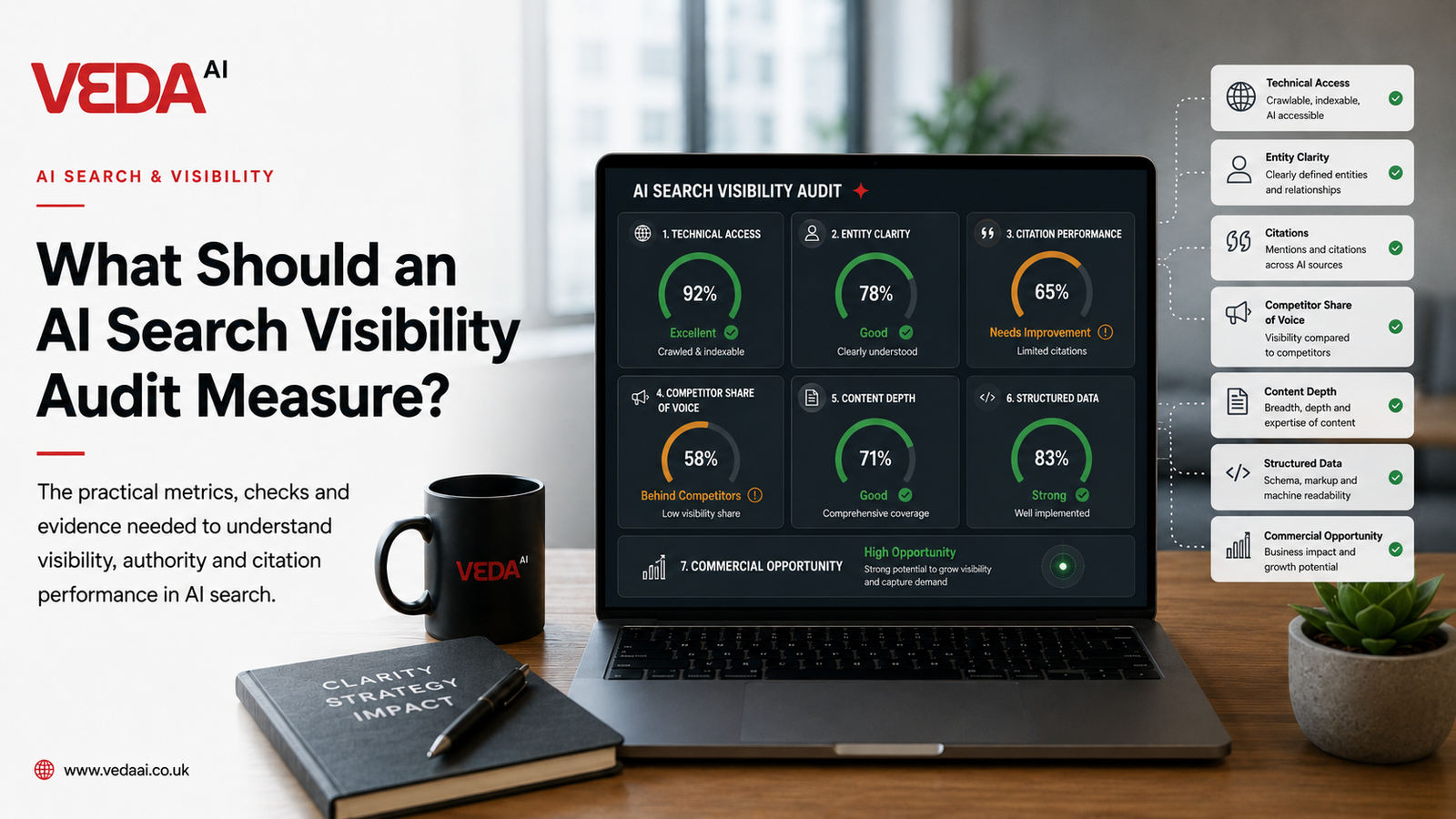
What Should an AI Search Visibility Audit Measure?
Most so-called AI audits are website checklists with new labels. A real one starts with commercially relevant questions and ends with a measurable baseline.
10 min read · 1 August 2026
AI Search & Visibility
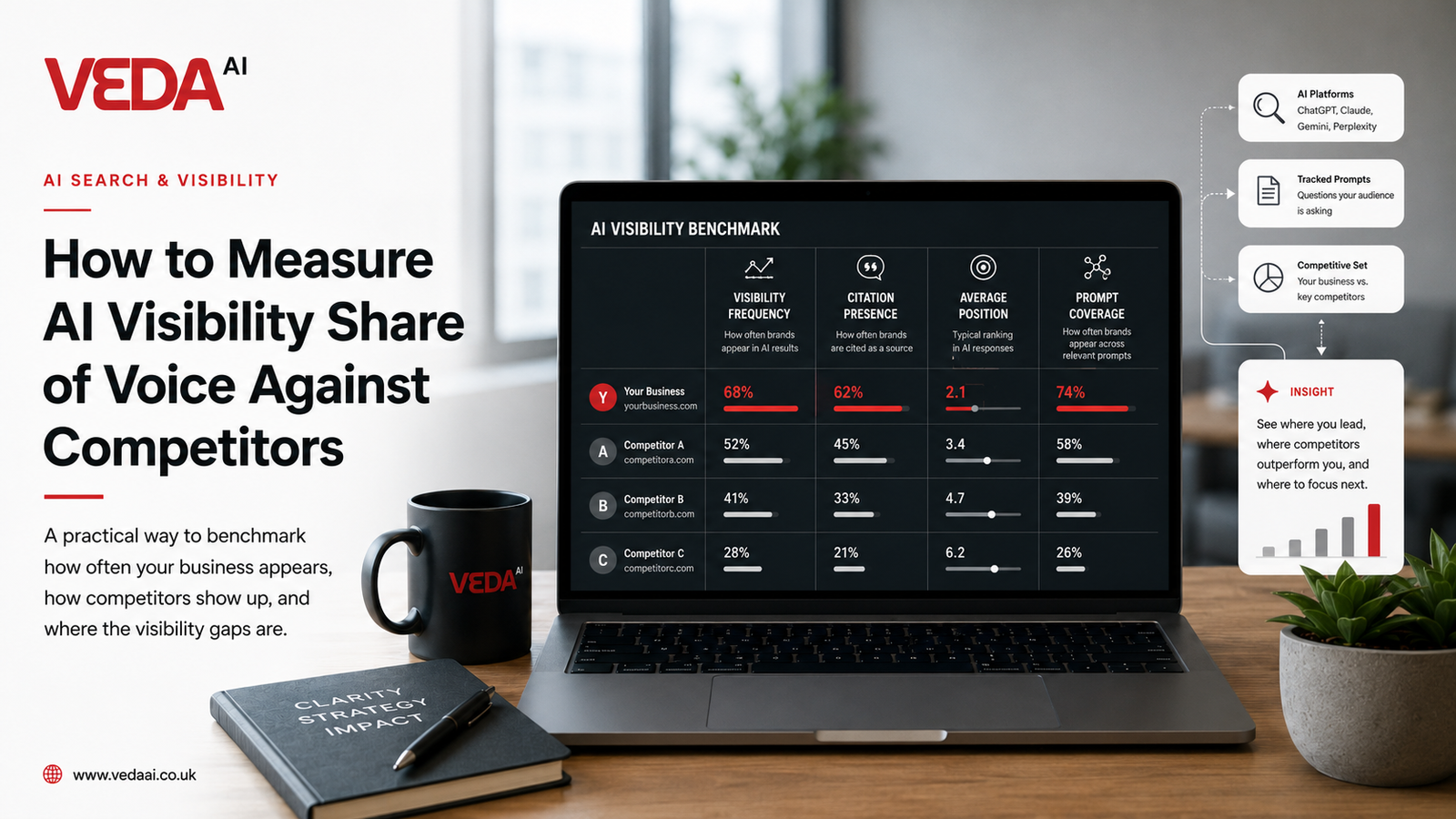
How to Measure AI Visibility Share of Voice Against Competitors
A single share-of-voice percentage is only as meaningful as the prompt set behind it. Here is what is actually countable across AI surfaces — and what is not.
9 min read · 1 August 2026
AI Search & Visibility
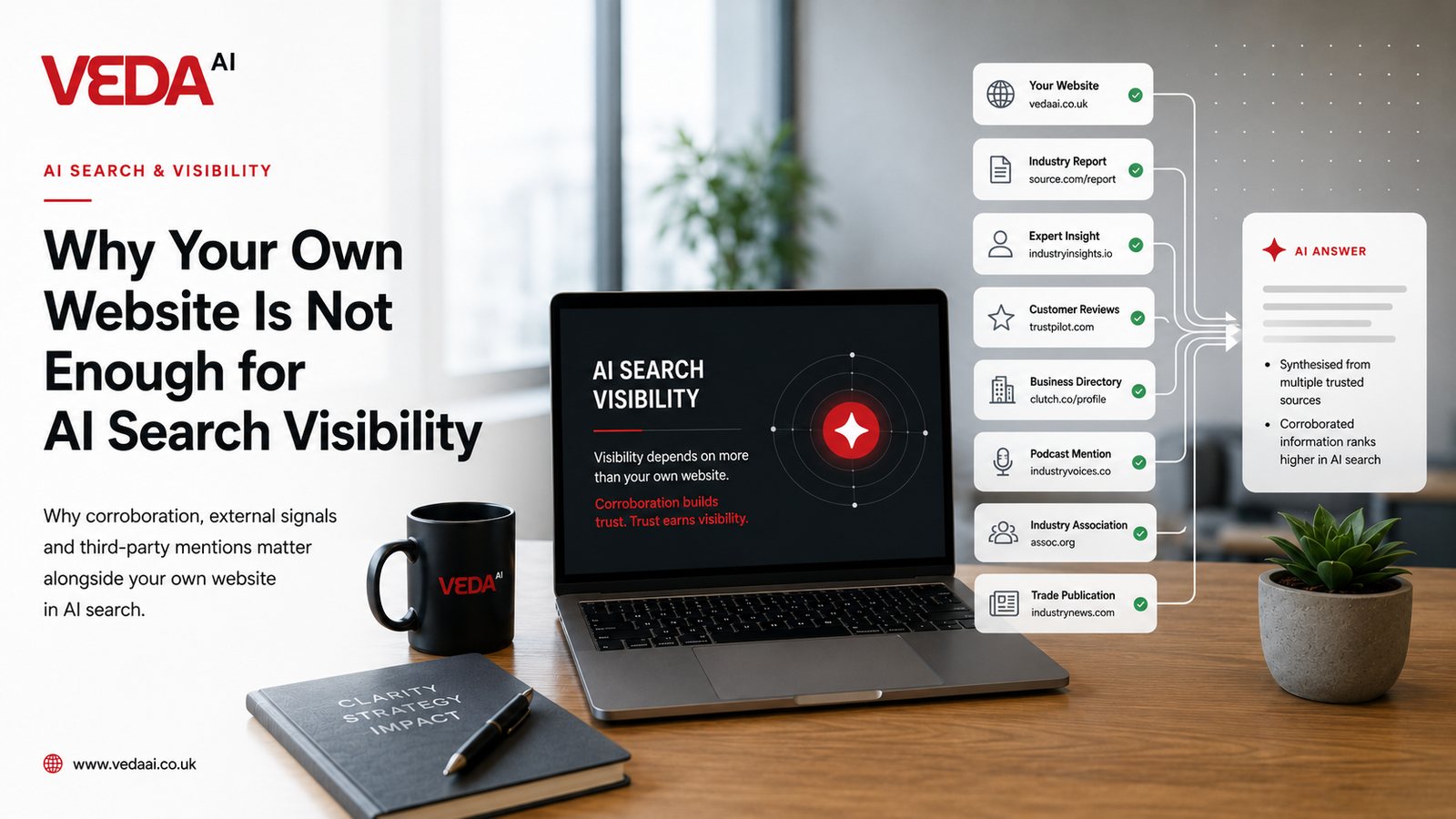
Why Your Own Website Is Not Enough for AI Search Visibility
A website is a claim. Corroboration is what makes a claim usable. That gap explains most of the AI visibility problems a good site cannot fix.
9 min read · 1 August 2026
Get Veda AI Edge.
Practical briefings on AI adoption, automation, intelligent products and AI-assisted search — what changed, why it matters and what to consider next. No hype, no AI theatre.
By joining you agree to receive Veda AI Edge from Veda AI. Unsubscribe any time.
Ready to find what’s worth fixing?
Start with a short call.
We’ll help you work out whether the right next step is the guide, the £995 + VAT Business Efficiency Audit, or a scoped implementation conversation.