Why Your Business Is Missing from ChatGPT and Other AI Answers
Being absent from AI answers is rarely mysterious. It is usually access, understanding, evidence, source coverage or competition — and they need different fixes.
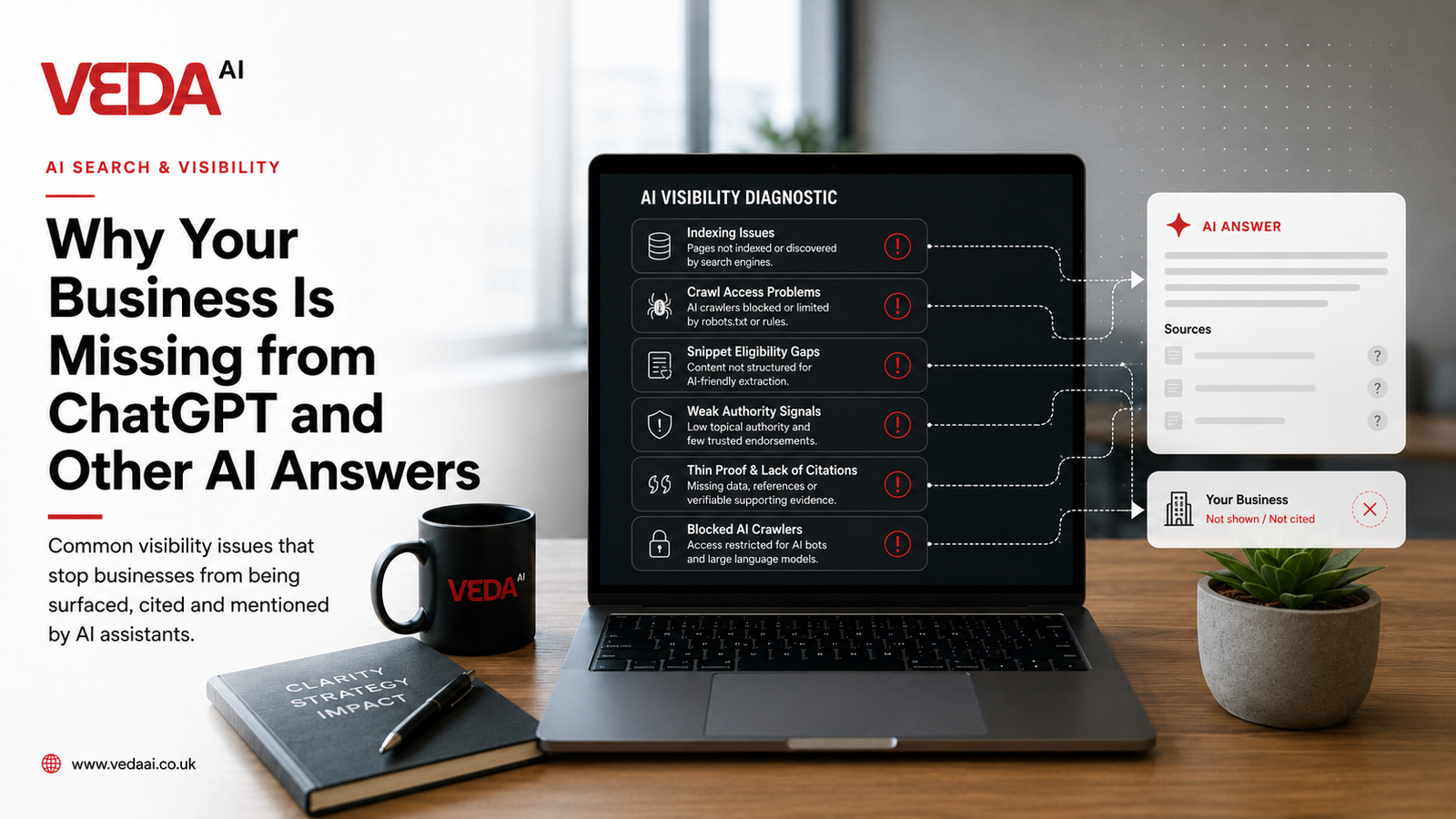
If an AI assistant never mentions your business, the cause is almost always one of five things: it cannot access your site, it cannot work out what you do, it has no evidence you have done it, the sources it trusts do not mention you, or a competitor simply has a stronger claim. Each has a different fix, and guessing between them wastes money.
It is worth saying at the outset that no amount of work guarantees inclusion in a generated answer. What you can do is remove the reasons for exclusion that are within your control, and there are usually more of those than people expect.
Cause 1: the assistant cannot access your content
This is the most common and the most fixable. OpenAI documents separate crawlers for separate purposes: OAI-SearchBot surfaces sites in ChatGPT’s search features, GPTBot gathers content that may be used in model training, and ChatGPT-User handles fetches a person triggers in conversation.
A great many businesses blocked all of them in one action during the period when training-data concerns were prominent. That is a legitimate choice about training. It is usually not the choice people intended to make about search surfacing, because it also removes the crawler responsible for it.
On Google’s side the requirement is stated directly: a page must be indexed and eligible to be shown with a snippet to be eligible for generative features. Google also notes that robots.txt directives for Googlebot are the control for site owners, and that page-level controls such as nosnippet, data-nosnippet, max-snippet and noindex limit what can be shown.
Worth checking first
Read your own robots.txt before commissioning anything. A single disallow line, added years ago for a reasonable reason, accounts for a surprising share of the businesses that believe they have an AI visibility problem.
Cause 2: the assistant cannot tell what you do
Access is necessary but not sufficient. A system still has to determine what kind of business you are, who you serve, where you operate and what you sell. Sites written primarily in brand language make this genuinely difficult.
Signals that this is your problem:
- Service pages that describe outcomes and philosophy but never name the service plainly.
- No consistent description of sector, company size or geography served.
- Different descriptions of the business on your site, LinkedIn, Companies House and directories.
- Team and credential information that exists in a PDF or an image rather than as text.
This is entity clarity, and strengthening it is part of our AI Search & Visibility work.
Cause 3: there is no evidence you have done the work
Assistants asked to recommend a supplier are, in effect, asked to take a risk on someone’s behalf. Claims without evidence are weak grounds for that. Businesses with named case studies, specific outcomes, identifiable people and visible credentials give a system something to work with. Businesses with a services page and a contact form do not.
This is not a request for invented metrics. Specific and honest beats impressive and vague: what the problem was, what was done, what changed, and what is not being claimed.
Cause 4: the sources it relies on do not mention you
Answers are synthesised from many places, and a good share of those places are not your website. Industry roundups, comparison articles, directories, association listings, trade press, reviews and recognised commentary all contribute.
If every source an assistant draws on for your category lists five firms and you are not one of them, the gap is not on your site at all. Establishing which sources those are, and which questions a competitor already owns, is part of what an AI Search Visibility Audit measures.
Cause 5: a competitor simply has a stronger claim
Sometimes nothing is broken. A competitor is genuinely better known, better evidenced or better corroborated for that question. That is a commercial problem rather than a technical one, and it is solved with proof and profile over time, not with markup.
How to tell which one applies to you
In rough order of cost, and stopping as soon as you find the cause:
- Check robots.txt and your crawler policy.
- Confirm the relevant pages are indexed and snippet-eligible.
- Read your own service pages as a stranger would. Can you tell what is sold, to whom, where?
- Ask the questions your buyers would ask, and record what comes back and who is named.
- Inspect the sources behind those answers, and look for who appears that you do not.
The first three you can do yourself this week. The last two are where a structured baseline earns its keep, because the answers vary by phrasing and need to be gathered consistently rather than anecdotally.
Matching symptom to cause
Different symptoms point at different causes, which is why a single generic fix rarely works.
- Never named, no competitors named either — the question is probably too niche or phrased unusually. Test variants before assuming a fault.
- Never named, competitors always named — likely source coverage or competitive strength, not your website.
- Named, but described wrongly — entity clarity. Your site is being read; it is being read incorrectly.
- Named on one assistant, absent on another — usually access or coverage differences between platforms. Check crawler policy first.
- Was named, no longer is — either a competitor gained ground or something changed on your side. Compare against a recorded baseline if you have one.
What not to do
- Do not add markup and expect it to change an answer. It describes; it does not persuade.
- Do not publish volume for its own sake. Thin content adds nothing an assistant needs.
- Do not buy guaranteed inclusion. It cannot be sold honestly.
- Do not unblock every crawler without deciding what you think about training use.
Of the five causes, source coverage is the one least fixable on your own site. We cover why corroboration and third-party mentions matter separately.
Key takeaways
- Absence is usually access, understanding, evidence, source coverage or competition.
- OpenAI’s search crawler is distinct from its training crawler and can be allowed separately.
- Google requires indexing and snippet eligibility for generative features.
- Diagnose before spending. The five causes have entirely different remedies.
Written by
Rian Patel
Founder, Veda AI
Practical thinking from real work with growing SMEs — written by the Veda AI team.
Related insights.
AI Search & Visibility
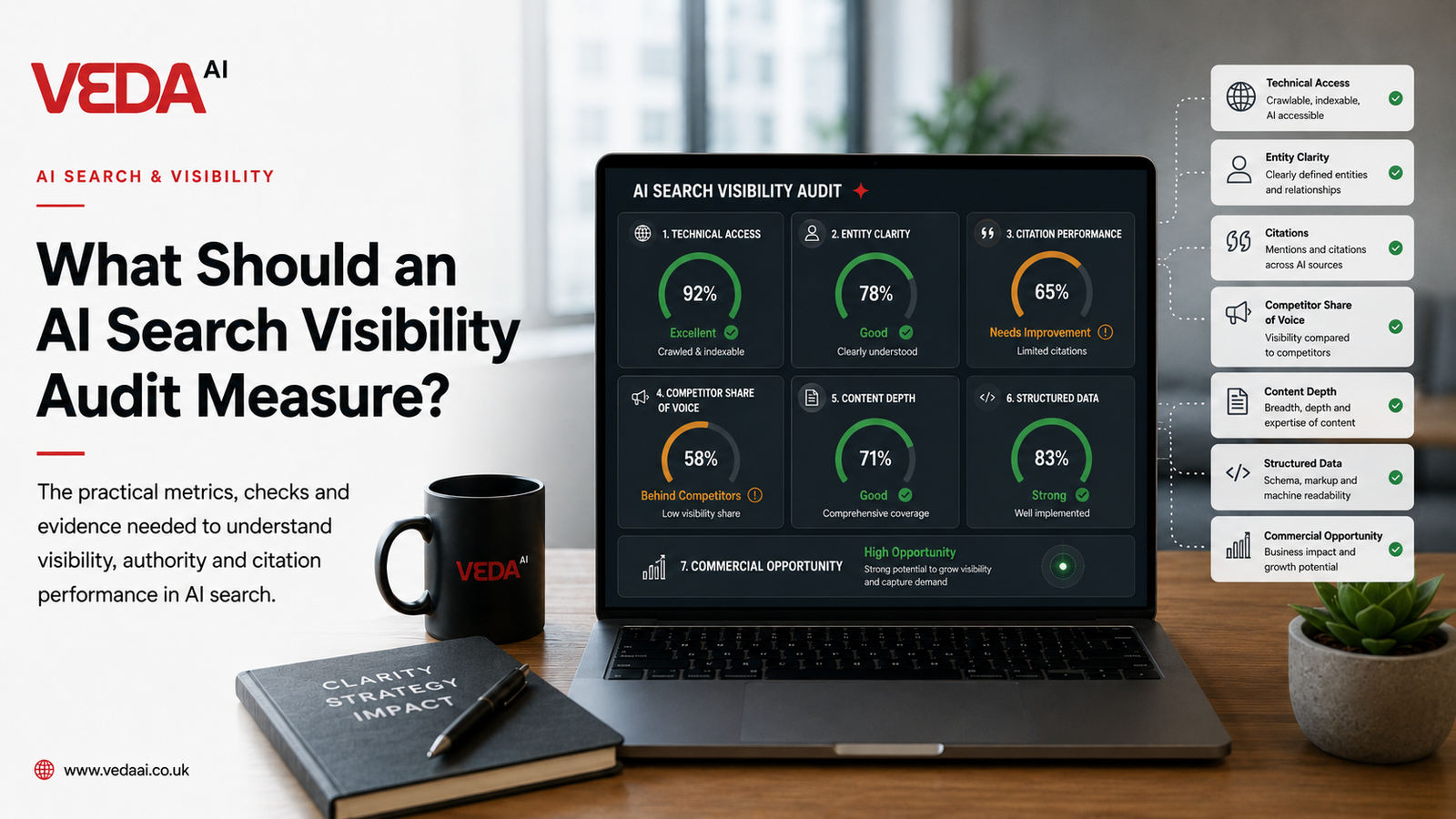
What Should an AI Search Visibility Audit Measure?
Most so-called AI audits are website checklists with new labels. A real one starts with commercially relevant questions and ends with a measurable baseline.
10 min read · 1 August 2026
AI Search & Visibility
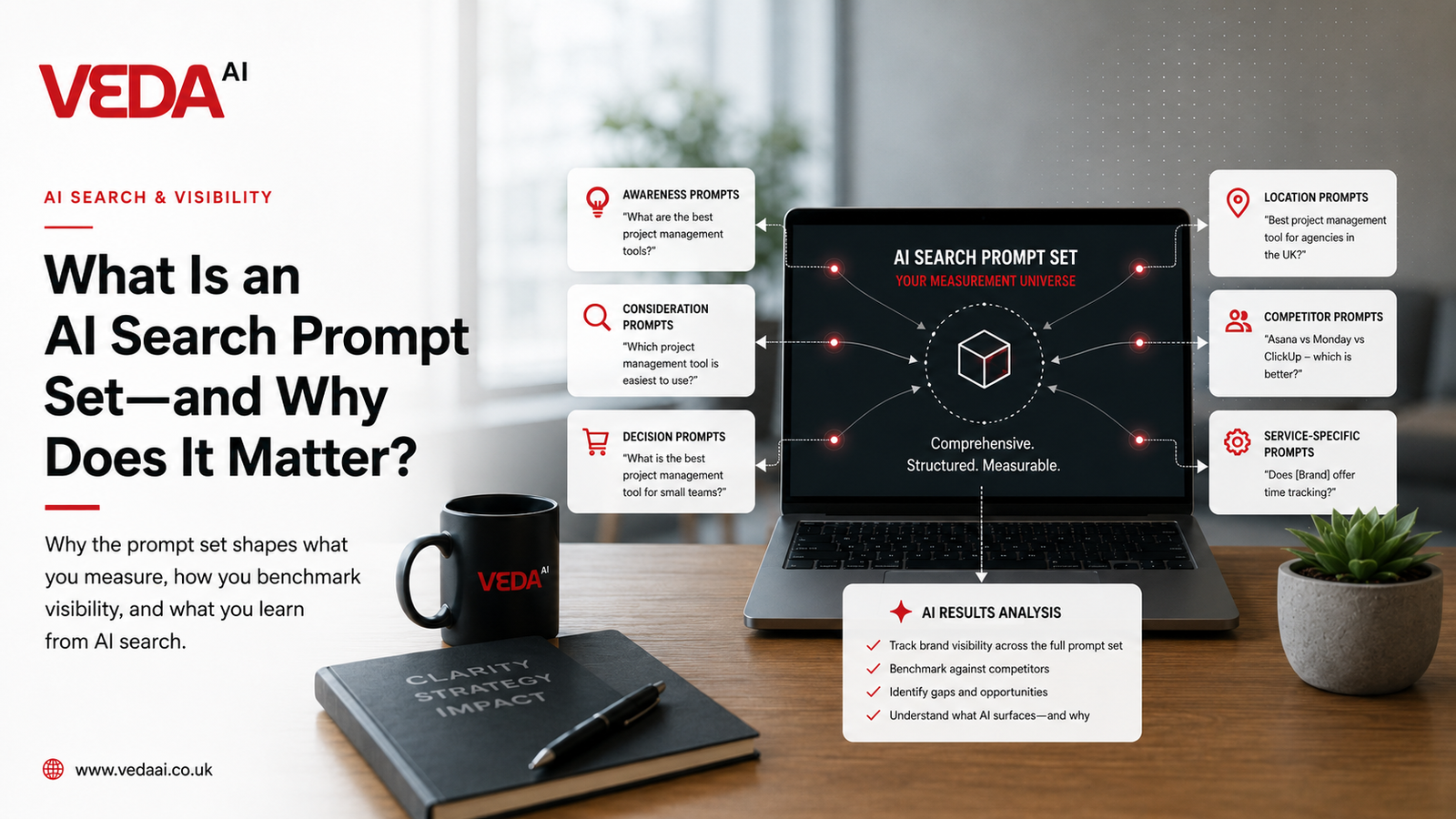
What Is an AI Search Prompt Set—and Why Does It Matter?
Visibility numbers only mean something relative to the questions they were measured against. The prompt set is that contract — and most reports never show you theirs.
9 min read · 1 August 2026
AI Search & Visibility
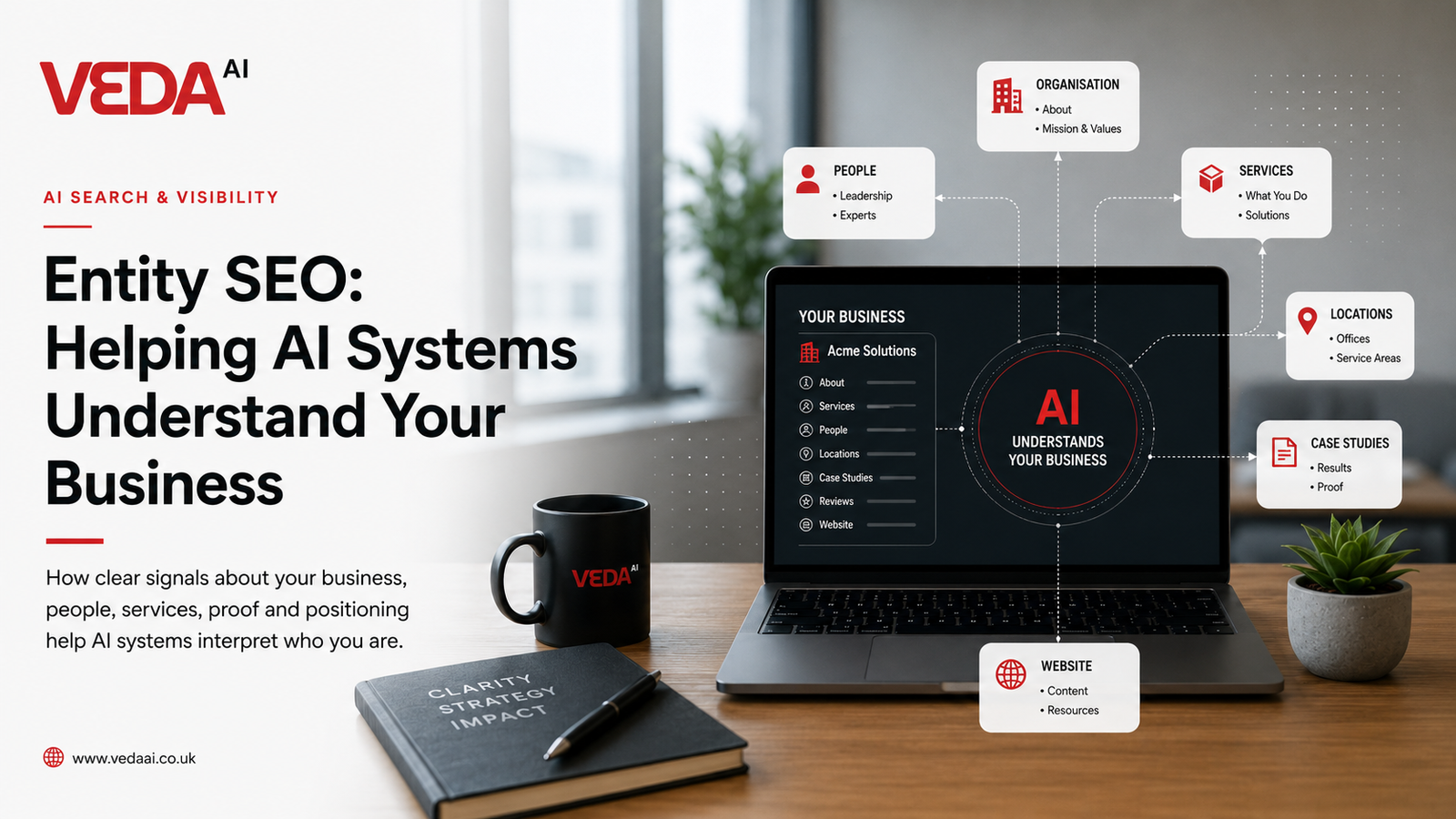
Entity SEO: Helping AI Systems Understand Your Business
Keyword optimisation makes a page findable. Entity clarity makes a business identifiable — and that is what determines whether a system can describe you at all.
9 min read · 1 August 2026
Get Veda AI Edge.
Practical briefings on AI adoption, automation, intelligent products and AI-assisted search — what changed, why it matters and what to consider next. No hype, no AI theatre.
By joining you agree to receive Veda AI Edge from Veda AI. Unsubscribe any time.
Ready to find what’s worth fixing?
Start with a short call.
We’ll help you work out whether the right next step is the guide, the £995 + VAT Business Efficiency Audit, or a scoped implementation conversation.